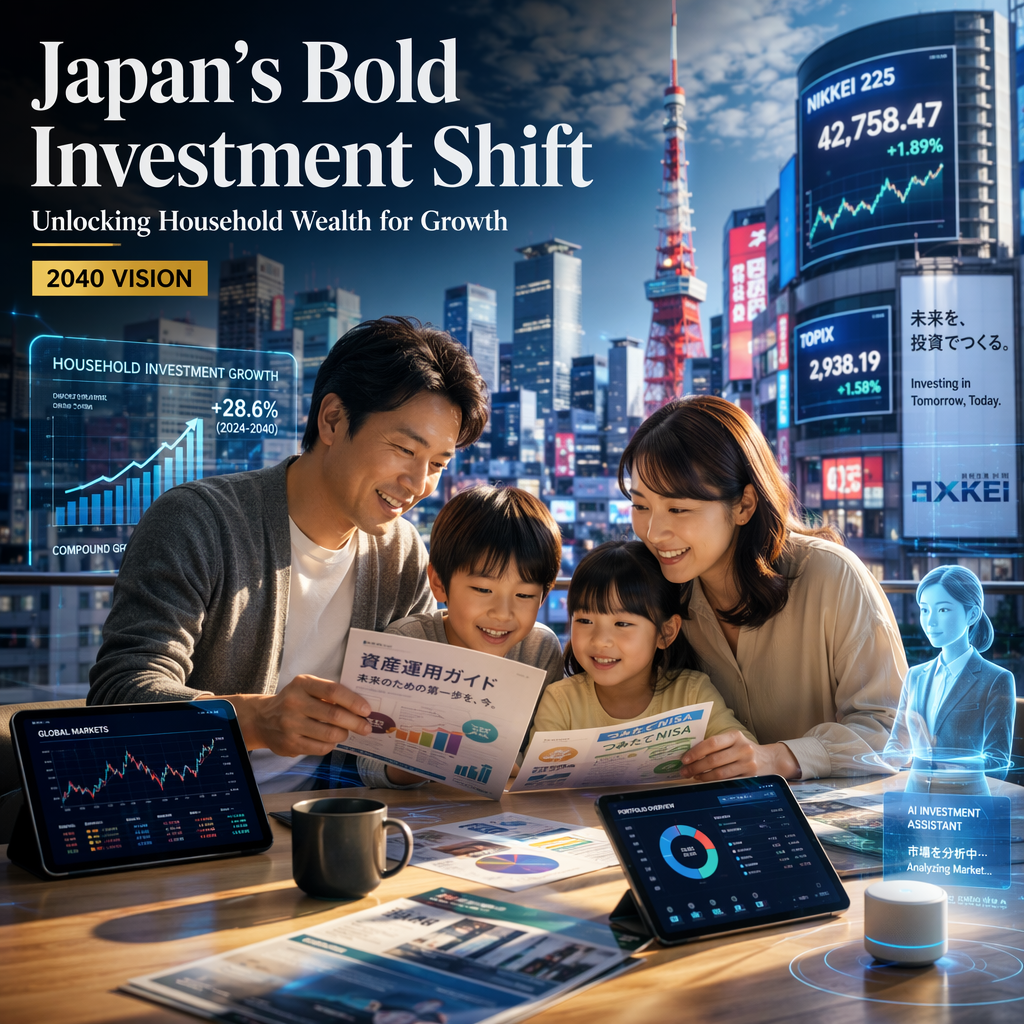
Japan has announced an ambitious goal to increase the proportion of household financial assets allocated to stocks, investment trusts, and bonds from the current 23% to 40% by 2040, as part of a broader strategy to shift away from traditional savings and stimulate economic growth [1]. The government is considering relaxing financial regulations and fostering public-private collaboration on artificial intelligence to facilitate this transformation [1].
To encourage this shift, Japan is promoting programs such as the NISA tax-free investment savings account, which is designed to make investing more accessible and attractive to retail investors [1]. Public information campaigns and pamphlets have been launched to educate citizens on the benefits of long-term investing and how these programs can help individuals grow their wealth over time [1].
Officials believe that increasing household participation in financial markets will generate greater capital formation, stimulate economic growth, and help counteract the effects of Japan’s aging population [1]. The initiative is also seen as a way to spur innovation and boost productivity within the Japanese economy [1]. Regulatory changes under consideration include easing restrictions on financial products and services, as well as promoting the use of digital platforms and AI to provide better investment advice and portfolio management for individual investors [1].
Regular public-private talks are planned to explore how artificial intelligence can be leveraged to improve financial literacy and investment outcomes, while ensuring appropriate consumer protections [1]. The government’s move reflects a recognition that Japan’s historically high savings rate, once considered a strength, now presents challenges in an environment of low interest rates and rising inflation. By incentivizing investment, the government aims to unlock trillions of yen in household assets and direct them toward higher-yielding opportunities [1].
CONCLUSION
Japan’s initiative to boost household investment allocations is expected to have a significant impact on the country’s financial markets and economic growth. By relaxing regulations and leveraging technology, the government aims to mobilize household savings into more productive investments, supporting both corporate growth and national economic resilience.