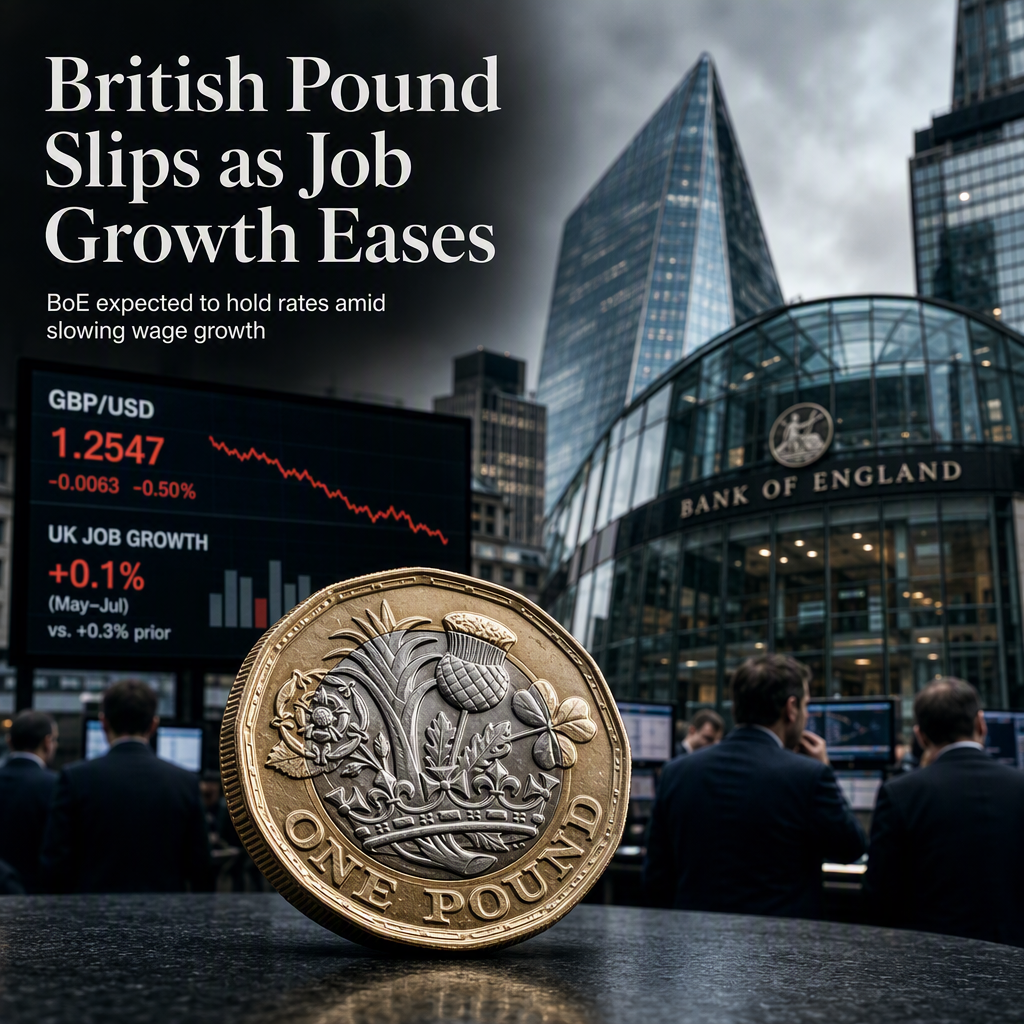
The British Pound (GBP) showed mixed performance against its currency peers following the release of UK labor market data for the three months ending July. The Office for National Statistics (ONS) reported the creation of 67,000 new jobs, which is lower than the 83,000 jobs added in the previous three months ending June [1]. The ILO Unemployment Rate remained steady at 4.9%, defying expectations of an increase to 5% [1]. Average Earnings Excluding Bonuses rose by 3.5% year-on-year, matching expectations, while wage growth including bonuses increased by 3.9%, slower than the previous reading of 4.2%, which was revised higher from 4.1% [1].
Investors are now awaiting the UK Consumer Price Index (CPI) data for August and the Bank of England’s (BoE) interest rate decision, both scheduled for Wednesday and Thursday, respectively [1]. Strategists at Brown Brothers Harriman expect the BoE to keep the policy rate at 3.75% for a sixth consecutive meeting, anticipating a 6-3 vote with three members backing a 25 basis point hike, while the majority opts to stay on hold. They cite easing UK wage growth and services inflation as reasons for the BoE to pause, a trend expected to be reinforced by incoming data [1].
Against the US Dollar, the Pound Sterling is down 0.17% to near 1.3478, with GBP/USD trading lower as the US Dollar outperforms ahead of the Federal Reserve’s monetary policy announcement on Wednesday [1]. Economists at ING have changed their view to expect a 25 basis point Federal Reserve rate hike in September, following Chair Kevin Warsh’s address at the Jackson Hole symposium, noting that recent data has justified this decision [1].
Technical analysis indicates that GBP/USD trades at 1.3477, sitting on a previously rising trend-line pivot and capped by the 20-day exponential moving average (EMA) at 1.3524. The near-term tone is mildly bearish, as price remains below its short-term EMA and struggles to sustain the prior uptrend, with the Relative Strength Index (RSI) near 43 suggesting fading bullish momentum [1].
CONCLUSION
The British Pound is under mild pressure following weaker job growth and steady unemployment, with market participants expecting the Bank of England to hold rates amid easing wage growth and inflation. The GBP/USD pair remains bearish in the near term, as technical indicators point to fading momentum and resistance overhead. Upcoming CPI data and central bank decisions are likely to further influence market direction.