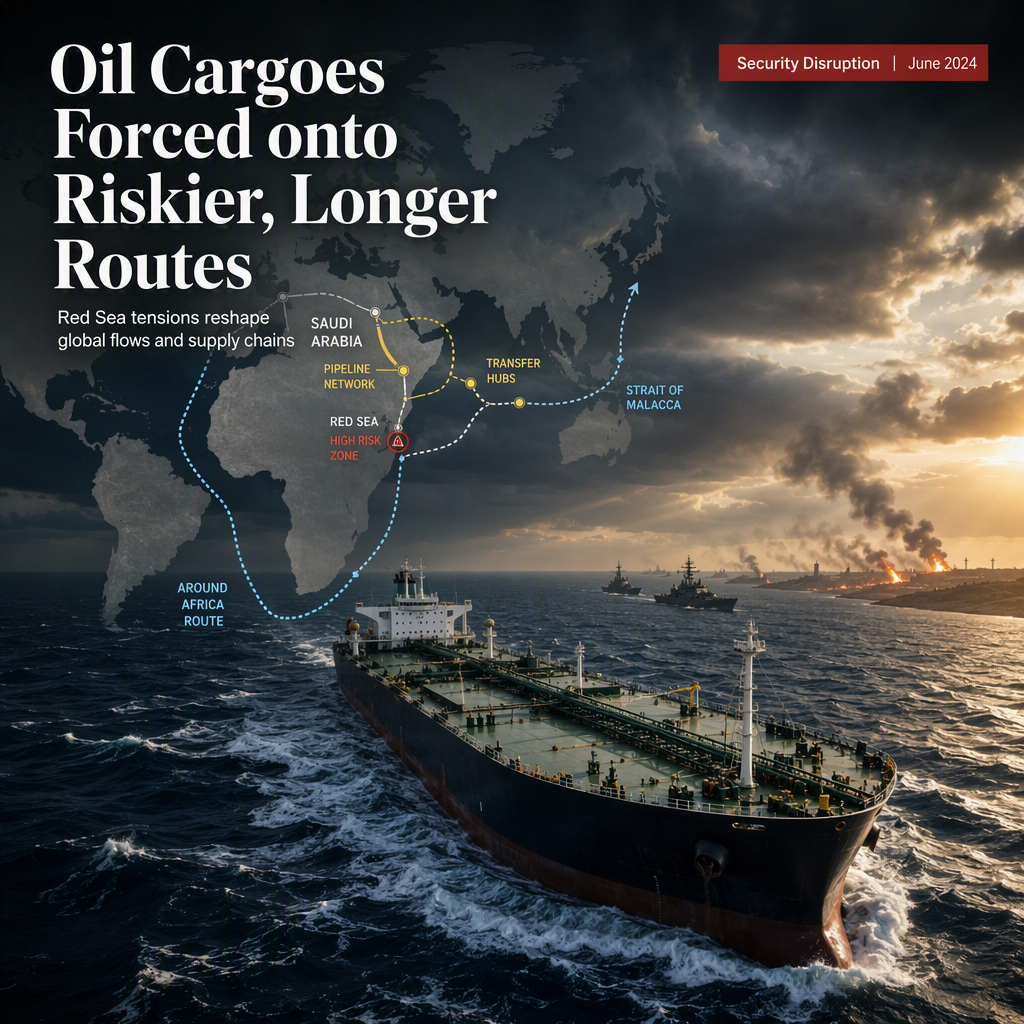
Societe Generale analysts Michael Haigh and Jeremy Sellem report that security risks in the Red Sea and Bab al-Mandab are significantly reshaping global oil flows, forcing oil cargoes onto longer and more complex routes [1]. The analysts highlight that total Red Sea oil flows have dropped by 4 million barrels per day (mb/d) since July 1, with a notable 3.7 mb/d decline specifically in Bab al-Mandab traffic [1]. This disruption is attributed to recent security incidents, including three confirmed attacks in the Red Sea last week, which have led to targeted threats against Saudi-flagged vessels, while Chinese-flagged tankers carrying Saudi crude have continued to transit Bab al-Mandab [1].
To mitigate these risks, Saudi crude is being rerouted through the East-West Pipeline to Yanbu, then loaded onto Very Large Crude Carriers (VLCCs). Since fully laden VLCCs cannot pass through the Suez Canal, the oil is transferred into Egypt's SUMED pipeline, reloaded in the Mediterranean, and shipped through Gibraltar and around the Cape of Good Hope. Other vessels are avoiding the Bab al-Mandab and Gulf of Aden by taking longer routes across the Indian Ocean and through the Strait of Malacca [1].
The report also notes that disruptions are not limited to the Red Sea. Kazakhstan is experiencing issues with CPC exports, Russia is facing elevated refinery outages, and there are recurring attacks on shipping infrastructure. These factors collectively demonstrate that the oil market remains exposed to further setbacks and that the primary challenge has shifted from production to the safe delivery of oil through increasingly hazardous routes [1].
No specific market reactions, forward-looking statements, or analyst opinions regarding price impacts are provided in the article [1].
CONCLUSION
Red Sea and Bab al-Mandab security risks have led to a sharp decline in oil flows and forced oil cargoes onto longer, riskier, and more expensive routes. The main challenge for the oil market has shifted from production to ensuring safe delivery, with ongoing disruptions highlighting persistent vulnerabilities in global supply chains.