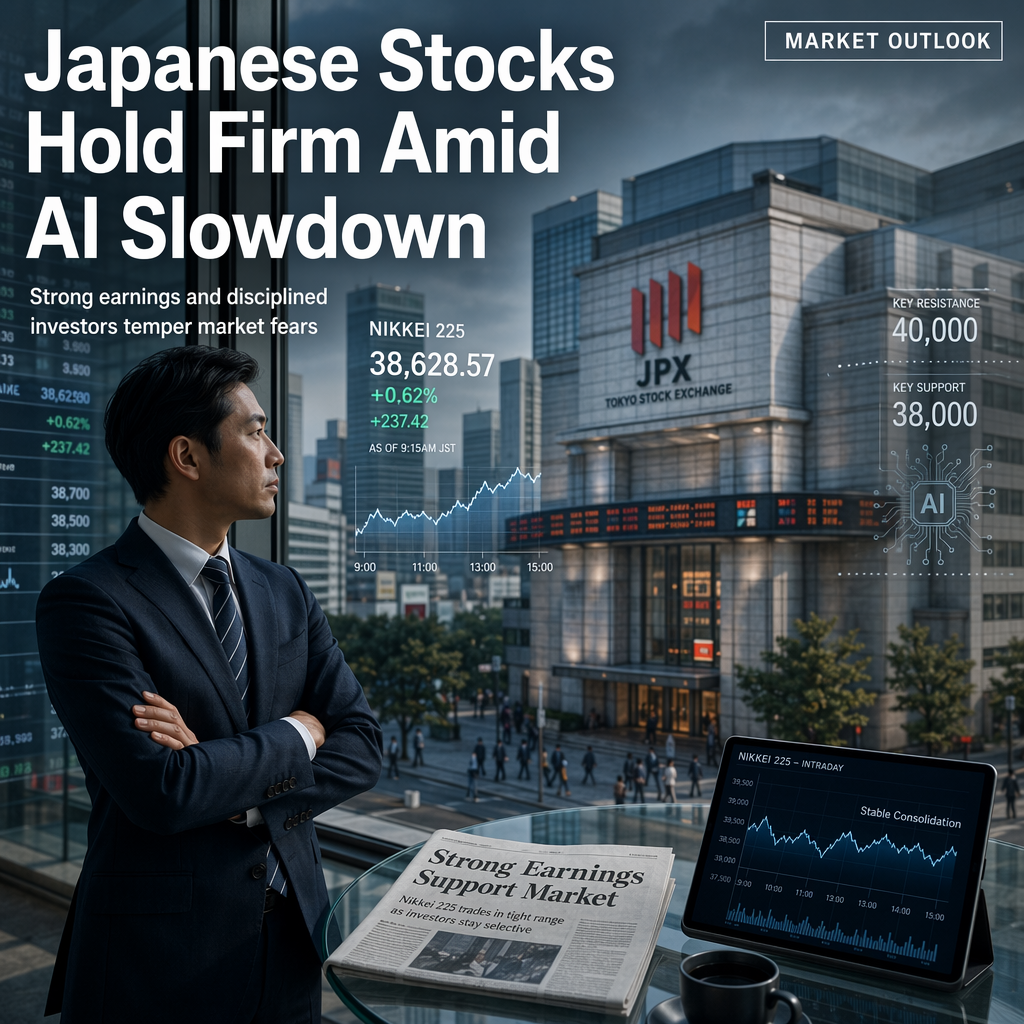
Japanese equities have experienced a moderation in their rapid advance as the artificial intelligence-led rally loses momentum, raising questions about the sustainability of recent gains and the resilience of the market [1]. The AI-driven surge previously led to a significant reshuffling in the Tokyo market, with technology and semiconductor companies attracting substantial investor attention [1]. However, recent trading sessions indicate a slowdown, prompting concerns about whether current valuations are justified [1].
Despite the cooling rally, experts highlight robust corporate earnings and relatively modest valuations as key factors supporting the market and tempering fears of a speculative bubble [1]. Analysts note that while price-to-earnings ratios for leading tech stocks have risen, they remain below levels typically associated with bubbles [1]. A Tokyo-based market strategist stated, "Japanese companies are delivering strong earnings growth, especially in technology and industrial sectors. The fundamentals are still sound, which should help temper fears of a major correction" [1].
Technical analysis reveals that the Nikkei 225 index has pulled back from recent highs but continues to hold above key support levels, indicating market resilience [1]. Sentiment remains positive, though less exuberant than earlier in the year, as investors rotate into stocks with stable earnings and lower valuations [1]. Chart analysis points to a consolidation phase, with resistance near recent peak levels and support around prior breakout areas [1]. Immediate support for the Nikkei 225 is identified at 38,000, with resistance near 40,000; a break below support could lead to further downside risk, while a move above resistance may signal renewed bullish momentum [1].
Market participants are advised to exercise caution, maintain diversified portfolios, and avoid chasing speculative gains, as technical indicators such as moving averages and RSI suggest a neutral-to-positive trend with the market likely to remain range-bound in the near term [1]. Analysts expect some volatility ahead due to global macroeconomic risks and uncertainties specific to the AI sector, but emphasize that the market is not as vulnerable as during previous bubbles, with investors showing greater discipline and a focus on fundamentals [1].
CONCLUSION
The Japanese stock market is demonstrating resilience despite the cooling of the AI-driven rally, supported by strong earnings and disciplined investor behavior. While some volatility is expected, analysts believe the market is fundamentally sound and less prone to a major correction. Investors are advised to remain cautious and focus on fundamentals as the market consolidates.