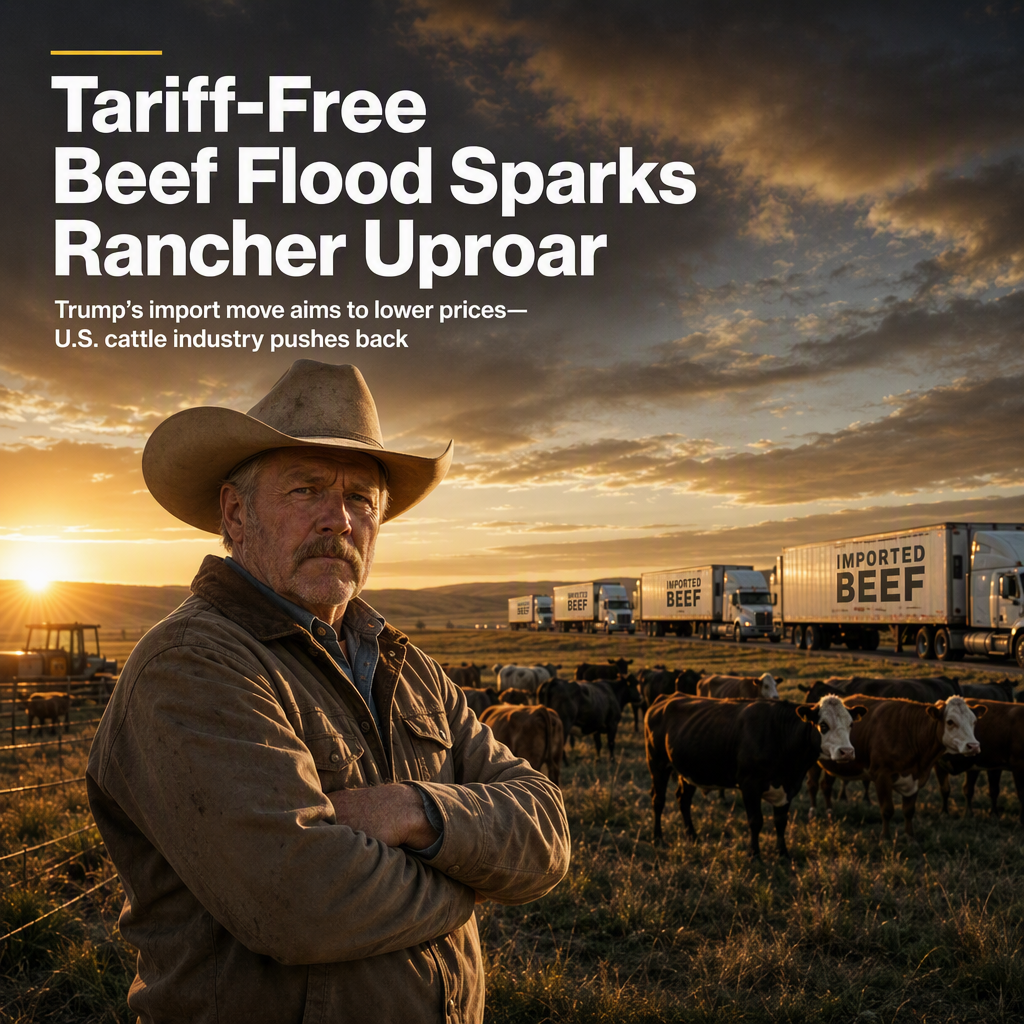
President Donald Trump announced that the United States will allow up to 300,000 metric tons of ground beef to be imported tariff-free over the next 90 days, with the stipulation that this beef will be sold at 25% below current market prices [1]. Trump stated that this measure aims to 'substantially lower' the price of ground beef for American families, citing a reduction in domestic cattle supply and increased prices under the Biden administration as the rationale for the move [1].
The announcement was met with immediate criticism from major cattle industry groups and several Republican senators, who expressed concerns that the influx of below-market beef could harm American ranchers [1]. The National Cattlemen's Beef Association (NCBA) voiced disappointment, with CEO Colin Woodall urging the federal government to refrain from interfering in the cattle industry and emphasizing strong consumer demand for U.S. beef [1]. Woodall argued that this is the third such announcement in less than a year and that the president is overlooking the willingness of American consumers to pay for high-quality domestic beef [1].
The American Farm Bureau Federation also warned that such short-term measures could have long-term negative effects for both consumers and ranchers [1]. U.S. Cattlemen's Association President Justin Tupper criticized the plan, stating, 'You don't put America first by putting U.S. cattle producers last,' and warned that the move could weaken domestic markets [1].
No specific market reactions, analyst opinions, or forward-looking statements regarding the impact on beef prices or the broader market were provided in the article [1].
CONCLUSION
Trump's decision to allow 300,000 metric tons of tariff-free beef imports is intended to lower consumer prices but has drawn strong opposition from U.S. cattle industry groups, who fear negative impacts on domestic producers. The move is seen as a high-impact policy shift with significant controversy, though no immediate market reactions or analyst forecasts were cited.