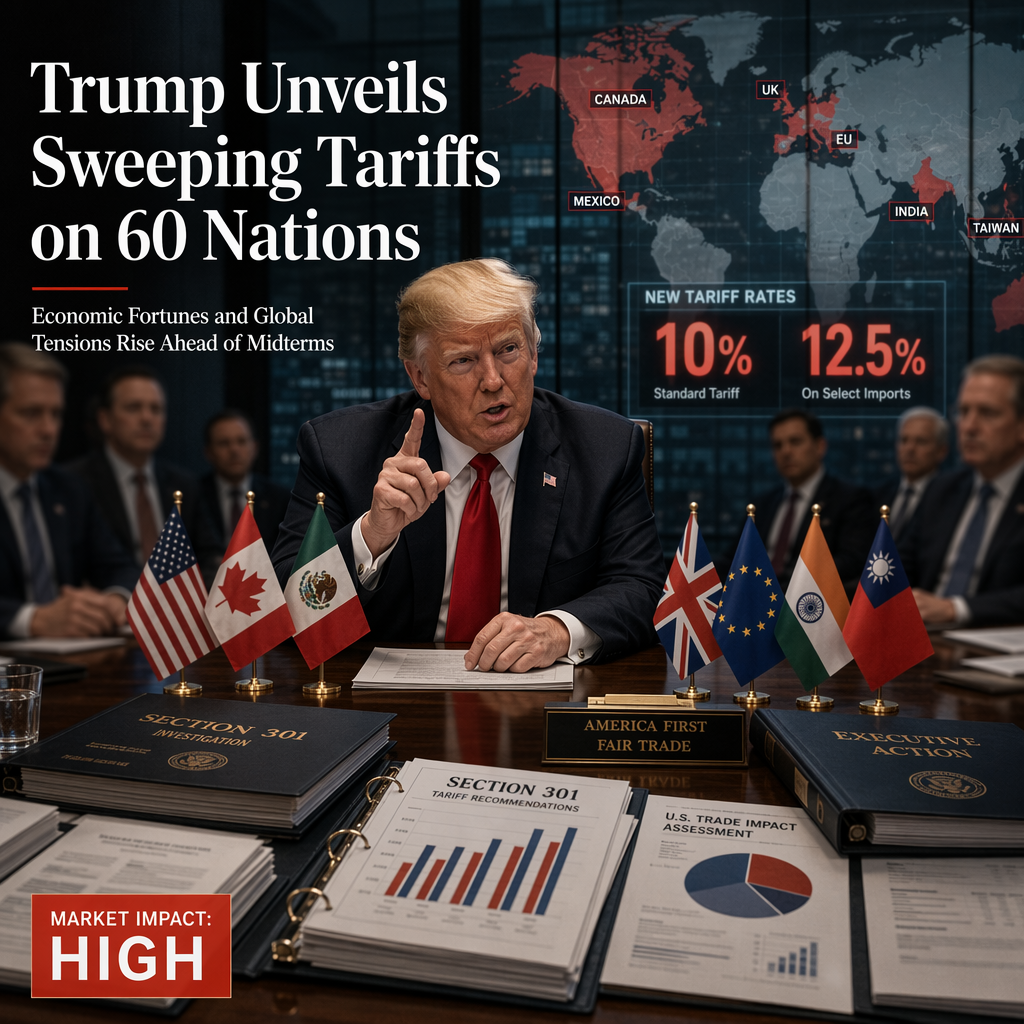
President Donald Trump defended his administration's tariff policy in a 'Fox & Friends' interview, asserting that tariffs have brought 'a fortune' into the United States and have significantly benefited domestic industries such as automotive and semiconductor manufacturing [1]. The announcement comes as the administration prepares to impose new tariffs of 10% and 12.5% on imports from 60 trading partners beginning Friday, coinciding with the expiration of a temporary global tariff [1].
The Office of the U.S. Trade Representative stated that these new tariffs, enacted under Section 301 of the Trade Act of 1974, will take effect immediately after the temporary duties expire at 12:01 a.m. ET Friday [1]. Specifically, Canada, Mexico, India, and the United Kingdom will face a 10% tariff, while Taiwan and the European Union will be subject to a 12.5% tariff [1]. Trump emphasized that these measures have led to increased domestic investment, citing examples such as General Motors' strong performance and the construction of semiconductor plants in Arizona valued at 'hundreds of billions of dollars' [1]. He also mentioned Toyota's decision to build $12 billion worth of plants in the United States, attributing this move to the desire to avoid tariffs [1].
Trump further claimed that the tariffs have had geopolitical benefits, stating that the threat of tariffs prevented conflicts, including a potential nuclear war between India and Pakistan [1]. He also noted that the Supreme Court struck down his previous 'reciprocal' tariffs of 10% to 50%, prompting the current approach under Section 301 [1].
In terms of trade agreements, the Trump administration has decided not to extend the U.S.-Mexico-Canada Agreement (USMCA) and will instead pursue independent trade deals with Canada and Mexico [1]. When asked about updating the USMCA, Trump expressed indifference, stating, 'I don't care. I mean I don't really want to' [1].
CONCLUSION
The Trump administration's new tariffs on 60 trading partners mark a significant shift in U.S. trade policy, with the president touting economic and geopolitical benefits. The immediate market impact is expected to be high, given the scope of the tariffs and the affected countries. Forward-looking statements suggest a continued focus on bilateral trade deals rather than multilateral agreements.