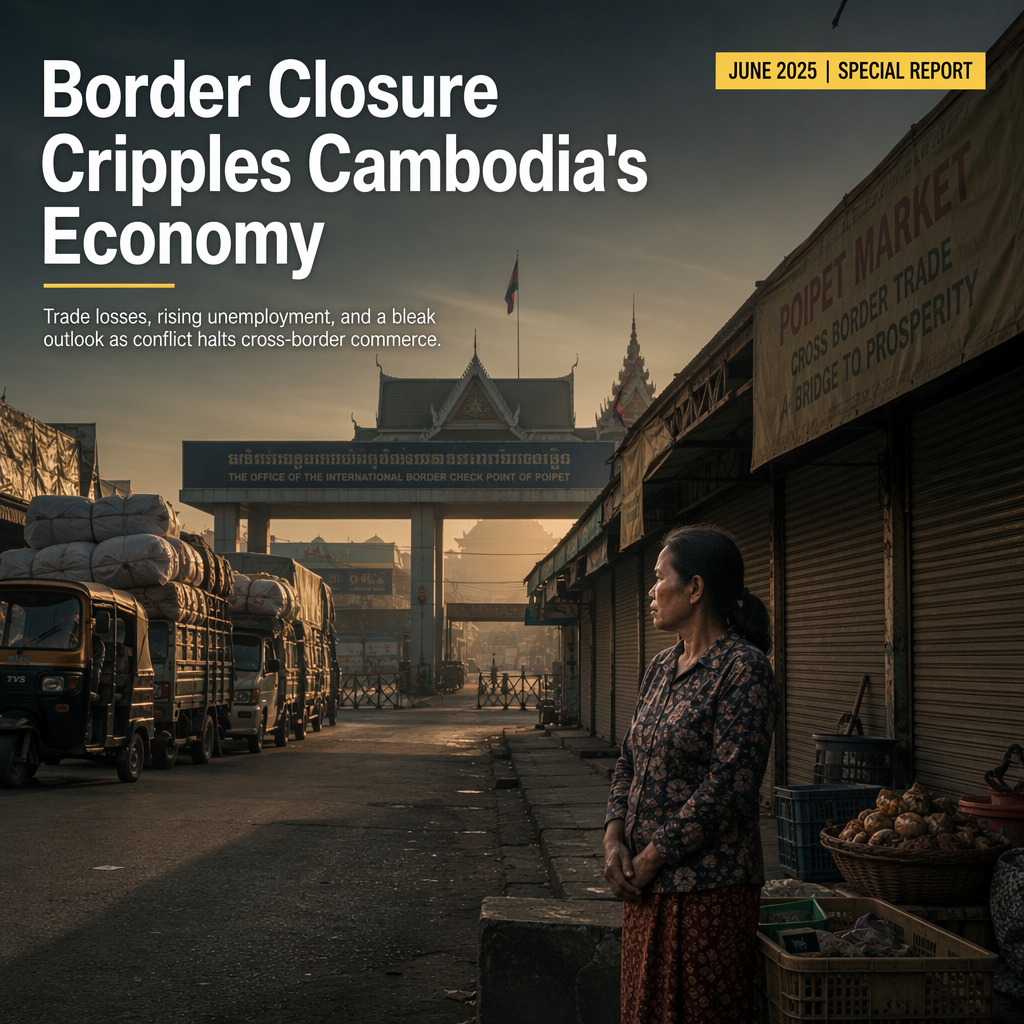
The Cambodian economy has suffered significant setbacks following the closure of its border with Thailand in June 2025, a move prompted by escalating political tensions that led to military clashes between the two countries [1]. The closure has left millions of Cambodians, particularly those in border cities like Poipet, searching for alternative employment as cross-border trade and daily labor migration have come to a halt [1]. Local traders in Poipet report that daily revenue has dropped by more than 80% since the shutdown, with only a small fraction of goods able to move through official channels [1].
Government estimates indicate that the conflict has resulted in a loss of over $500 million in cross-border trade within the past year [1]. The International Monetary Fund (IMF) has responded by sharply downgrading Cambodia's economic forecasts, citing the prolonged border closure as a major factor [1]. GDP growth for Cambodia is now expected to reach only 2.1% in 2026, a significant decrease from the pre-conflict projection of 5.5% [1]. The economic strain is evident not only in trade but also in remittances, consumer spending, and employment, with a local economist noting a rise in unemployment and a decrease in consumer spending as direct consequences [1].
Market sentiment remains negative, with businesses and investors closely monitoring the situation for any signs of a diplomatic breakthrough that could lead to the reopening of the border [1]. Technical analysis shows that the Cambodian riel is trading near multi-year lows against the Thai baht and US dollar, with weakened support levels and continued pressure due to the lack of cross-border liquidity [1]. Resistance is expected around previous highs, but recovery is unlikely until the border reopens [1].
Cambodian officials have expressed concern that the ongoing conflict will continue to depress economic growth, and traders are advised to watch for any developments that could signal a rebound in trade and market activity [1].
CONCLUSION
The Thailand-Cambodia border closure has had a profound and negative impact on Cambodia's economy, slashing trade volumes, employment, and growth forecasts. Market sentiment remains pessimistic, and recovery is unlikely until diplomatic progress leads to a reopening of the border.