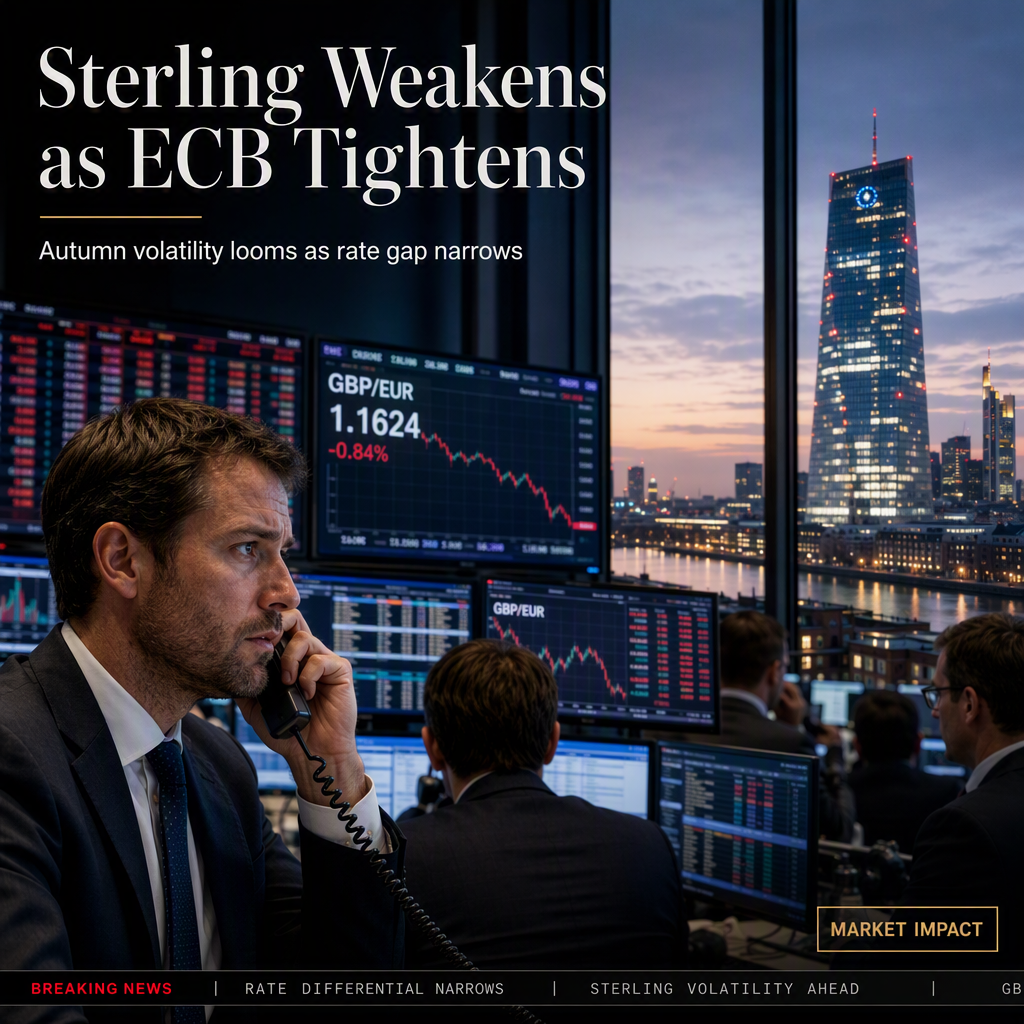
Recent developments in European and UK monetary policy have led to notable shifts in currency markets. Rabobank’s Bas van Geffen reports that EUR money markets are now pricing in more than four additional European Central Bank (ECB) rate hikes beyond the two already delivered, reflecting investor expectations that are outpacing policymakers’ intentions. ECB President Lagarde has signaled reluctance to endorse market views, and leaks suggest any next move is more likely in December than October, tempering expectations for front-loaded tightening [1].
On the UK side, Deutsche Bank’s Shreyas Gopal notes that the Bank of England (BoE) has maintained a strategy of delaying rate hikes, which has kept the Pound stable. However, with a likely 6-3 vote to hold rates and unchanged guidance expected, Sterling’s carry advantage against the Euro is narrowing as the ECB tightens, potentially triggering GBP weakness [2]. This view is echoed by Brown Brothers Harriman, who expect the BoE to keep the policy rate at 3.75% for a sixth consecutive meeting, despite swaps markets implying 100bps of hikes to 4.75% over the next twelve months. They caution that the BoE may not need to tighten as much as markets expect, given the UK economy’s slack and restrictive fiscal policy, making GBP vulnerable to a dovish repricing [3].
Société Générale strategists highlight that the focus is shifting to the UK Budget on October 28, rather than upcoming MPC meetings. They warn that fiscal austerity could cast doubt on the UK outlook, and a narrowing rate differential combined with tighter fiscal policy may lead to a 'sterling wobble' this autumn, potentially pushing EUR/GBP back to 0.88 in Q4 [3]. Technical analysis shows EUR/GBP trading around 0.8573, up 0.10% on the day, with momentum indicators suggesting balanced but mildly positive movement [3].
BNY’s Geoff Yu argues that while Eurozone growth and inflation risks are real, being long EUR is not the best expression of these views. He points to strong industrial data and fiscal support favoring European assets, but notes weak demand, ECB policy-error risk, and rich EUR valuation. Yu recommends EUR-funded carry trades, as the currency remains overvalued—nearly 2% above its one-year BIS REER average—and its rate differential against USD is still negative. He suggests that European equities can outperform even as the EUR weakens, and that unhedged allocations may face a drag if REER normalizes [4].
CONCLUSION
Markets are recalibrating expectations for both the ECB and BoE, with aggressive rate hike pricing for the ECB and a narrowing rate differential pressuring Sterling. Analysts warn of potential GBP volatility ahead of the UK Budget and recommend caution on outright EUR positioning due to valuation and policy risks. The overall sentiment is cautious, with medium market impact expected as investors await further policy signals.