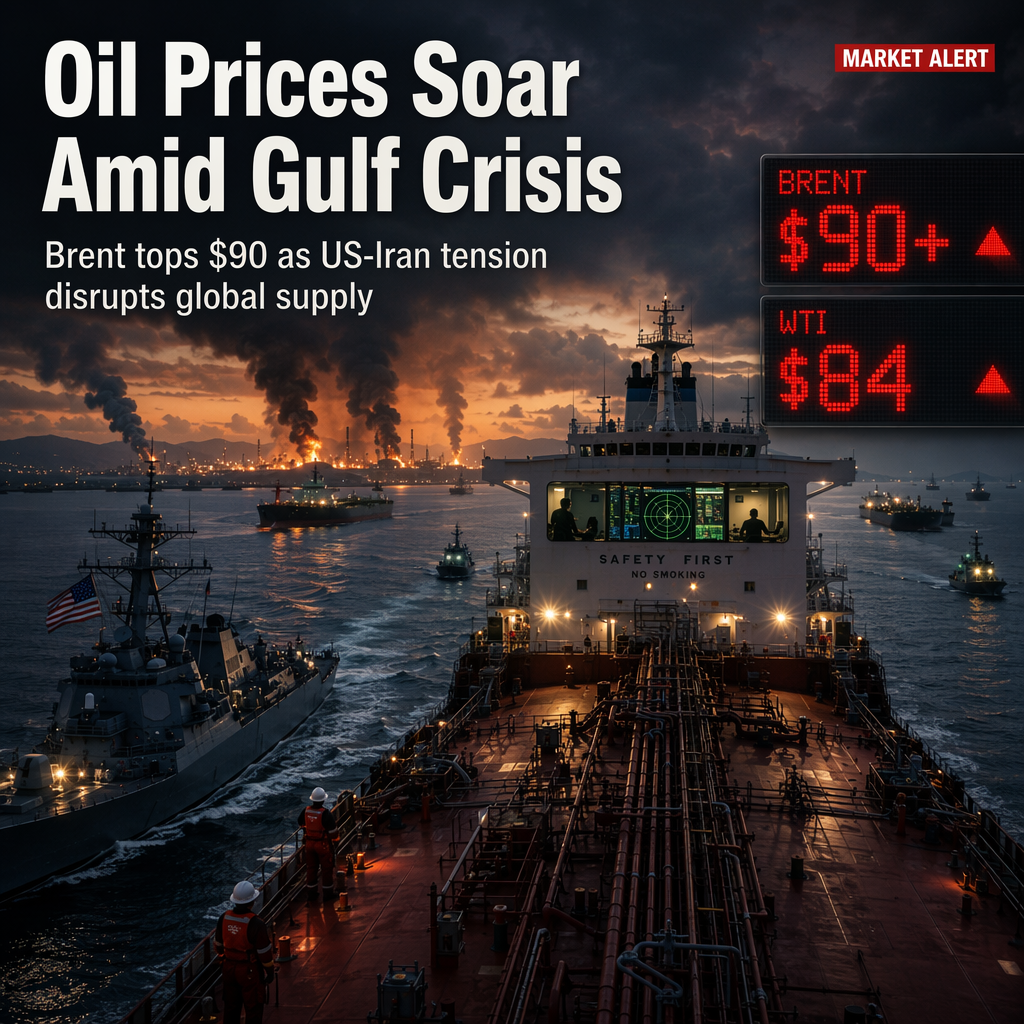
Global oil markets experienced a sharp rally on Monday as the ongoing conflict between the United States and Iran intensified, raising fears of significant disruptions to energy shipments through the Strait of Hormuz, a critical oil transit route [4][5]. Brent crude for September delivery surged approximately 2.77% to surpass $90 per barrel, while US West Texas Intermediate (WTI) crude for August delivery climbed about 2.4% to $84.49, with WTI opening around $83.50 during Asian trading hours [4][5].
The escalation follows the US military's confirmation of a third American service member killed in recent operations, with additional unidentified remains recovered near the site of an Iranian attack in Jordan that had previously resulted in two US personnel deaths and one missing [2][4][5]. The US has conducted its ninth consecutive night of strikes against Iranian targets, focusing on degrading Iranian military capabilities, including coastal surveillance, air defense systems, maritime assets, and missile and drone storage facilities [3][4][5]. In response, Iranian officials declared the ceasefire with the US effectively abandoned, and Iran intensified attacks on shipping vessels near the Strait of Hormuz, as well as launching ballistic missiles and drones targeting sites across Bahrain, Jordan, Kuwait, and Iraq [1][4].
The violence has expanded beyond military targets to include critical infrastructure, with bridges, utilities, and port facilities coming under fire. Kuwait Petroleum Corp. confirmed that an Iranian strike hit one of its oil facilities over the weekend [4]. The renewed hostilities have heightened concerns about the security of global oil supply, with oil prices surging nearly 20% in July as Gulf exports dwindle and the US resumes its blockade of Iranian ports [4][5].
Market analysts are warning of a tightening crude market. David Roche of Quantum Strategy noted that at the current rate of depletion, oil inventories could become tight by September, potentially increasing pressure on US policymakers. Roche advised staying long on Brent with a target price range of $95 to $105 per barrel [5]. The heightened geopolitical risk has also led to increased safe-haven demand for the US Dollar, weighing on riskier assets such as the New Zealand Dollar, British Pound, and Euro, all of which have struggled against the Greenback amid the crisis [1][2][3].
Looking ahead, traders are closely monitoring further geopolitical developments and upcoming central bank meetings, including the European Central Bank's session on Thursday, which could influence currency and commodity markets further [3].
CONCLUSION
The escalation of US-Iran hostilities has driven oil prices sharply higher, with Brent breaking above $90 and WTI nearing $84, as markets brace for potential supply disruptions through the Strait of Hormuz. Analysts warn of tightening inventories and further price increases if the conflict persists. The crisis has also boosted the US Dollar and pressured risk-sensitive currencies, amplifying volatility across global financial markets.