
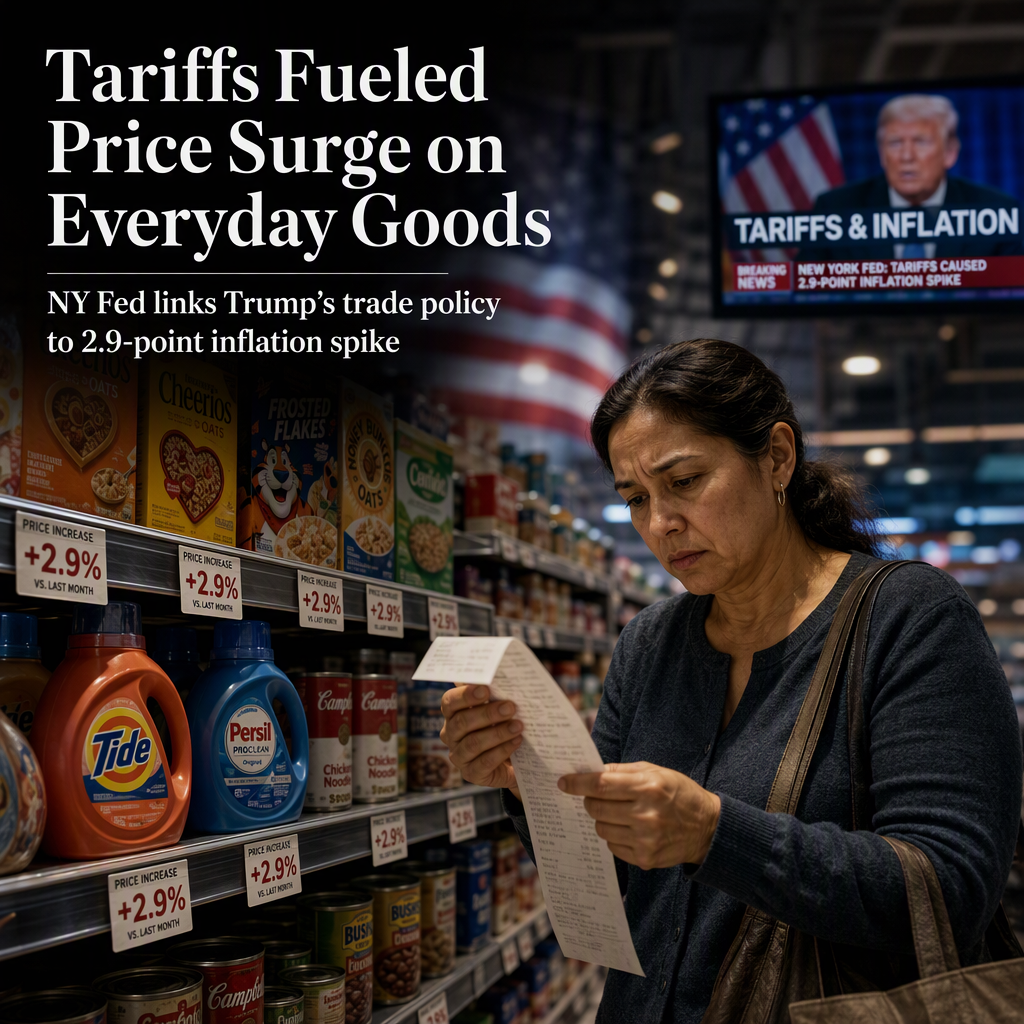
A report from the New York Federal Reserve has found that inflation on many everyday items was entirely due to tariffs imposed during President Donald Trump's administration in 2025 and early 2026 [1]. The study analyzed 67 categories of goods and determined that, as of February, prices were 2.9 percentage points higher because of these tariffs. Without the levies, prices for these goods would have declined by almost 1% during the same period [1].
The report provides concrete evidence of the impact of Trump's tariff policy—a central element of his recent campaign and second term—on consumer prices. For each percentage point increase in the average tariff, consumer goods prices rose by roughly a quarter of a percent a year later [1]. Annual price growth for the tracked goods peaked at the start of 2026, and the report indicates that consumers will continue to face elevated prices into 2027 as a result of the policy [1].
According to the New York Fed, about two-thirds of the tariff-related price increases came directly from the levies, while the remaining third resulted from indirect effects, such as U.S. companies using imported parts and materials [1]. The study's authors, Mary Amiti, Sebastian Heise, and David Weinstein, emphasized that tariffs have a larger and more prolonged impact on consumer prices than the direct effect alone would suggest [1].
The report also notes that the Supreme Court struck down many of Trump's tariffs in February, leading to billions of dollars in refunds to retailers. However, the White House has pledged to continue pursuing tariffs through alternative measures, with many imported products now facing tariffs of about 10%, which is lower than the earlier round of tariffs [1].
CONCLUSION
The New York Fed's analysis demonstrates that tariffs were the primary driver of recent inflation in everyday goods, with effects expected to persist into 2027. The Supreme Court's intervention has partially rolled back these tariffs, but the White House remains committed to maintaining some level of trade barriers. Market participants should anticipate continued price pressures on consumer goods due to ongoing tariff policies.