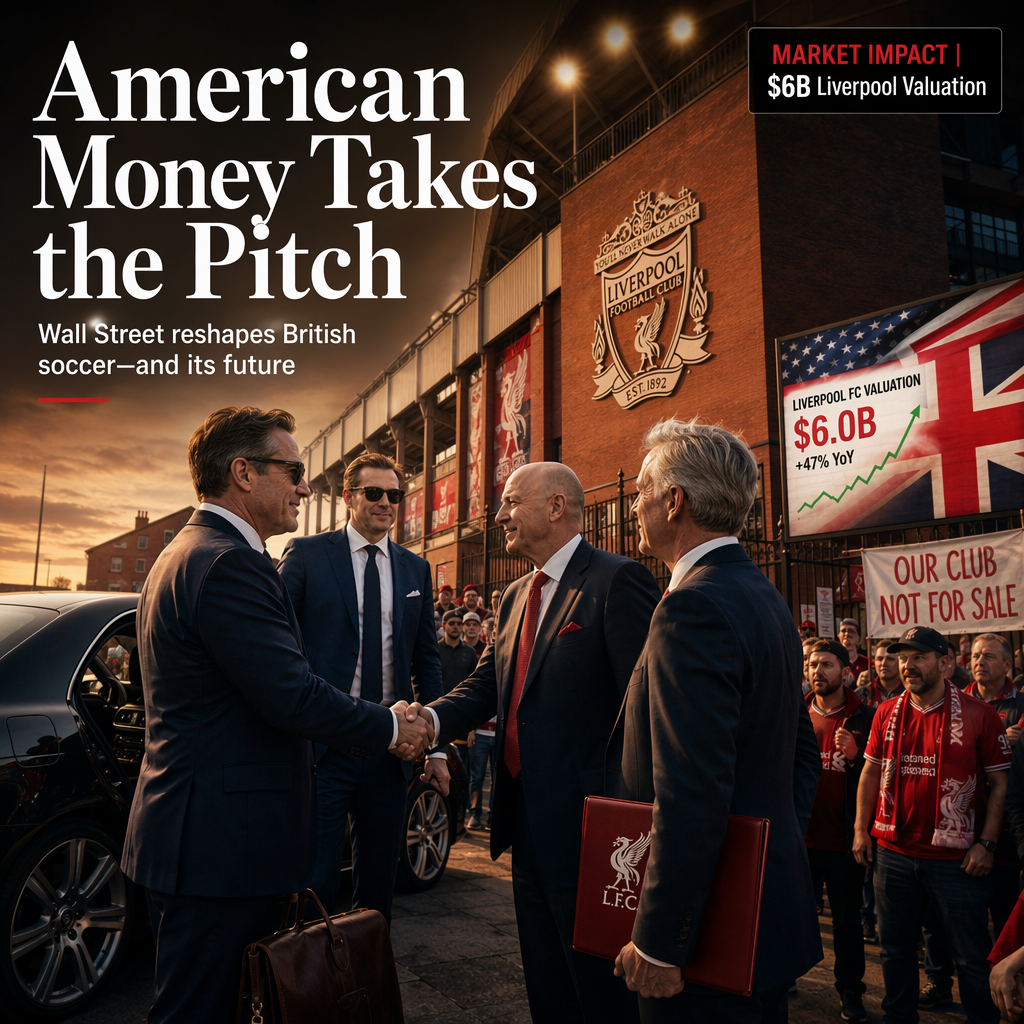
American ownership of Premier League clubs has seen a significant rise in recent years, with 11 out of the 20 current Premier League teams now under American control, a trend that began with the Glazer family's acquisition of Manchester United in 2005 [1]. Fenway Sports Group (FSG), which purchased Liverpool FC for £300 million in October 2010, is now in talks to sell a significant minority stake to a syndicate led by British-Indian entrepreneur Amit Bhatia, in a deal that reportedly values Liverpool at $6 billion [1]. This potential transaction highlights the substantial returns available to American investors in British soccer, as FSG's tenure has coincided with Liverpool winning two Premier League trophies and one European Champions League title [1].
The appeal of British soccer clubs to American investors is further underscored by the involvement of U.S. celebrities in lower-tier teams, such as Ryan Reynolds and Rob McElhenney's acquisition of a fifth-tier Welsh team and Snoop Dogg's investment in Swansea City, a second-division side, in 2026 [1]. Analysts cited by CNBC attribute this surge in interest to operational inefficiencies in British and European football clubs, which are often run with fans as the primary focus and are typically loss-making entities [1]. For example, only eight Premier League clubs reported an operating profit in the 2024/25 season, while the league as a whole posted combined pre-tax losses of £948 million ($1.26 billion), according to Deloitte [1].
These inefficiencies present opportunities for American investors to optimize revenue channels and improve profitability, though there is a cautionary note that excessive commercialization could risk alienating traditional supporters [1]. The growing American presence in British soccer boardrooms, coupled with high-profile deals and celebrity involvement, signals a shift in the business model and global appeal of the sport [1].
CONCLUSION
The influx of American investment in British soccer clubs is reshaping the financial landscape of the sport, with soaring club valuations and a focus on revenue optimization. While this trend offers significant profit potential, it also brings challenges in balancing commercialization with fan loyalty. The market impact is high, as evidenced by the scale of recent deals and the growing influence of U.S. investors.