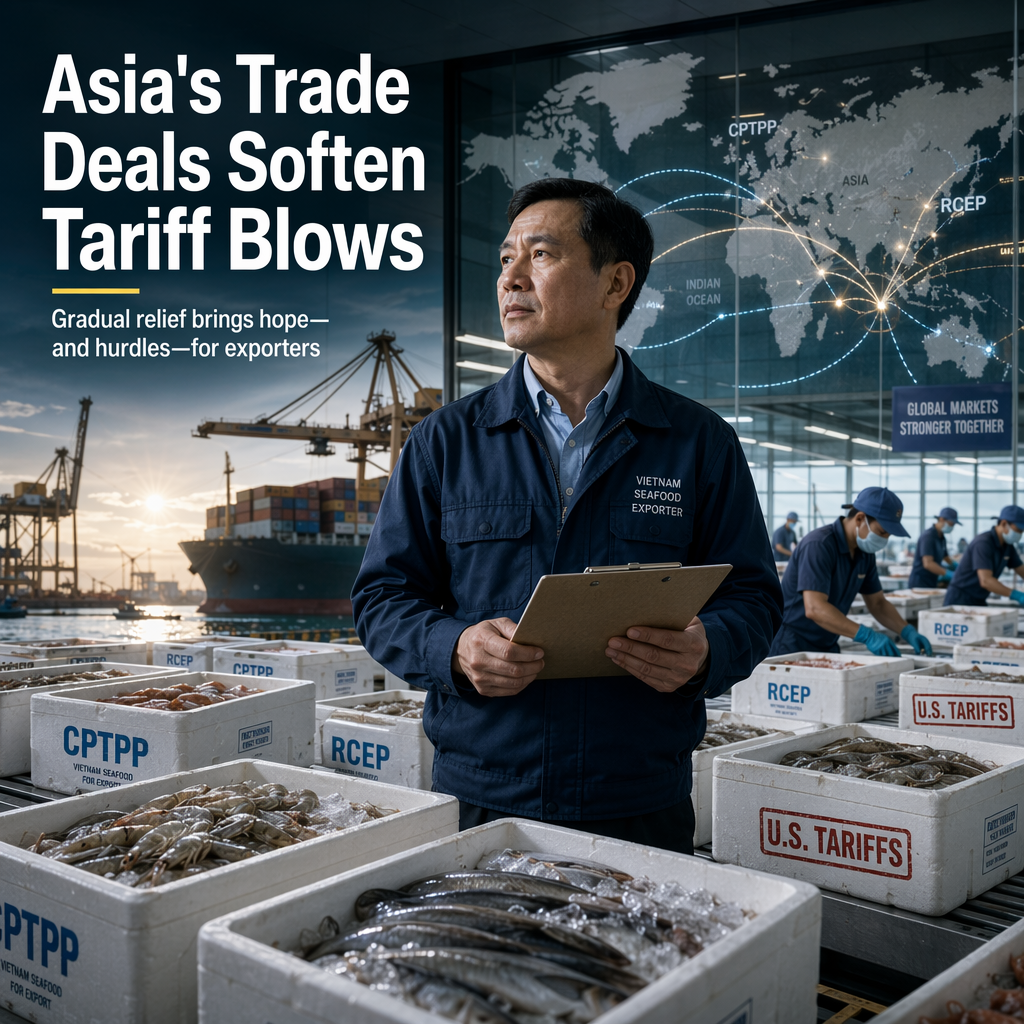
The implementation of Asia's significant trade agreements, namely the Comprehensive and Progressive Agreement for Trans-Pacific Partnership (CPTPP) and the Regional Comprehensive Economic Partnership (RCEP), is gradually mitigating the effects of U.S. tariffs imposed during the Trump administration. For nearly 25 years, the United States was the leading market for Vietnamese seafood exporters, including shrimp, catfish, and tuna, despite recurring issues with trade barriers and tariffs [1].
The benefits of CPTPP and RCEP are not uniform across all industries and countries. Vietnamese seafood, for example, has experienced fluctuations in demand and tariff impacts as a result of shifting U.S. trade policy [1]. While these trade pacts promise reduced tariffs and improved market access, the majority of tariff reduction commitments are being phased in over time, rather than taking effect immediately [1].
This gradual implementation has helped to soften, but not entirely eliminate, the negative consequences of U.S. tariffs for affected Asian industries. The staggered nature of the tariff reductions means that some sectors continue to face challenges, even as the agreements provide a buffer against the full force of U.S. trade measures [1].
CONCLUSION
Asia's major trade agreements are providing partial relief from U.S. tariffs, but the benefits are unfolding slowly and unevenly across industries. While sectors like Vietnamese seafood are seeing some mitigation of tariff impacts, the gradual phase-in of tariff reductions means challenges persist for many exporters.