
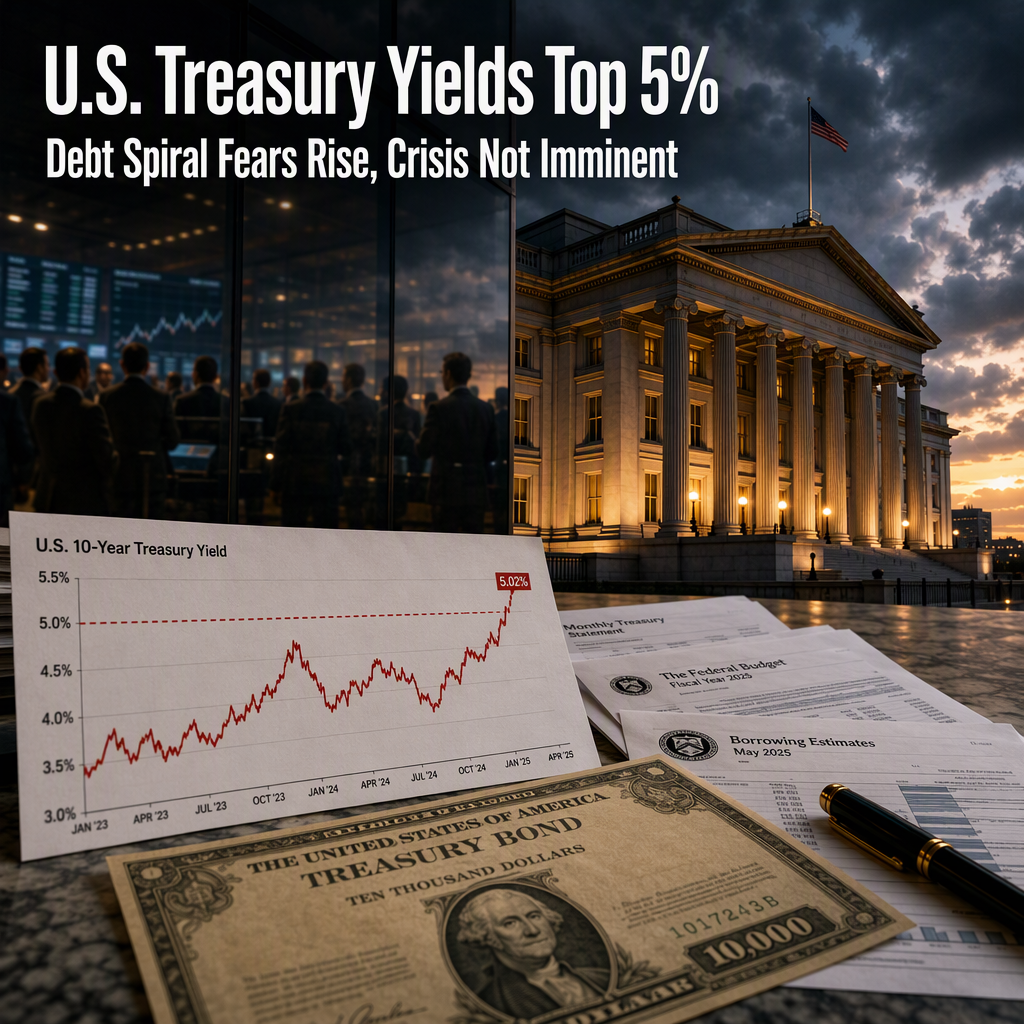
U.S. Treasury yields have climbed above 5%, sparking renewed fears that higher government borrowing costs could trigger a debt spiral and potentially a fiscal crisis. The benchmark 10-year Treasury yield is now firmly above 5%, while the government's net interest costs are estimated at about $1.05 trillion for the first 11 months of fiscal year 2026 [1]. Maya MacGuineas, president of the Committee for a Responsible Federal Budget, warned that rising borrowing costs could become self-reinforcing, as mounting interest expenses force the government to borrow even more. She stated, 'The real threat is the debt spiral. If interest begets debt, and debt begets interest, eventually debt will spin out of control. A fiscal crisis, once unthinkable, is now a distinct possibility' [1].
Despite these concerns, some analysts argue that a fiscal crisis is not imminent. TD Securities strategists Gennadiy Goldberg and Molly Brooks noted, 'A fiscal apocalypse is not upon us just yet,' emphasizing that the recent surge in yields may be driven as much by strong economic growth as by fiscal fears [1]. The bank estimates U.S. interest expenses in fiscal year 2026 to be around $1.1 trillion, with projections rising to $1.4 trillion in 2027, $1.5 trillion in 2028, and $1.6 trillion in 2029 if yields remain at current levels [1].
A key mitigating factor is the structure of U.S. government debt. The weighted-average maturity of the debt is about 5.9 years, meaning that higher borrowing costs will feed through gradually as existing bonds mature and new debt is issued. The average coupon on Treasury securities, excluding bills, is still just 3.1%, and the average interest rate on U.S. debt is about 3.4%, which remains below the rate at which the economy is growing in nominal terms [1].
Market implications are significant, as the rise in yields has heightened scrutiny of U.S. fiscal sustainability and could influence investor sentiment and government financing costs going forward. However, the gradual transmission of higher rates and ongoing economic growth provide some buffer against an immediate crisis [1].
CONCLUSION
While U.S. Treasury yields above 5% have intensified concerns about a potential debt spiral, analysts suggest that a fiscal crisis is not imminent due to gradual refinancing and strong economic growth. The situation warrants close monitoring, but immediate market panic appears unwarranted according to current expert assessments.