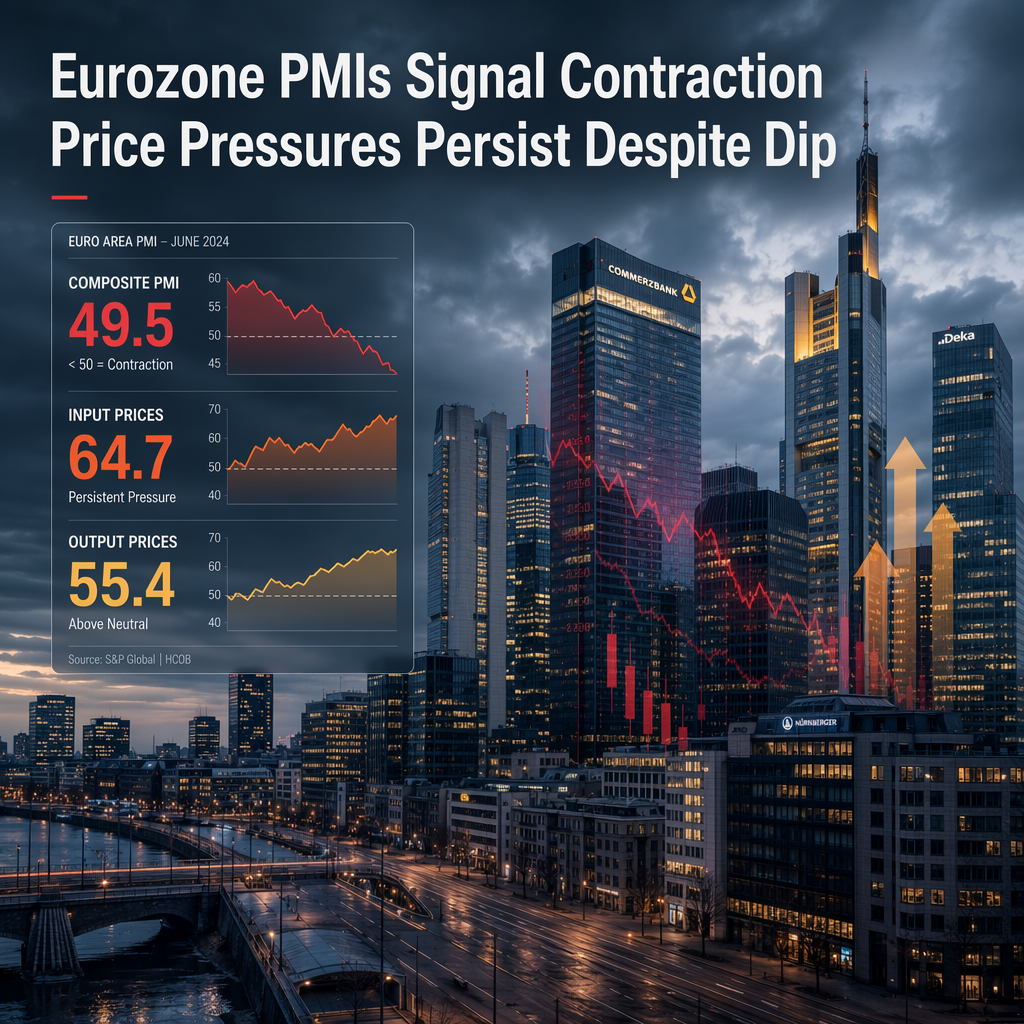
According to Nomura strategists, the latest Purchasing Managers' Index (PMI) data for the euro area in June signals that business activity remains in contraction, with the composite PMI at 49.5, which is below the 50 threshold that separates expansion from contraction. This reading, however, represents a 1.0 point increase from the previous month and was above both Nomura's and consensus expectations, primarily driven by the service sector, while the manufacturing output index was largely unchanged [1].
The report highlights that price indices across all surveyed European countries and sectors declined in June, yet all remain above 50, indicating ongoing upward price pressures. Specifically, the euro area composite input price index dropped by 5.2 points to 64.7, but this is still 5.7 points higher than in February. Similarly, the composite output price index fell by 1.7 points to 55.4, which is 2.3 points higher than its February level [1].
Upward price pressures are most pronounced in the manufacturing sector, where both input and output price PMIs remain significantly elevated compared to February. Despite the recent declines, these indices suggest that inflationary pressures persist, particularly in manufacturing, and have not returned to pre-Iran war shock levels [1].
The data implies that while there is a slight improvement in business activity, the euro area continues to face challenges from weak growth and sticky inflation, which could influence monetary policy and market expectations going forward [1].
CONCLUSION
The June euro area PMI data points to ongoing economic contraction and persistent inflationary pressures, especially in manufacturing. While there was a modest improvement in the composite PMI, price indices remain elevated, suggesting that inflation risks have not abated. Market participants may remain cautious as growth and price stability concerns persist.