
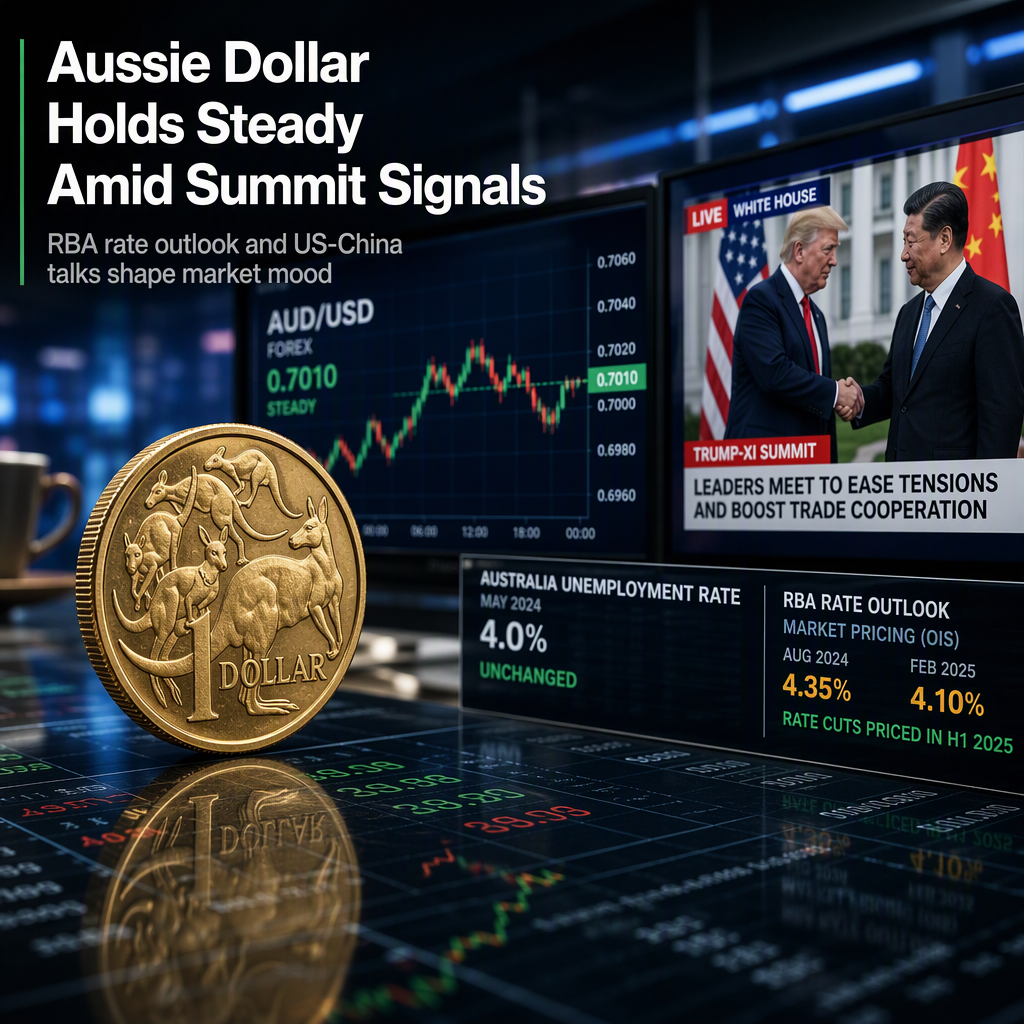
The Australian Dollar (AUD/USD) remained stable around 0.7010 during early Asian trading hours on Friday, as traders evaluated the outcomes of the summit between US President Donald Trump and Chinese President Xi Jinping at the White House [1]. President Xi stated that US-China relations had reached a new historical milestone, with broad agreement on numerous issues and a new arrangement following trade talks, which he described as good news. He emphasized the importance of peaceful coexistence and partnership between Beijing and Washington [1]. US Treasury Secretary Scott Bessent announced that the US and China agreed to extend their bilateral trade truce, originally set to expire in November, through January 10 [1].
Despite these developments, market participants noted that the summit was largely symbolic, lacking substantive breakthroughs on contentious topics such as artificial intelligence, trade, Taiwan, and the war with Iran [1]. Any progress in US-China trade negotiations could potentially support the Australian Dollar, given China's status as a major trading partner for Australia [1].
On the domestic front, Australia's unemployment rate increased to 4.6% in August from 4.5% in July, according to the Australian Bureau of Statistics [1]. This data is significant ahead of the Reserve Bank of Australia (RBA) rate decision next week. RBA Governor Michele Bullock previously stated that a rise in the jobless rate is necessary for inflation to decrease, and the market expects a 25-basis-point rate hike next week. The slight uptick in unemployment is not anticipated to deter the RBA from tightening policy [1].
Elias Haddad of Brown Brothers Harriman commented that the rise in unemployment was above consensus and the RBA's year-end projection, but attributed it mainly to a higher participation rate, indicating persistent labor market tightness. Haddad believes that the underlying resilience in labor demand supports further RBA tightening and a constructive medium-term outlook for the Australian Dollar [1].
Technical analysis shows AUD/USD maintains a bearish near-term tone, trading below the 100-day moving average and the Bollinger middle band. The Relative Strength Index (RSI) at 32.7 is near oversold territory, suggesting that downside momentum may be stretched [1].
CONCLUSION
The Australian Dollar is holding steady as markets digest the Trump-Xi summit and anticipate the upcoming RBA rate decision. While the summit provided positive rhetoric, it lacked concrete breakthroughs, and Australia's jobs data supports expectations of further monetary tightening. Overall, the outlook for the Aussie remains constructive, with technical indicators hinting at stretched downside momentum.