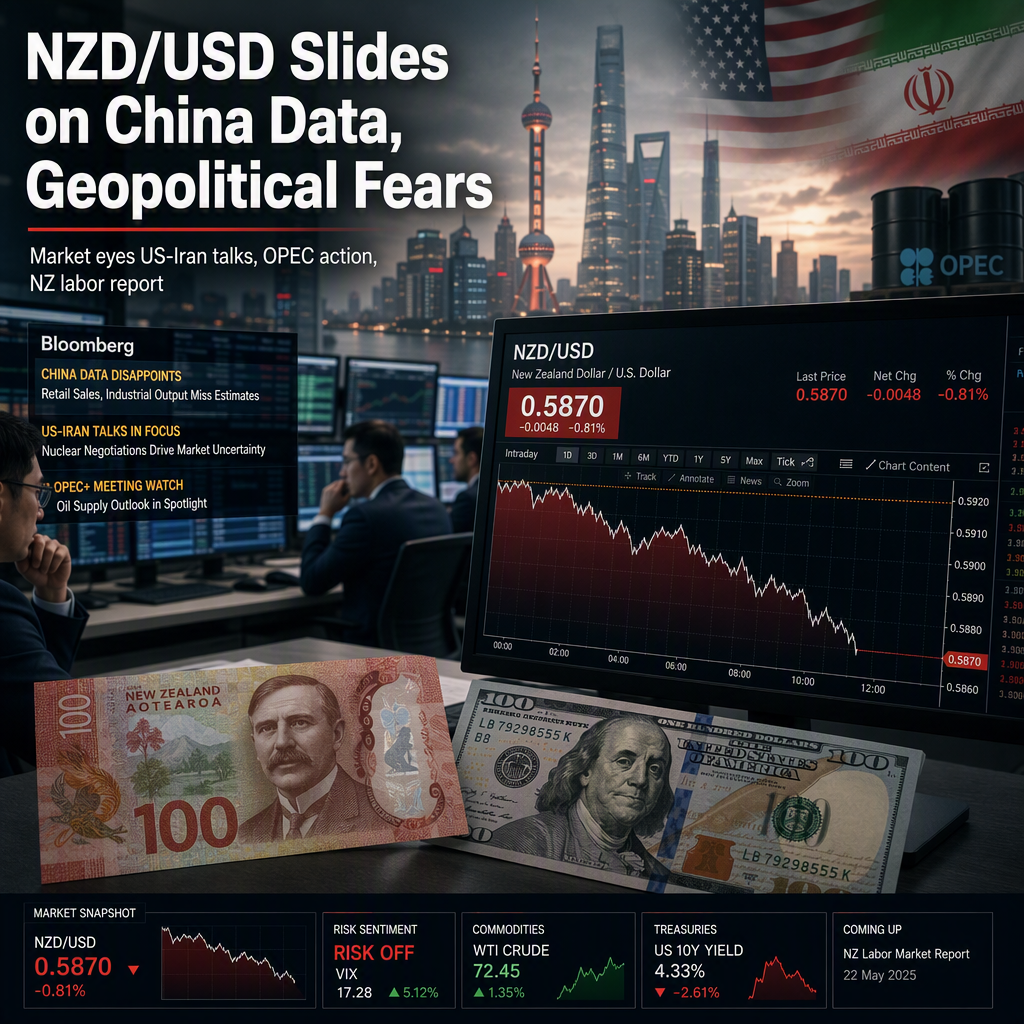
The New Zealand Dollar (NZD) eased against the US Dollar (USD), with NZD/USD trading around 0.5870 on Monday, down 0.11% for the day. This decline followed weaker-than-expected economic data from China, as the Manufacturing Purchasing Managers Index (PMI) for July slowed to 50.9 from 51.7 in June, missing the market consensus of 51.5 according to RatingDog. Despite this downside surprise, the reaction in the Kiwi was limited, as traders focused on geopolitical developments, particularly the ongoing talks between the United States and Iran [1].
US President Donald Trump announced that a new round of talks with Iran would begin on Monday afternoon, after previously suspending planned military strikes. However, Iranian officials rejected Trump's statements, calling them 'another lie' and stating that their armed forces remain on high alert. These conflicting messages have kept investors cautious, with market participants closely monitoring any progress or escalation, as an agreement could improve risk sentiment and support growth-sensitive currencies like the NZD, while renewed tensions would likely boost demand for the safe-haven USD [1].
Additionally, the Organization of the Petroleum Exporting Countries and its allies (OPEC+) decided to increase oil production in September, contributing to lower oil prices and slightly reducing expectations of tighter monetary policy from the Federal Reserve. This has limited the upside potential of the US Dollar [1].
Looking ahead, investors are awaiting the release of the Institute for Supply Management (ISM) Manufacturing PMI later on Monday and Friday's July Nonfarm Payrolls (NFP) report, which could provide further clues on the Fed's policy outlook and influence the next direction for NZD/USD. Strategists at Brown Brothers Harriman expect New Zealand’s second-quarter labor market report, due Tuesday, to show continued stability, with employment projected to rise 0.1% quarter-on-quarter, the unemployment rate at 5.4%, and private regular wages up 0.6% quarter-on-quarter. They also note that the improvement in the ANZ Business employment intentions index to a five-month high in June points to more favorable labor market conditions, and that above-target inflation could argue for additional RBNZ rate hikes, which would be supportive for the NZD [1].
CONCLUSION
The NZD/USD pair is under pressure from weaker Chinese data and ongoing US-Iran geopolitical uncertainty, with market sentiment remaining cautious. Upcoming US economic releases and New Zealand's labor market report are expected to provide further direction, while the RBNZ outlook remains underpinned by steady labor data and potential for further rate hikes.