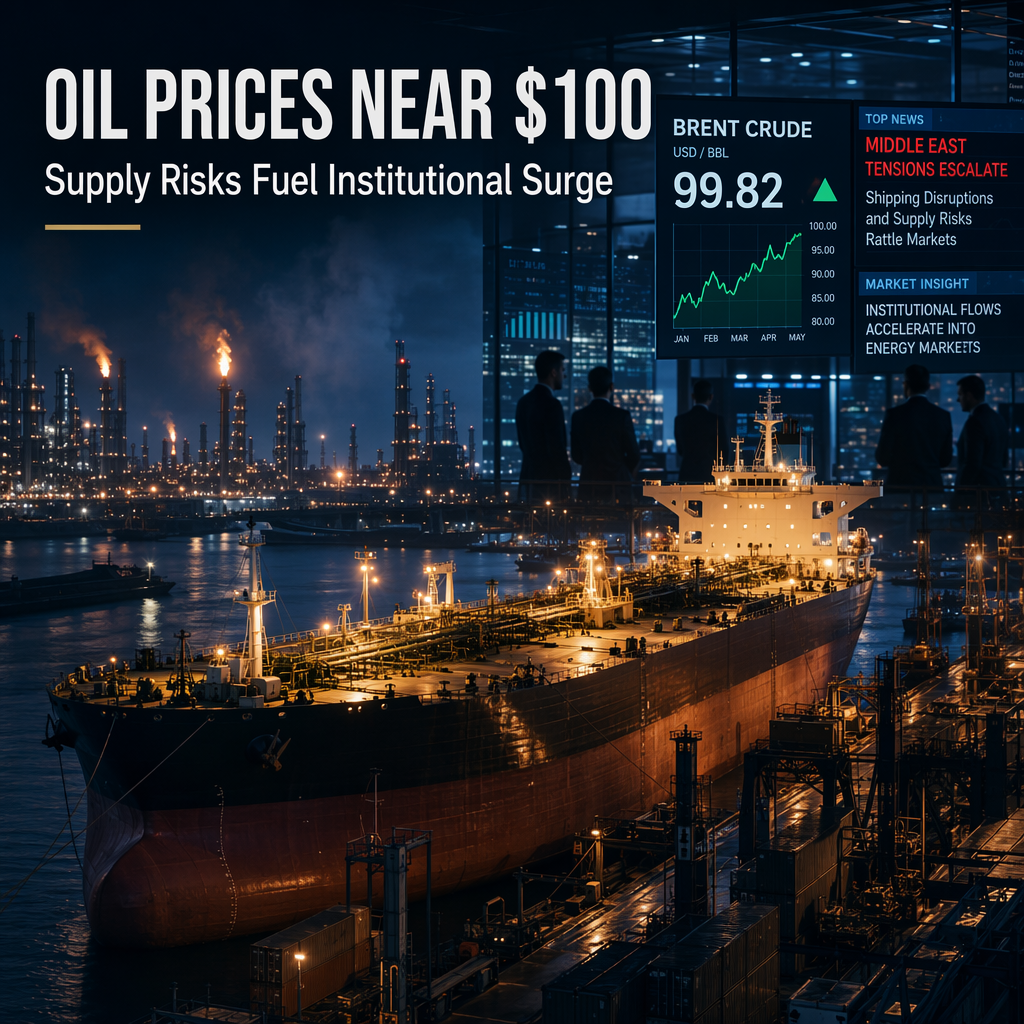
Oil prices have remained elevated, with Brent crude hovering near $100 a barrel after briefly surpassing that level for the first time since May, driven by renewed Middle East tensions, disruptions in the Red Sea and Strait of Hormuz, and a halt in Kazakhstan's exports [1]. According to BNY's Geoff Yu, these supply risks have revived the supply risk premium in oil markets, with Brent's large gains since March underscoring the strength of the move [1].
Institutional energy flows have shifted significantly, moving from liquidation to high-conviction re-accumulation, particularly since July, which is identified as a clear inflection point [1]. The latest weekly reading for U.S. energy flows is at the 83rd percentile, and the monthly flow is at the 90th percentile, indicating aggressive buying from a still-depleted base—energy holdings are only at the 17th percentile of the March-July window, well below the early-March peak [1]. This suggests that while investors are buying aggressively, positioning is not yet at crowded levels [1].
The surge in oil prices is directly contributing to inflation and interest rate anxiety, with both U.S. and German yields rising as investors anticipate greater central bank pressure [1]. The broader risk highlighted is that ongoing military escalation could trigger a macro shock affecting energy, bonds, and equities [1].
Recent events contributing to the price surge include President Trump stating he was considering a massive attack on Iran and Houthi strikes on Saudi tankers in the Red Sea, which have heightened fears of a wider energy shock [1].
CONCLUSION
Oil prices remain elevated near $100 due to persistent supply risks and geopolitical tensions, prompting aggressive institutional re-accumulation from a low base. The resulting inflation and interest rate concerns are driving yields higher, with the potential for broader macroeconomic impacts if military escalation continues.