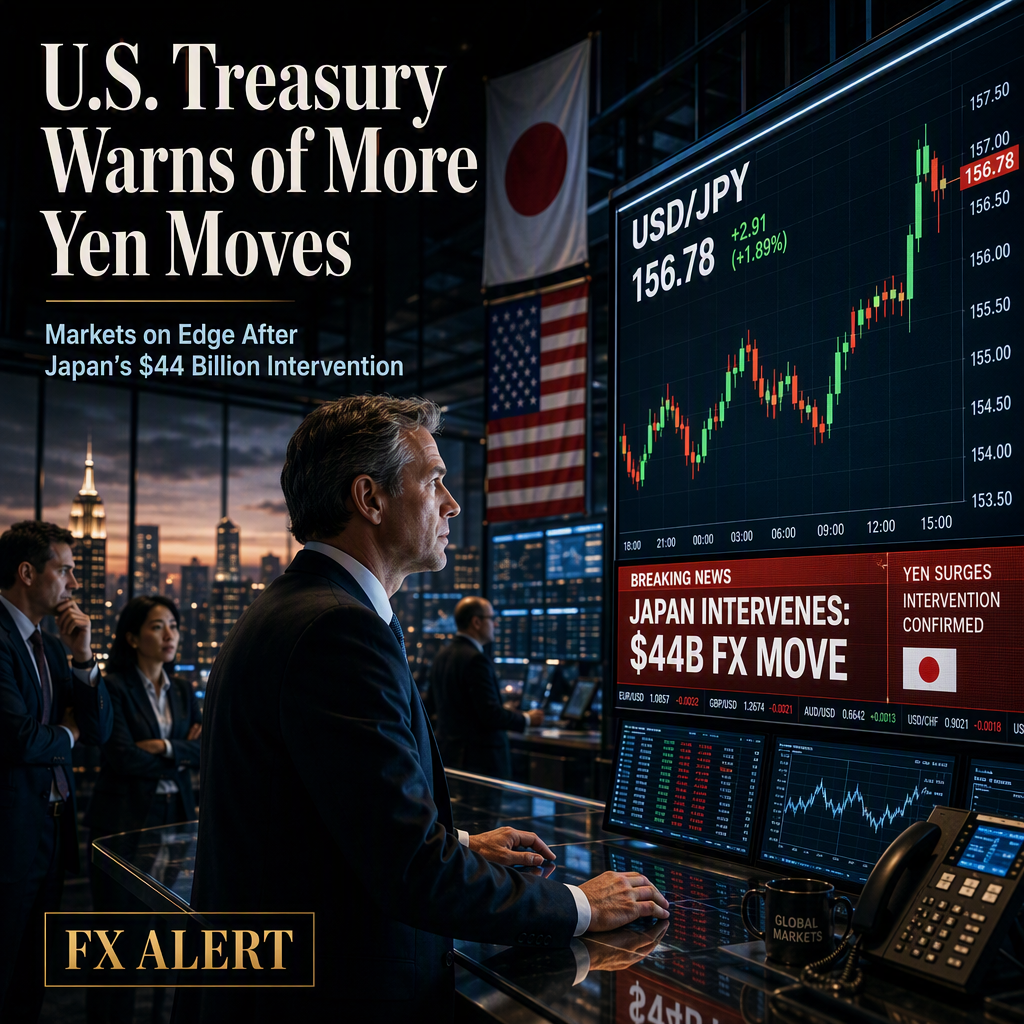
The U.S. Treasury Department has informed currency market participants to prepare for potential additional intervention in the yen, following a significant operation by Japanese authorities on Thursday to support their currency [1]. On that day, Japan intervened in the foreign-exchange markets by buying yen and selling dollars, which reportedly caused the yen to surge to its highest level since mid-May [1]. Market sources estimate the scale of Thursday's intervention could be as high as $44 billion [1].
This intervention came after a period of heightened volatility for the yen, which had been under downward pressure against the U.S. dollar [1]. The U.S. Treasury's communication to banks underscores that authorities are closely monitoring currency movements and are prepared to act again if necessary [1]. Traders have been advised to remain alert for further operations in the foreign exchange market, particularly involving the Japanese yen [1].
The yen's surge has fueled speculation about the possibility of repeated interventions as Japanese authorities aim to stabilize the currency and prevent excessive depreciation [1]. The Bank of Japan has also indicated awareness of upside inflation risks, which could lead to faster-than-expected interest rate hikes, adding complexity to the currency market outlook [1].
Following the intervention, the yen strengthened to the 157 range per dollar, a level closely watched by market participants as a potential trigger for further intervention [1]. Technical analysts suggest that support for the yen could strengthen if it remains below the 160 mark, while a sustained move above 160 could invite renewed downward pressure [1]. Traders and analysts are also monitoring statements from U.S. and Japanese officials, as well as movements in Asian technology shares, which have influenced broader currency market sentiment [1].
CONCLUSION
Japan's substantial intervention in the foreign exchange market, estimated at up to $44 billion, has led to a sharp appreciation of the yen and heightened market vigilance for further official actions. The U.S. Treasury's warning to banks signals a high level of coordination and readiness to intervene again if necessary, keeping currency markets on edge.