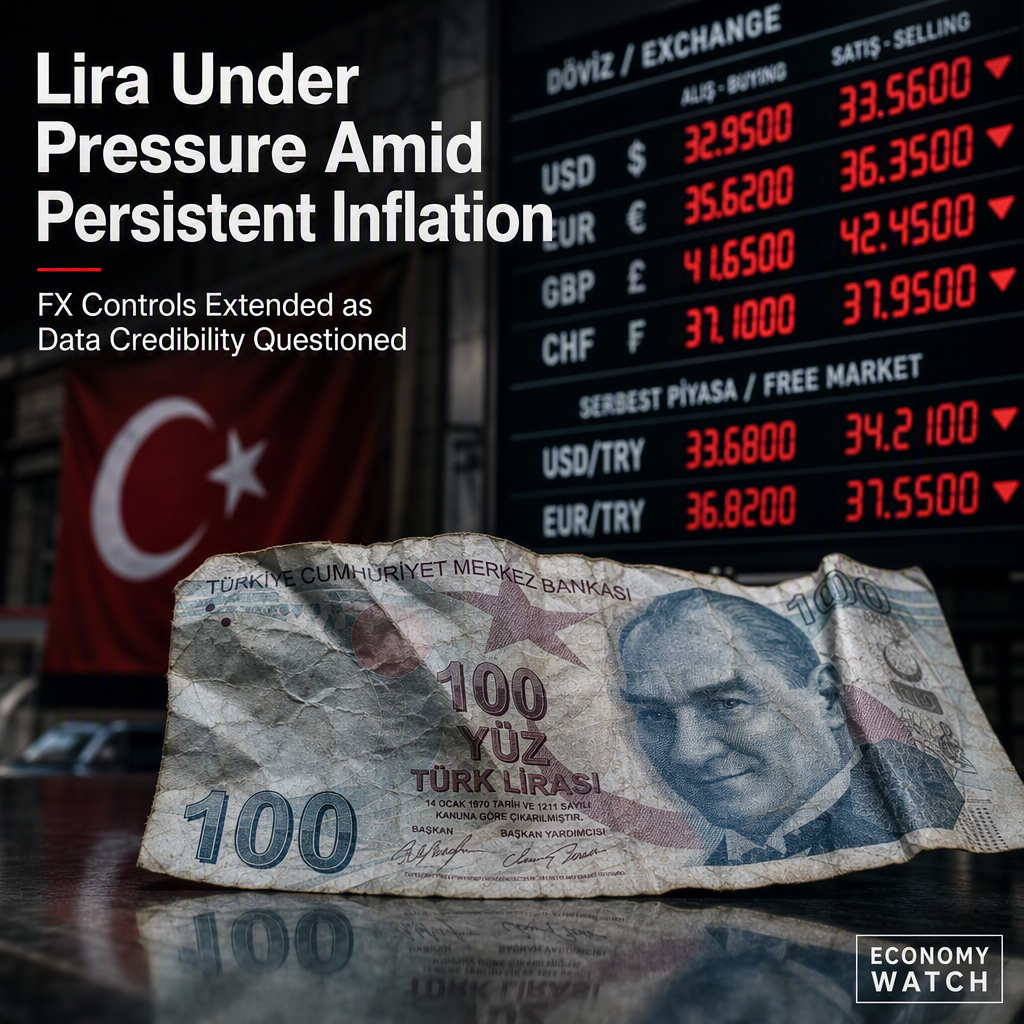
Turkey's July Consumer Price Index (CPI) slowed to 31.7% year-on-year from 32.1% in June, with prices rising 1.78% month-on-month, according to Commerzbank’s Tatha Ghose. However, the apparent improvement in headline and core inflation is considered misleading, as underlying price momentum remains strong. After exponential smoothing, both headline and core CPI are still averaging above 2% month-on-month, indicating persistent inflationary pressures [1].
The reliability of inflation data is further questioned due to discrepancies in Istanbul CPI reporting. The older Istanbul CPI series (base: 2015) shows inflation near 40% year-on-year, while the new series (base: 2023) reports a lower rate of 35%. Such revisions, especially when they appear favorable, are met with skepticism by the FX market, given ongoing debates about the credibility of Turkish inflation statistics [1].
In addition to inflation concerns, the Central Bank of the Republic of Turkey (CBRT) has overhauled its foreign exchange (FX) conversion scheme. Firms now face conversion limits tied to value added, profitability, and labor costs. The 3% conversion support and the requirement to surrender 35% of export proceeds have been extended until January 2027. While these measures help support reserves, they are characterized as 'soft capital controls' and do not represent a shift toward more market-friendly policies [1].
Commerzbank concludes that the combination of July's inflation data and the revised FX conversion scheme does not provide clear relief for the Turkish Lira, suggesting continued pressure on the currency [1].
CONCLUSION
Despite a slight slowdown in headline inflation, underlying price pressures and skepticism over data reliability persist in Turkey. The extension of FX controls and lack of decisive policy improvement offer no clear support for the Turkish Lira, indicating ongoing challenges for the currency.