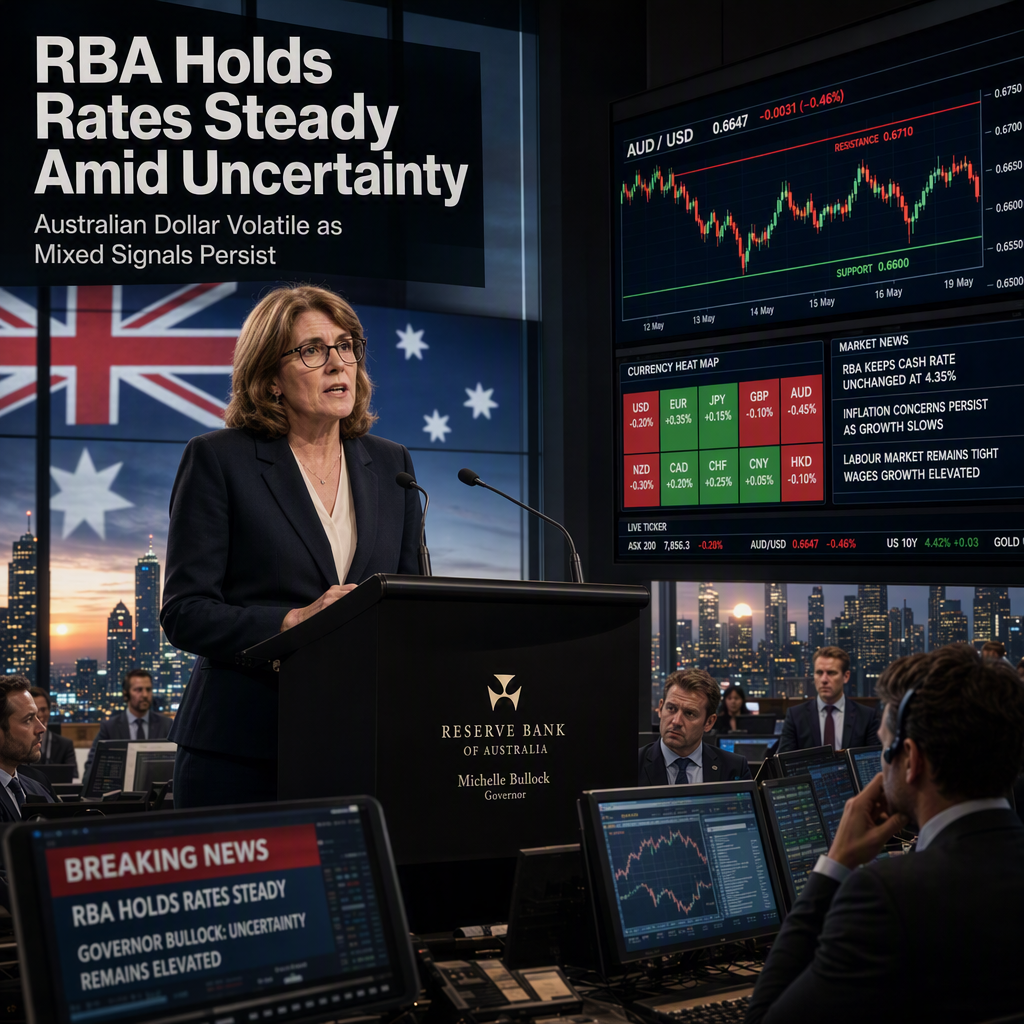
The Reserve Bank of Australia (RBA) decided to keep its benchmark interest rate unchanged at 4.35% in a unanimous decision, defying some market expectations of a possible dissenting vote in favor of a rate hike [1][2]. The RBA's updated forecasts indicated a higher unemployment rate and lower short-term inflation, while medium-term inflation risks were revised upward, leaving the door open for potential future rate hikes [1]. However, Commerzbank's Volkmar Baur suggested that the next likely move from the RBA would be a rate cut, implying continued pressure on the Australian Dollar (AUD) in the coming months [1].
Following the policy announcement, RBA Governor Michelle Bullock delivered a speech in which she struck a hawkish tone, hinting at the possibility of an interest rate hike in the coming months. Bullock stated that the domestic economy is operating "above capacity" and emphasized the need to slow economic growth to address inflationary pressures [2]. This commentary initially triggered a moderate decline in the AUD/USD pair, which spiked down below 0.7050 from Monday’s highs near 0.7075, before regaining some ground shortly afterward [2].
Technical analysis shows that AUD/USD is hovering around 0.7050, maintaining a mildly bullish near-term bias within an upward-sloping channel. However, momentum indicators such as the 4-hour Relative Strength Index (14) and the MACD suggest waning upside pressure, with the RSI nearing the 50 midline and the MACD slipping marginally into negative territory [2]. Key support and resistance levels are identified at 0.7030 and 0.7085, respectively [2].
A currency heat map for the day indicated that the Australian Dollar was the strongest against the US Dollar, despite the initial volatility following the RBA's decision and Bullock's remarks [2].
There is a notable discrepancy between the sources: while Commerzbank expects the next RBA move to be a rate cut, Governor Bullock's comments suggest a possible rate hike in the near future [1][2].
CONCLUSION
The RBA's decision to hold rates steady was in line with market expectations, but forward guidance remains mixed, with some analysts expecting a rate cut and the central bank signaling potential hikes. The Australian Dollar experienced short-term volatility but ultimately showed resilience against the US Dollar. Investors should monitor upcoming economic data and RBA communications for clearer direction.