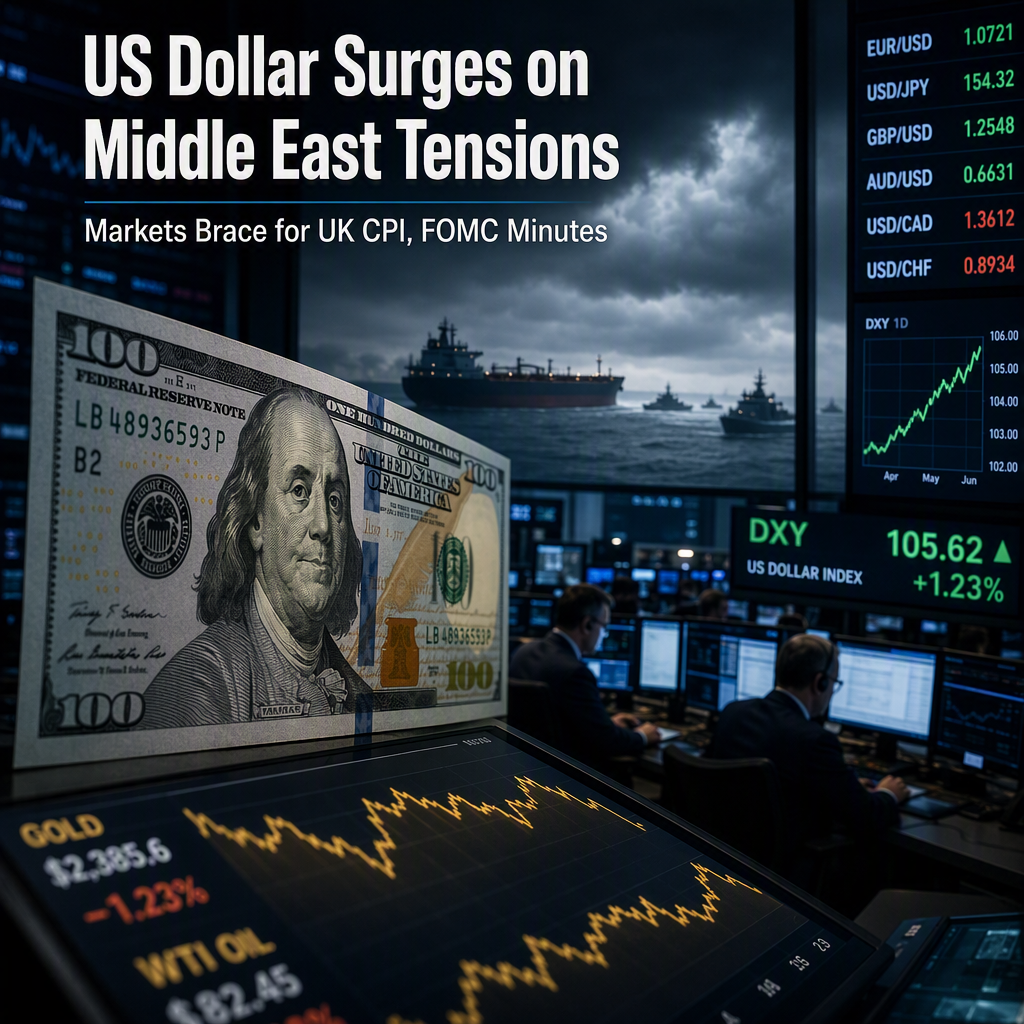
The US Dollar Index (DXY) maintained a firm tone near the 99.60s on Tuesday, supported by safe-haven demand as geopolitical tensions escalated around the Strait of Hormuz [1]. The US Dollar was the strongest against the New Zealand Dollar, with a 0.46% gain, and posted gains against all other major currencies, including the Euro, British Pound, Japanese Yen, Canadian Dollar, Australian Dollar, and Swiss Franc [1]. Gold and Oil both experienced sell-offs, while most major currencies drifted lower against the Greenback [1].
The heightened tensions stemmed from a reported incident in which a vessel was struck by an unknown projectile in the Strait of Hormuz. Iran's top negotiator stated that the Strait would remain closed until Washington meets the conditions of a now-expired interim deal, while US President Donald Trump asserted via social media that the waterway is open and operating, and that no talks with Tehran are scheduled [1]. This ongoing uncertainty contributed to a geopolitical premium supporting the US Dollar [1].
In currency markets, EUR/USD traded on the soft side, holding a narrow range around the 1.1580 zone as the US Dollar retained its upper hand. GBP/USD edged lower, hovering around the mid-1.3500s ahead of the upcoming UK Consumer Price Index (CPI) release for July, which is expected to show a higher annual rate. A stronger-than-expected CPI print could revive expectations for Bank of England rate hikes and potentially support the Pound, while a weaker print would leave Sterling vulnerable [1].
Looking ahead, market participants are focused on a busy Wednesday, which will feature UK inflation data, Eurozone final Harmonized Index of Consumer Prices (HICP) figures for July, and the release of the Federal Open Market Committee (FOMC) Minutes. Additionally, a scheduled speech from European Central Bank President Christine Lagarde is anticipated [1].
CONCLUSION
The US Dollar's firm performance was driven by safe-haven flows amid renewed tensions in the Strait of Hormuz and uncertainty over US-Iran relations. Market attention now shifts to key economic releases and central bank communications, which could influence currency movements in the coming sessions.