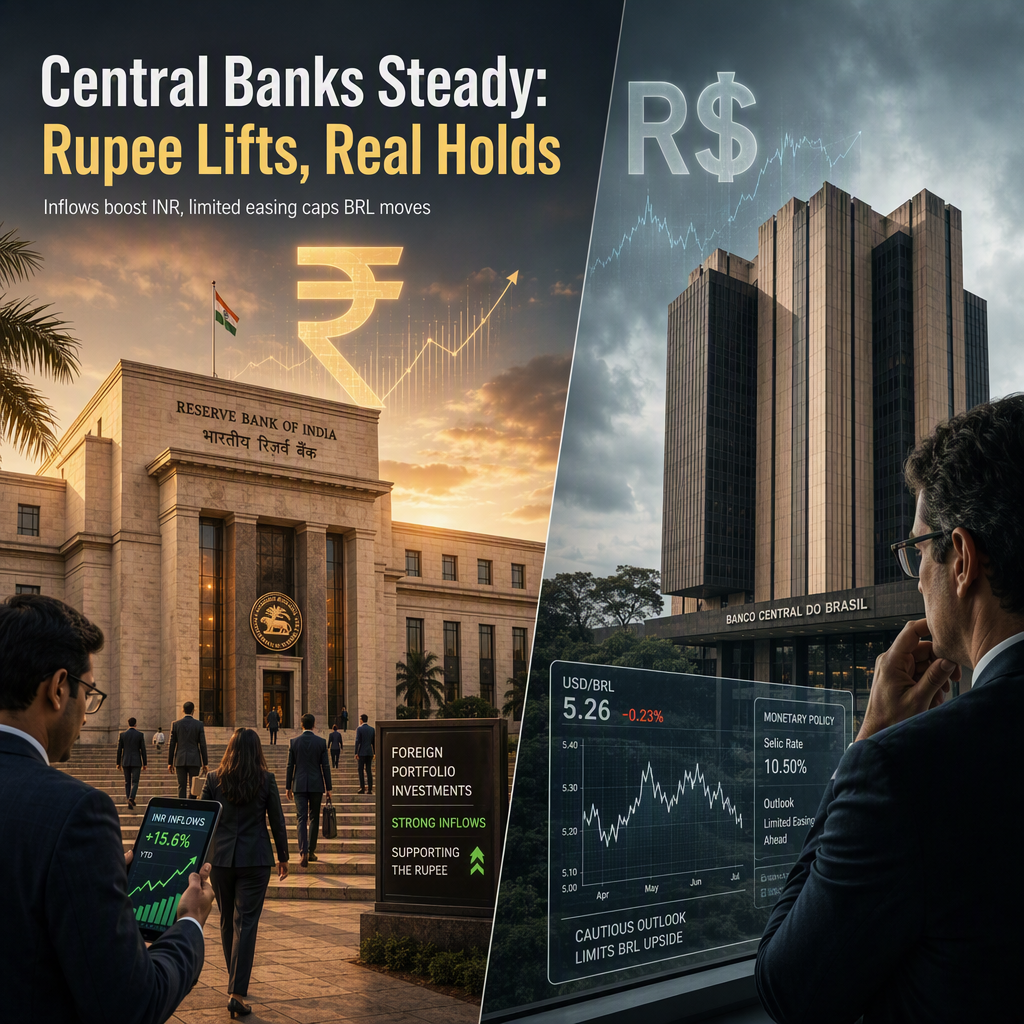
The Reserve Bank of India (RBI) unanimously decided to keep its policy rate at 5.25% for the fourth consecutive meeting, maintaining a neutral bias and emphasizing that risks to growth and inflation are evenly balanced [1]. The RBI projects real GDP growth of 6.4% in Q2, an increase from the previous estimate of 6.3%, and maintains its Q3 growth projection at 6.5%. Core inflation is expected to decline after peaking in Q3 [1]. The Indian Rupee (INR) has been supported by positive real rates, active RBI foreign exchange intervention, and strong capital inflows since June. According to the RBI, India has attracted nearly $41 billion in overseas capital since June, covering almost twice the country's current account deficit [1].
In contrast, the Brazilian Central Bank (BCB) is expected to implement a further 25 basis point rate cut, but real rates would remain highly restrictive at around 9.4% [2]. Despite market expectations for a rate cut, BCB President Galípolo has expressed caution due to persistent inflation and inflation expectations, suggesting that the key interest rate may remain at a restrictive level for an extended period [2]. The BCB Focus survey indicates that participants expect a benchmark interest rate of 13.75% by year-end, implying only one more rate cut is anticipated [2]. Given these conditions, aggressive easing is unlikely, and the Brazilian Real (BRL) is not expected to experience significant near-term impact from monetary policy adjustments [2].
Both central banks are taking cautious approaches in response to domestic and global economic conditions. The RBI's measures and capital inflows are seen as supportive for the INR, while the BCB's restrictive stance limits the potential for further rate cuts and curbs FX volatility for the BRL [1][2].
CONCLUSION
The RBI's steady policy and strong capital inflows are providing support for the Indian Rupee, while the Brazilian Central Bank's limited easing and high real rates are expected to cap any significant FX impact on the Real. Both currencies are likely to remain stable in the near term, with central banks prioritizing balanced approaches amid inflation and growth concerns.