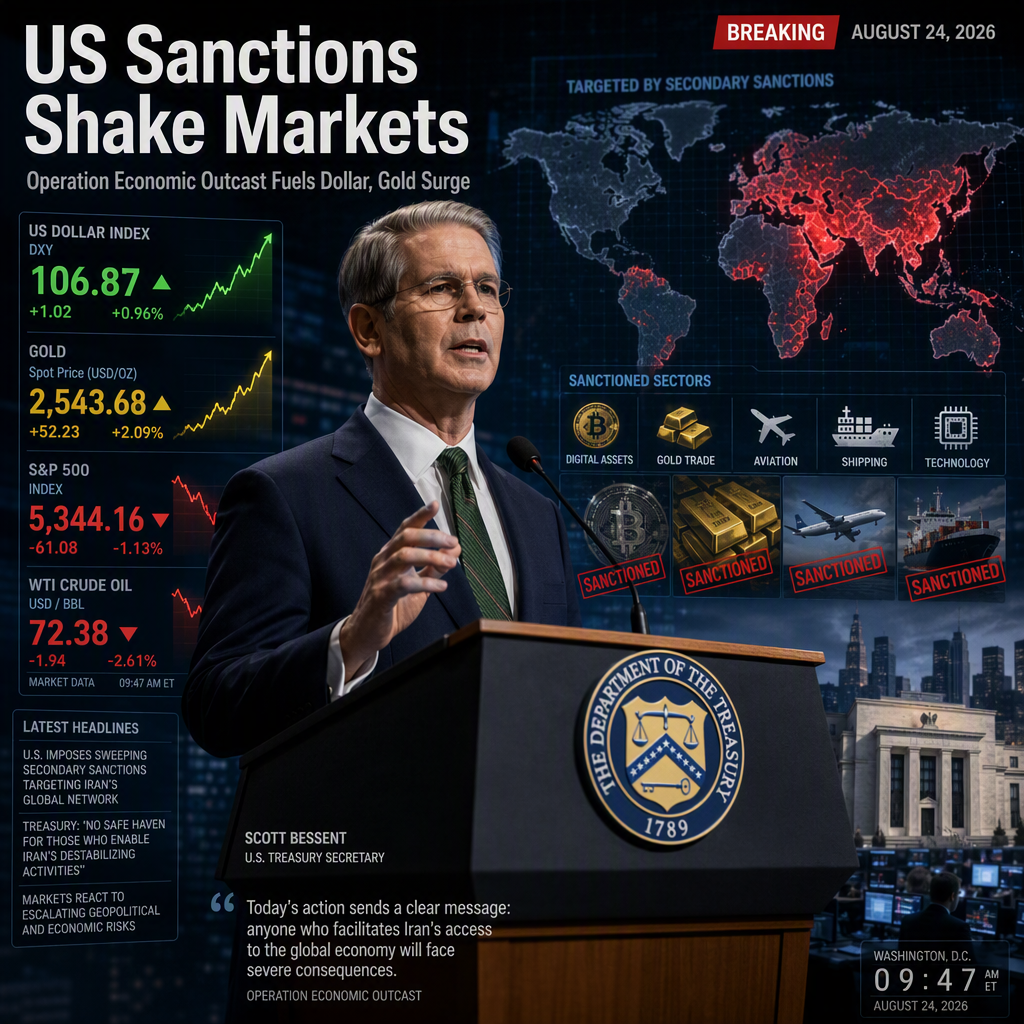
On August 24, 2026, US Treasury Secretary Scott Bessent announced 'Operation Economic Outcast,' a comprehensive campaign of secondary sanctions targeting entities and countries trading with Iran across sectors such as digital assets, gold, aviation, technology, and shipping [1][2]. The measures, described as 'unprecedented,' sanctioned nearly 60 entities linked to Iran, including broker networks and shadow fleet vessels in multiple countries, with the stated aim of cutting funding for the IRGC [2]. Bessent also warned that a major financial institution would be sanctioned within days and pledged a 'zero leakage' enforcement drive [3].
The announcement triggered significant market reactions. The US Dollar firmed against every major currency, with the Dollar Index reclaiming the 99.00 mark for the first time since the previous Wednesday's decline [1][3]. The dollar was particularly strong against the Canadian Dollar (+0.57%), New Zealand Dollar (+0.30%), and Australian Dollar (+0.30%) [3]. Gold surged to its highest level in more than three months, approaching $4,650 per troy ounce, as investors sought safe-haven assets in response to the heightened geopolitical risk [1][3].
Equity markets were pressured, with the S&P 500 dropping roughly 0.33% on the day, closing near 7,653 after a chip-led selloff ahead of Nvidia's earnings and anxiety over AI-related price hikes [1]. Oil prices, however, slipped despite the sanctions threat, with WTI settling near $85.80, down about 1.58% on the day, as the market may have already priced in much of the announcement following a week of advance signaling [1]. Treasury yields eased as energy costs declined [1].
The Mexican Peso weakened against the US Dollar, with the USD/MXN pair gaining over 0.25% to trade at 16.96, as the US sanctions on Iran offset firmer Mexican inflation data and a modest GDP rebound [2]. The risk-off tone weighed on growth-sensitive currencies broadly, while traders looked ahead to upcoming US economic data releases and Fed Chair Kevin Warsh's speech at the Jackson Hole Symposium [2][3].
Forward-looking statements from policymakers included ECB's Piero Cipollone noting that eurozone inflation conditions remained far from adverse scenarios, and Minneapolis Fed President Neel Kashkari stating that the US Treasury market continued to function properly despite rising yields [1].
CONCLUSION
The US Treasury's sweeping secondary sanctions on Iran sparked a broad risk-off move, strengthening the dollar and gold while pressuring equities and emerging market currencies. Despite the geopolitical escalation, oil prices fell, suggesting the market had anticipated much of the news. Investors are now focused on upcoming US economic data and central bank commentary for further direction.