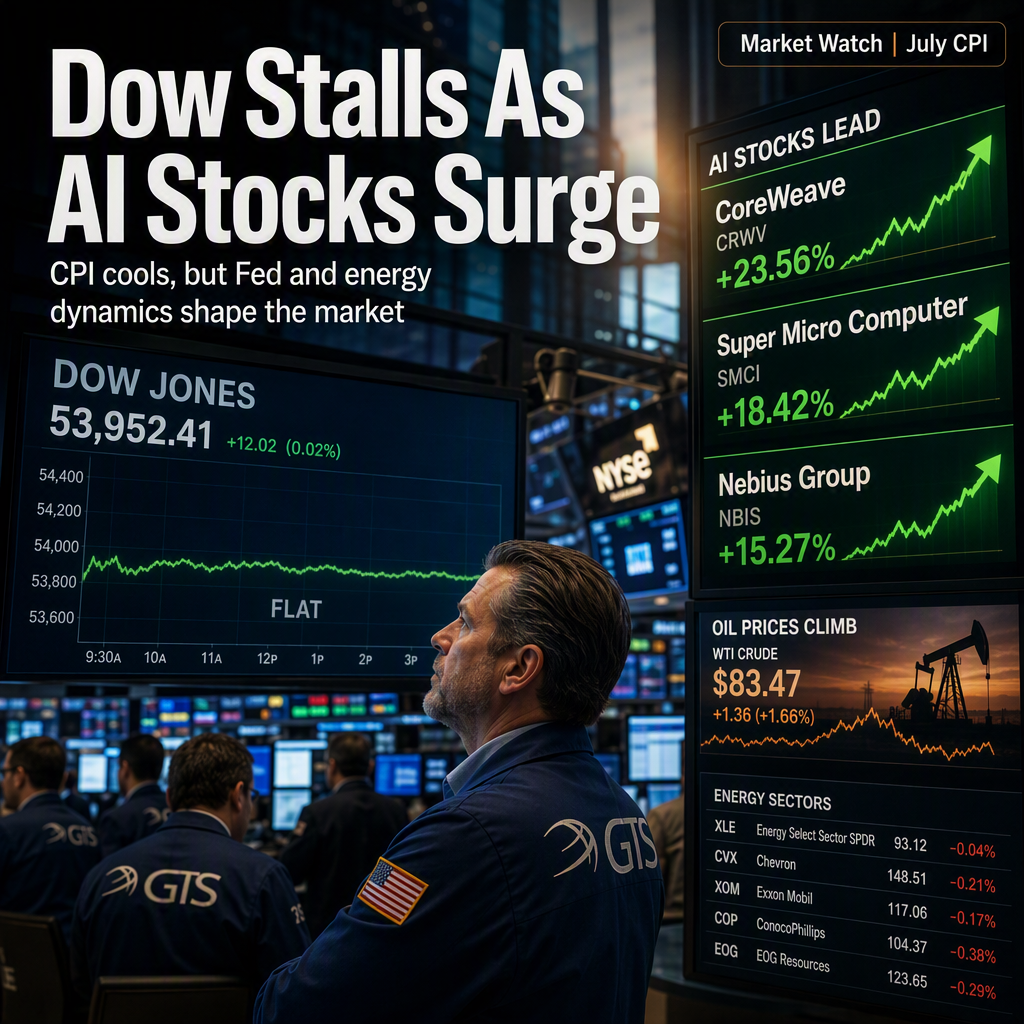
The July Consumer Price Index (CPI) report matched consensus expectations, with headline prices rising 0.1% month-over-month, reversing a 0.4% decline in June, and bringing the annual rate to 3.4% from 3.5% [1]. Core CPI increased 0.2% for the month and 2.5% year-over-year, slightly softer than June and in line with forecasts [1]. The only miss was the unadjusted index, which came in seven hundredths of a point below consensus [1].
Despite the cooler inflation data, the Dow Jones Industrial Average failed to sustain any gains, briefly touching the 54,000 level before fading and trading just below the previous close near 53,800 [1]. In contrast, the S&P 500 rose 0.2% and the Nasdaq Composite gained 0.5%, driven by strong performances from artificial intelligence-related stocks such as CoreWeave (CRWV, +18%), Super Micro Computer (SMCI, +13%), and Nebius (NBIS, +16%)—none of which are Dow components [1]. Within the Dow, Cisco Systems (CSCO) rose just over 2%, contributing only a modest impact due to the index's price-weighting methodology [1].
Market expectations for the Federal Reserve's September 16 meeting shifted, with rate futures now pricing a 58% chance of holding rates steady, compared to an even split earlier in the week [1]. However, the Dow's lackluster movement suggests the inflation print did not provide a decisive catalyst for the index [1].
Energy prices played a notable role in the inflation data, with energy costs falling 1.5% in July after a 5.7% decline in June, though they remain nearly 15% higher year-over-year [1]. Crude oil prices stayed above $83.00 for a fifth straight session, despite Energy Information Administration (EIA) data showing a build of over 17.4 million barrels against expectations for a small draw, indicating that geopolitical factors are influencing prices more than inventory levels [1].
CONCLUSION
The July CPI report delivered no surprises, but the Dow Jones Industrial Average failed to capitalize, remaining flat as gains in AI stocks lifted other indices. Market participants shifted expectations toward a Fed rate hold in September, while energy dynamics and sector-specific rallies shaped broader market moves. The event underscores the Dow's limited exposure to current market drivers.