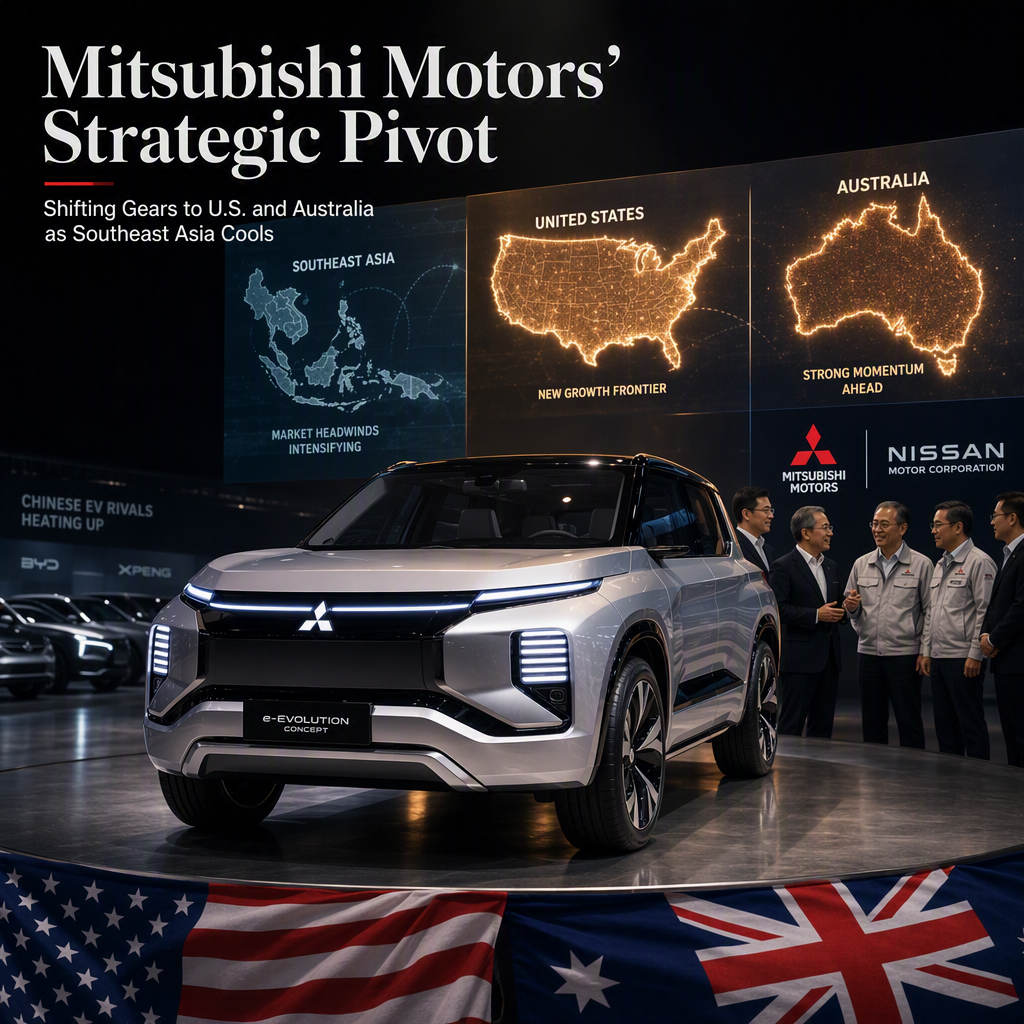
Mitsubishi Motors is undertaking a strategic pivot toward the U.S. and Australian markets as it faces declining sales and market share in Southeast Asia, a region that has traditionally been one of its strongest markets [1]. The company is responding to intensified competition from Chinese electric vehicle (EV) makers, such as BYD, which are increasingly pressuring Japanese automakers in the region [1].
To compensate for its lack of manufacturing capacity in North America, Mitsubishi Motors plans to procure vehicles from partners, including Nissan, and potentially other manufacturing alliances, as a temporary measure while it evaluates long-term manufacturing options in these target markets [1]. The new Eclipse Sportback electric vehicle, which will be based on the Nissan Leaf, exemplifies Mitsubishi's collaborative approach to filling gaps in its product lineup for the U.S. and Australia [1].
Mitsubishi Motors is also exploring the introduction of additional new EV models tailored for the U.S. and Australian markets, reflecting its ongoing investment in electrified vehicles [1]. The company has committed $470 million to its Thailand operations for electrified vehicle production, underscoring its focus on EV development despite the challenges in Southeast Asia [1].
This strategic shift highlights broader trends in the automotive industry, with Japanese manufacturers adapting their global strategies in response to the rapid rise of Chinese EVs and evolving market dynamics in key regions [1].
CONCLUSION
Mitsubishi Motors is redirecting its strategic focus to the U.S. and Australia as competition from Chinese EV makers erodes its position in Southeast Asia. By leveraging alliances and investing in electrified vehicles, the company aims to maintain competitiveness and adapt to shifting global market trends.