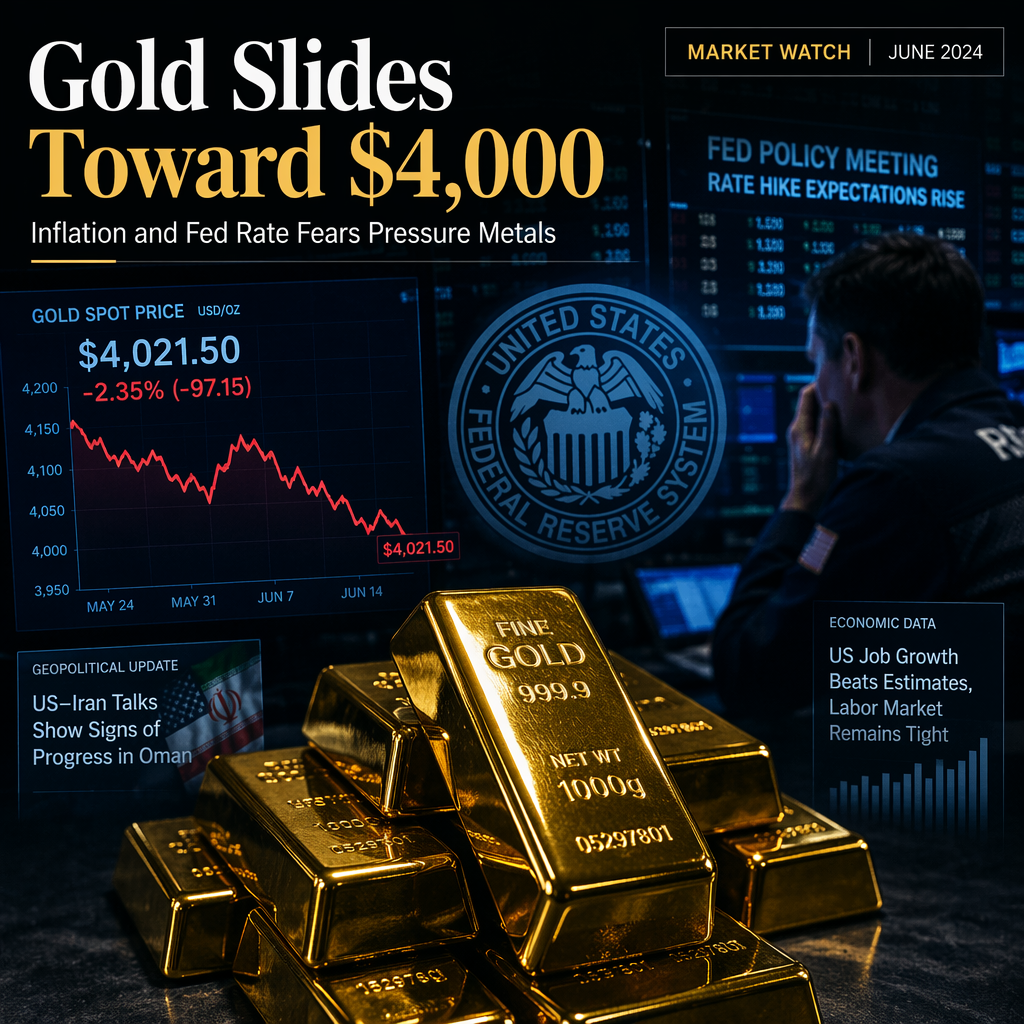
Gold prices (XAU/USD) declined to approximately $4,015 during the early Asian session on Tuesday, extending recent losses as persistent inflationary pressures reinforced expectations that central banks, particularly the US Federal Reserve, will maintain higher interest rates for an extended period [1]. The Federal Reserve held rates steady at its June policy meeting but signaled the possibility of a rate hike later this year due to inflation remaining above its 2% target [1].
Market participants are closely monitoring geopolitical developments, with CNBC reporting that the United States and Iran are scheduled to hold talks in Doha, Qatar, on Tuesday following a weekend of heightened tensions in the Middle East. However, uncertainty remains elevated as Iran’s Ministry of Foreign Affairs has not responded to the proposed discussions [1]. Peter Grant, vice president and senior metals strategist at Zaner Metals, noted that the market is highly sensitive to Middle East headlines and is still adjusting to the Federal Reserve’s more hawkish stance [1].
Gold, traditionally viewed as a hedge against inflation, becomes less attractive in a high-interest-rate environment because it does not yield interest. As a result, the prospect of prolonged higher rates has weighed on the yellow metal’s appeal [1]. Traders are awaiting key US employment data, including the ADP report on Wednesday and the Nonfarm Payrolls (NFP) report on Thursday, for further guidance on the Fed’s policy trajectory. Strong employment data could reinforce the higher-for-longer rate outlook and put additional pressure on gold prices, while signs of labor market weakness could weaken the US Dollar and potentially support gold in the near term [1].
CONCLUSION
Gold prices have come under pressure, falling toward $4,000 as inflation concerns and expectations of sustained higher interest rates dampen investor demand. Upcoming US employment data will be critical in shaping the Federal Reserve’s next moves and could influence gold’s near-term direction. Geopolitical uncertainty in the Middle East adds to market volatility, but the dominant theme remains the Fed’s hawkish outlook.