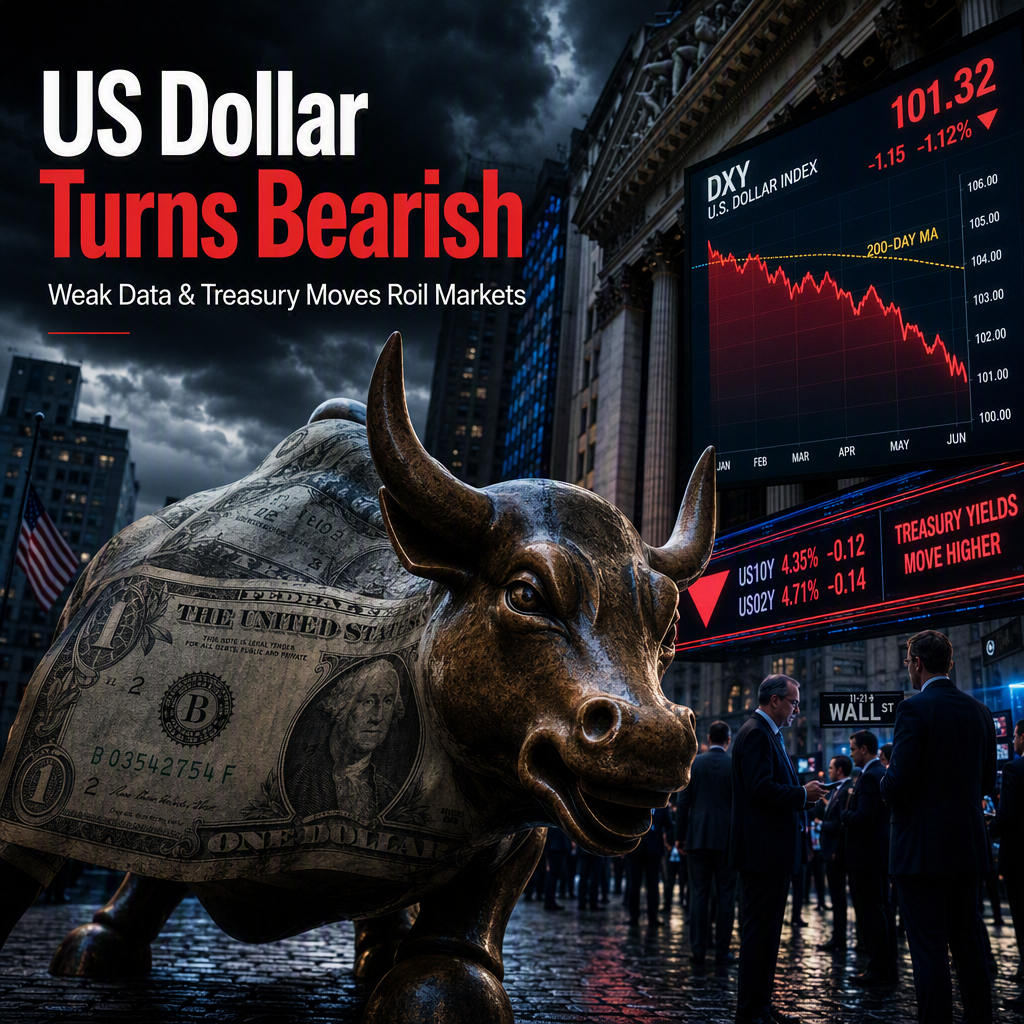
TD Securities strategists report that the US Dollar (USD) has shifted into a bearish regime following the Treasury buyback announcement on August 19, which pushed the US Dollar Index (DXY) below its 200-day simple moving average (SMA) [1]. The strategists attribute this bearish momentum to several factors, including recent weaker US economic data, rising risks to US institutional credibility, and concerns about financial repression, as well as potential communication risks at the upcoming Jackson Hole event [1].
According to TD Securities, the USD's bearish turn was nearly triggered after benign US data releases in July, but the Treasury buyback announcement cemented the prevailing momentum [1]. The strategists note that recent US data releases have reversed all upside surprises from the second quarter, and US data is now underperforming relative to the rest of the world (RoW) [1]. This has led to a gradual pricing out of near-term Federal Reserve rate hike expectations, with further room for these expectations to decline unless US data strengthens again [1].
Market positioning has also shifted, with USD positions flipping from long to short and potential for further growth in short positions [1]. Broad USD downtrends remain intact, except in select currency pairs such as USD/CAD [1]. Additionally, front-end risk reversals are broadly moving toward USD puts versus G10 currencies, and rising implied volatility suggests investors are actively pursuing the USD lower [1].
CONCLUSION
The US Dollar has entered a bearish regime, driven by weak US data, the Treasury buyback announcement, and declining Fed rate hike expectations. Market positioning and risk reversals indicate investors are increasingly bearish on the USD, with broad downtrends expected to persist unless US data improves. The market takeaway is a high-impact shift toward USD weakness in the near term.