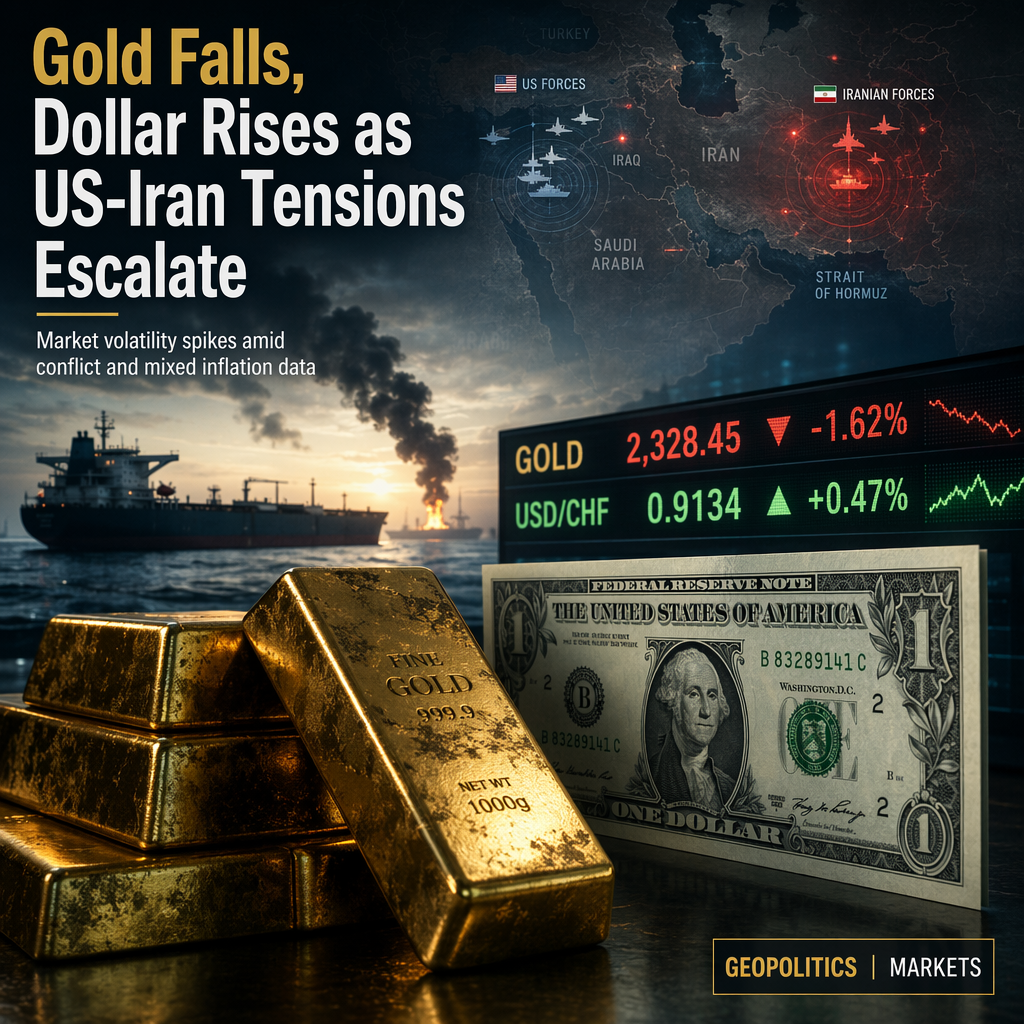
Gold (XAU/USD) declined during the Asian session on Thursday, approaching the previous day's swing low near $4,025, as traders responded to escalating US-Iran tensions and persistent inflation risks. Despite softer US inflation data—specifically, a 0.3% monthly drop in the US Producer Price Index (PPI) for June and a deceleration in the annual rate from 6% in May to 5.5% in June—elevated crude oil prices kept the possibility of a US Federal Reserve (Fed) rate hike later this year alive, supporting the US Dollar (USD) and pressuring gold prices downward [1][2].
The US Bureau of Labor Statistics reported the steepest month-on-month decline in the US Consumer Price Index (CPI) since April 2020, with June's CPI falling to 3.5% from May's three-year high of 4.2%, below the market expectation of 3.8% [1][2]. This initially led traders to scale back expectations for an imminent Fed rate hike, with the CME FedWatch Tool showing the implied probability for a September hike dropping to around 44% from 50% the previous day [2]. However, the ongoing military escalation between the US and Iran—marked by US airstrikes on Iranian targets and retaliatory drone and missile attacks by Iran—has revived inflationary fears, particularly due to the risk of energy supply disruptions in the Strait of Hormuz and potentially the Bab el-Mandeb Strait [1][2].
US President Donald Trump warned that critical Iranian infrastructure could be targeted if hostilities continue, while Iran's Islamic Revolutionary Guard Corps threatened to expand the conflict to additional regional energy supply routes [1]. The US Central Command (CENTCOM) confirmed missile strikes on an oil tanker in the Strait of Hormuz, further heightening market anxiety [2]. These developments have kept crude oil prices near a one-month high, reinforcing inflation concerns and supporting the case for at least one 25-basis-point Fed rate hike in 2026, according to market commentary [1].
In currency markets, the USD/CHF pair traded around 0.8060 during Asian hours, with the US Dollar recovering losses amid rising risk aversion linked to Middle East tensions [2]. The Swiss Franc (CHF) held losses as the Swiss National Bank (SNB) maintained its policy rate at 0% and reiterated its readiness to intervene in foreign exchange markets to prevent excessive franc appreciation and imported inflation [2]. Despite the safe-haven demand for CHF, the pair faced downside pressure due to ongoing inflation fears and oil supply disruptions [2].
Technical analysis for gold suggests a bearish near-term bias below the 200-day Simple Moving Average, with momentum indicators hinting at only tentative stabilization. A sustained break below the $4,000 psychological mark could expose year-to-date lows around $3,943-$3,942 [1].
CONCLUSION
Escalating US-Iran tensions and persistent energy-driven inflation risks have pressured gold prices and supported the US Dollar, despite softer US inflation data. Market participants remain cautious, with expectations for a Fed rate hike later this year still in play due to geopolitical uncertainties and elevated oil prices. The situation continues to drive volatility in both gold and currency markets, with further developments likely to influence future policy expectations.