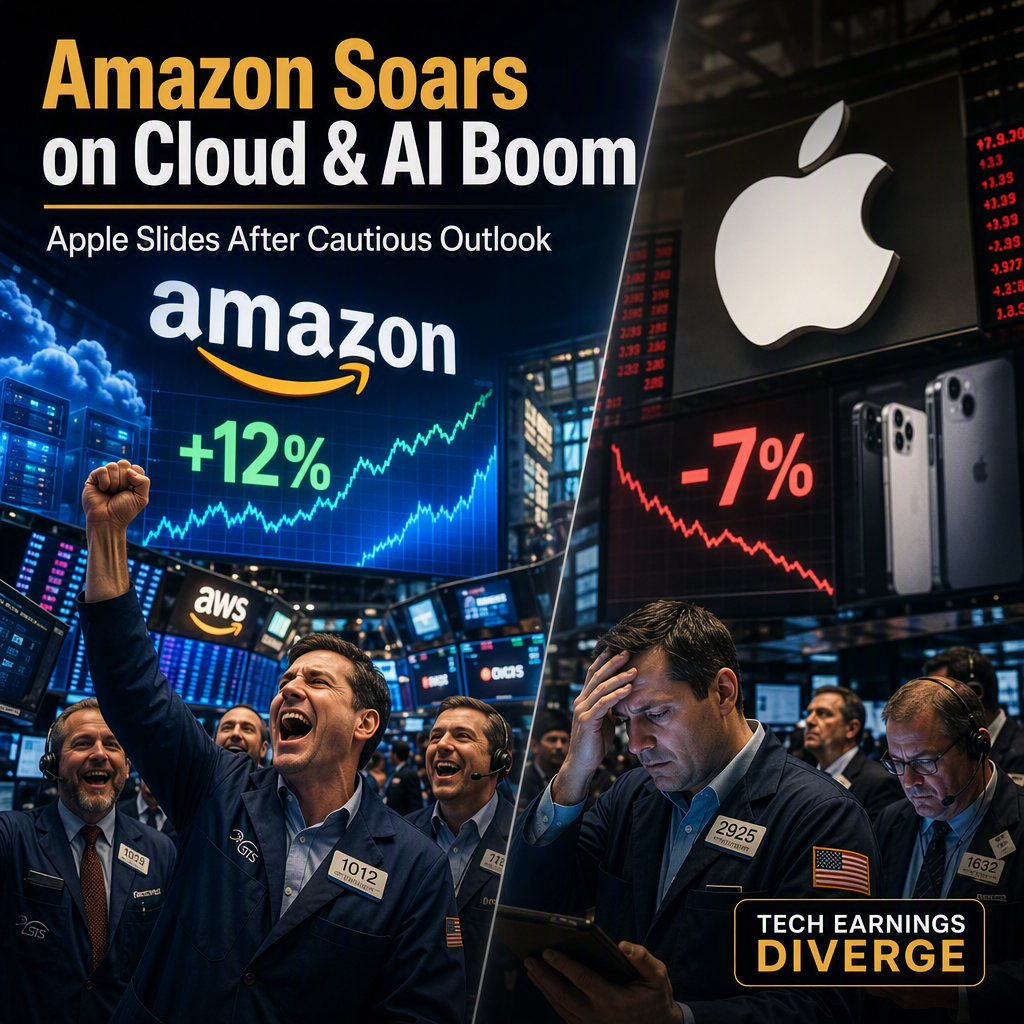
Amazon and Apple reported their June quarter earnings on Thursday, resulting in sharply divergent stock price movements. Amazon shares surged 12% in premarket trading, while Apple fell 7% following the announcements. At Thursday's close, Amazon was nearly 4% higher, and Apple was down by more than 1% [1].
Apple's earnings, revenue, and iPhone sales all exceeded market expectations. However, the company issued weak guidance for the current quarter, forecasting revenue growth between 9% and 11%, which missed analysts' expectations for 12% growth according to LSEG. Apple cited supply constraints, including a significant shortage of memory and competition for chip manufacturing capacity, as reasons for the subdued outlook. These challenges have led Apple to raise prices on the Mac and iPad, with analysts anticipating an iPhone price increase later this year [1].
Amazon impressed investors with a 37% year-on-year revenue jump in its cloud computing business, Amazon Web Services (AWS), marking the strongest expansion since 2021. AWS is closely watched as it books most of Amazon's AI-related sales, and its robust growth signals strong demand for AI products. Despite forecasting capital expenditures to reach $220 billion this year, up from a prior forecast of $200 billion, Amazon's cloud growth appeared to justify the increased spending. Tracy Woo, principal analyst at Forrester, noted that AWS's strong growth "is a clear indicator that its infrastructure investments are meeting market demand rather than outpacing it" [1].
Year-to-date, Amazon's stock has been up around 4%, while Apple has risen 23%. Apple is viewed as an alternative to tech companies investing heavily in AI infrastructure, as it has not embarked on a major capex expansion. The earnings season has seen investors picking their AI winners, with Meta sinking 8% and Microsoft rallying 15% on Thursday, reflecting differing views on AI strategies among tech giants [1].
CONCLUSION
Amazon's strong cloud and AI-driven growth has reassured investors, resulting in a significant share price surge despite increased capital expenditures. In contrast, Apple's weaker guidance and supply constraints led to a notable stock decline. The market is clearly differentiating between tech companies based on their AI strategies and investment outlooks.