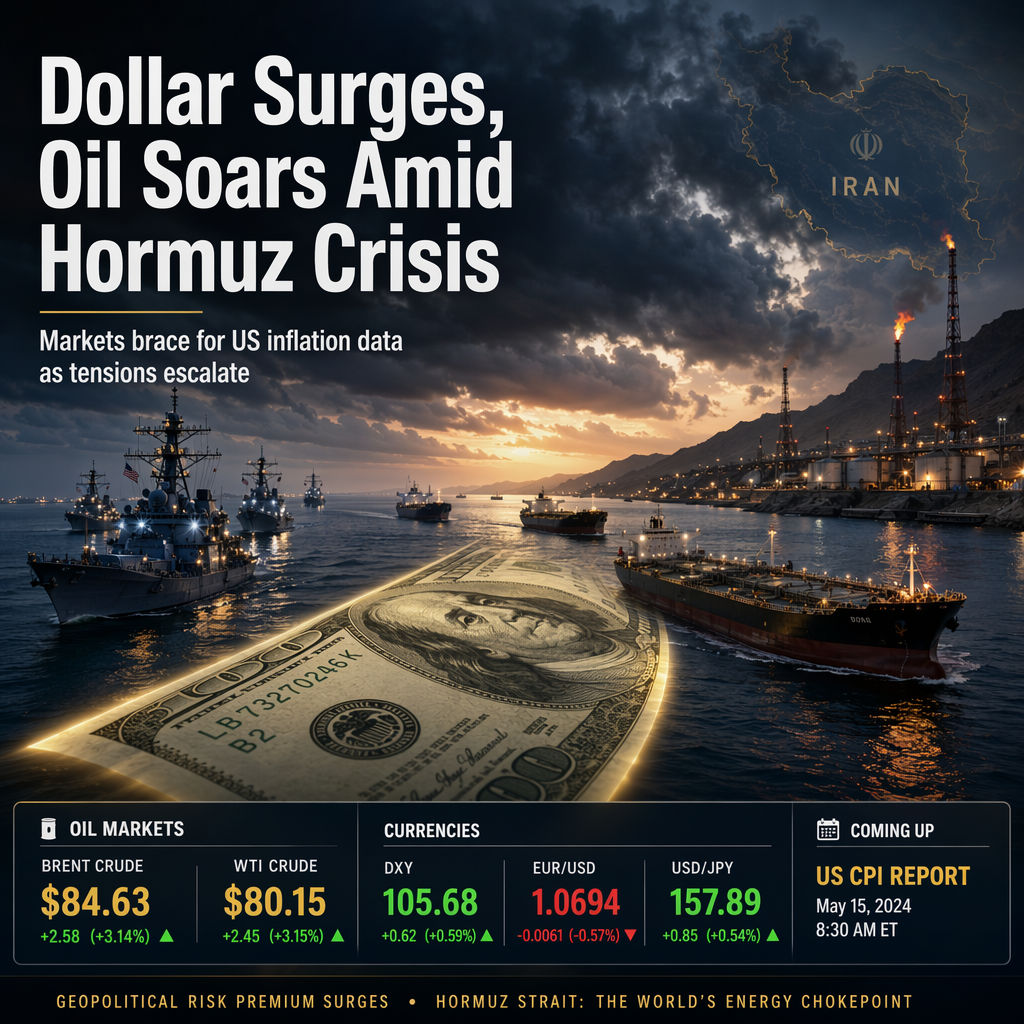
The US Dollar Index (DXY) surged toward 101.30, gaining approximately 0.3% on the day, as escalating tensions between the United States and Iran fueled safe-haven demand and pushed energy prices sharply higher [1]. US President Donald Trump asserted that the Strait of Hormuz would remain open 'with or without Iran,' declared the US the 'Guardian of the Hormuz Strait,' and announced a blockade targeting Iranian ships and customers. In response, Iran rejected Washington’s involvement and warned that any unauthorized US attempt to transit the Strait would face strong resistance, further stating that cooperation between regional countries and the US could be considered an act of war [1].
The heightened geopolitical risk sent Oil prices to a one-month high, which, according to the article, could complicate the Eurozone’s inflation and growth outlook due to the region’s reliance on imported energy [1]. In currency markets, the US Dollar was the strongest against the Swiss Franc, gaining 0.69%, and also posted notable gains against the Euro (0.28%), British Pound (0.35%), Japanese Yen (0.45%), Canadian Dollar (0.03%), Australian Dollar (0.53%), and New Zealand Dollar (0.20%) [1].
EUR/USD fell toward 1.1380, losing 0.3% as broad US Dollar strength outweighed support for the Euro. GBP/USD also declined near 1.3350, down around 0.35% [1]. The article notes that higher Oil prices could further complicate the Eurozone’s inflation and growth outlook [1].
Looking ahead, market participants are focused on the upcoming US Consumer Price Index (CPI) report. Headline inflation is expected to ease to 3.8% year-over-year in June from 4.2%, with the monthly reading forecast to decline 0.1% after rising 0.5%. Core CPI is projected to remain unchanged at 2.9% year-over-year and 0.2% month-over-month [1]. Federal Reserve Chair Kevin Warsh is scheduled to testify later in the session, followed by several other Fed officials, and European Central Bank President Christine Lagarde is also set to speak [1].
CONCLUSION
Escalating US-Iran tensions have driven the US Dollar and Oil prices higher, with significant impacts on currency markets and potential implications for Eurozone inflation. Investors are now turning their attention to key US inflation data and central bank commentary for further market direction.