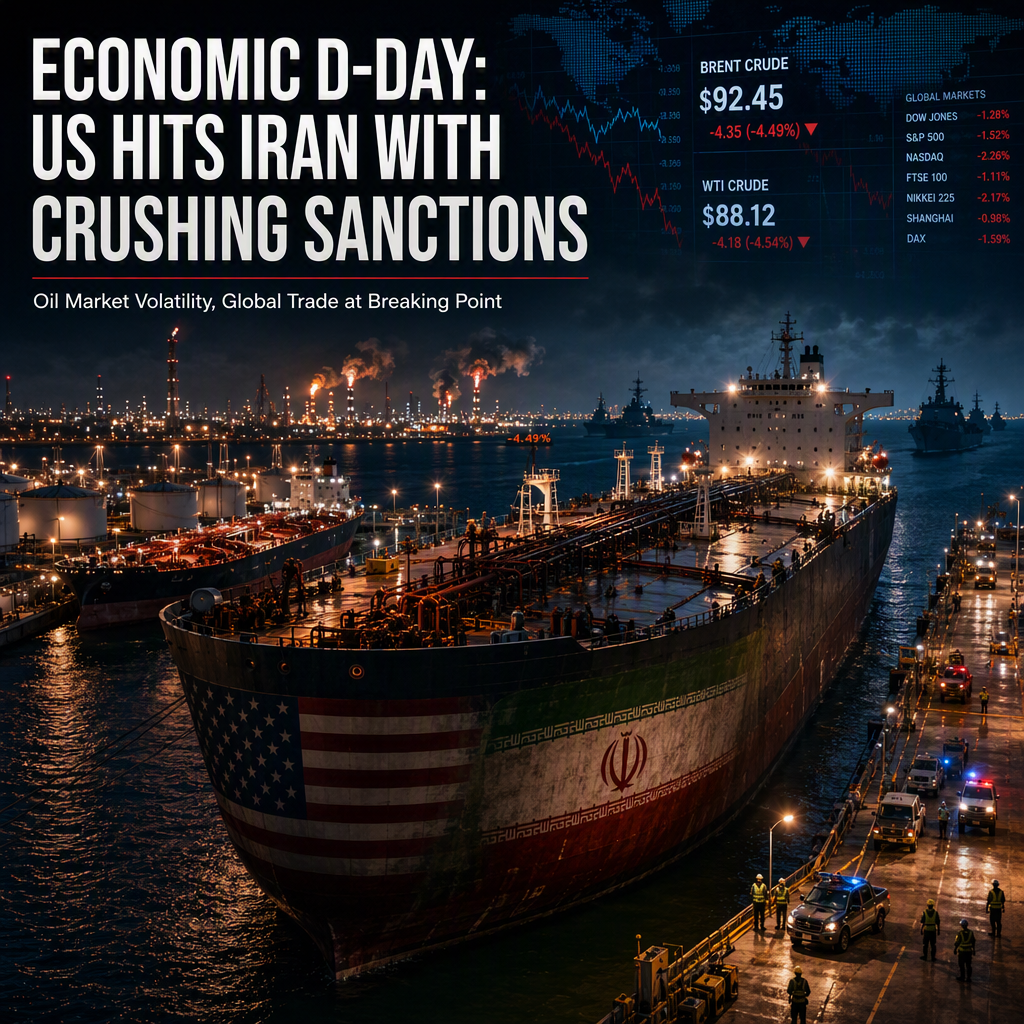
The Trump administration is preparing to implement a sweeping new round of economic sanctions on Iran, described by Treasury Secretary Scott Bessent as an 'economic D-Day' and 'the single greatest financial offensive ever marshalled against an adversary' [2][3]. These measures aim to further isolate Iran by targeting remaining commercial and financial links, including countries and entities involved in purchasing and transporting Iranian petroleum, moving money through exchange houses and free-trade zones, maintaining ship registries, and facilitating other financial activity [2]. President Donald Trump has characterized the campaign as the 'MOST CRUSHING ECONOMIC OPERATION EVER TAKEN AGAINST ANY COUNTRY,' warning that any nation providing Iran with an economic 'lifeline' could face U.S. economic consequences [2].
Iran has responded with threats of retaliation, with Mohsen Rezaei, secretary of Iran’s Supreme National Security Council, warning that if the economic pressure continues, 'not a single drop of oil will be exported, neither through the Strait of Hormuz nor from anywhere in the Persian Gulf.' Rezaei further stated that Iran would consider any country's participation in the U.S. economic campaign as an act of war [2]. This escalation has heightened concerns among governments and companies with financial, shipping, and energy ties to Iran, forcing them to weigh the risks of maintaining economic relations with Tehran versus facing U.S. sanctions [2].
Market analysts anticipate that the new sanctions could significantly restrict Iran's access to international markets and financial systems, leading to increased volatility in regional energy markets, especially crude oil prices [1][3]. Brent crude support levels are noted near $82 per barrel with resistance at $86, while WTI support is at $78 with resistance at $81, according to technical indicators cited in the sources [1]. NBC News reports that key resistance for crude oil futures stands near $80 per barrel, with support around $72, and analysts forecast immediate price spikes at the pump if Iranian oil is restricted from the global market [3]. Technical analysts also advise monitoring the RSI on energy sector stocks, which have approached overbought territory, suggesting caution as volatility may increase following the sanctions announcement [3].
The broader market implications extend beyond energy. The ongoing U.S.-Canada trade war is also contributing to market uncertainty, with Canadian officials vowing to retaliate against U.S. tariffs and U.S. manufacturers reporting increased costs due to tariffs on Canadian steel and aluminum [3]. Christine Romans, NBC's chief business correspondent, warned that consumers should prepare for higher prices not just at the gas pump, but throughout the supply chain, as the combined impact of Iran sanctions and the U.S.-Canada trade dispute could drive inflationary pressures in the American economy [3].
Investors and traders are advised to closely monitor official announcements, OPEC reactions, and technical levels in oil and gas markets, as well as to adjust risk management strategies in light of heightened geopolitical tensions and potential retaliatory actions from Iran [1][3].
CONCLUSION
The Trump administration's 'economic D-Day' sanctions on Iran mark a significant escalation in U.S. economic pressure, with immediate and potentially far-reaching effects on global oil markets and trade. Market participants are bracing for increased volatility, higher energy prices, and broader inflationary pressures, while governments and companies with ties to Iran face difficult decisions amid threats of retaliation. The coming days will be critical as markets react to both the sanctions and ongoing trade disputes.