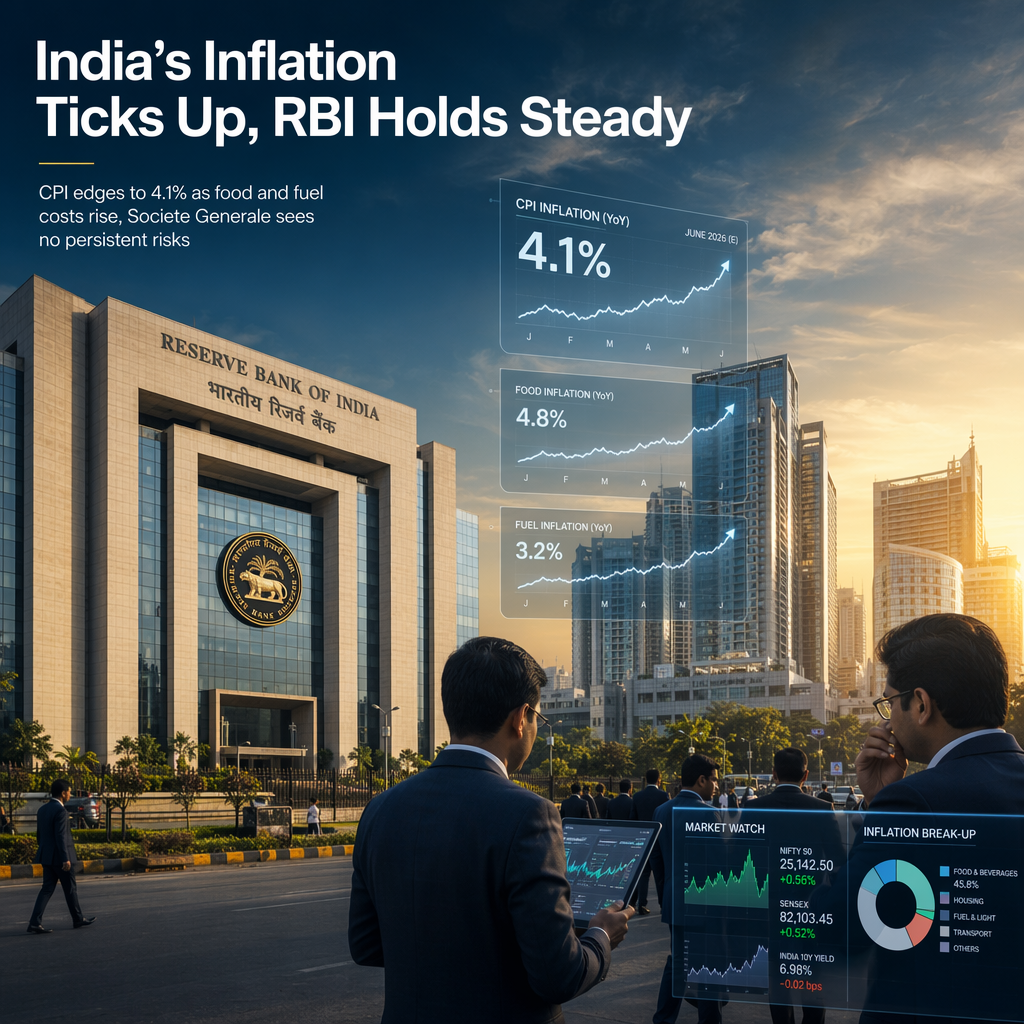
Societe Generale strategist Kunal Kundu projects that India's headline Consumer Price Index (CPI) inflation for June 2026 will register at approximately 4.1% year-on-year, a slight increase from May's 3.9% but still comfortably within the Reserve Bank of India's (RBI) inflation tolerance band [1]. The anticipated uptick is attributed primarily to gradual firming in food, fuel, and select services categories, rather than broad-based inflationary pressures [1].
Kundu notes that the divergence between wholesale and consumer prices has grown following a sharp rise in global commodity and energy costs. However, the pass-through from wholesale prices to retail inflation is expected to be partial and delayed, mitigating the risk of a rapid surge in consumer prices [1]. The strategist emphasizes that competitive market conditions, policy buffers, and moderate domestic demand should prevent a sustained acceleration in inflation [1].
The report highlights that the current environment is characterized by margin pressures within the production chain, as evidenced by the widening gap between the Wholesale Price Index (WPI) and CPI, rather than signaling imminent retail inflation risks [1]. Core CPI may rise incrementally, but it remains consistent with the RBI's inflation target, suggesting no immediate threat of persistent overheating [1].
Given these dynamics, Societe Generale argues that the modest increase in inflation supports the case for continued policy patience from the RBI, with inflation likely to remain modestly above recent lows rather than entering a sustained acceleration phase [1].
CONCLUSION
India's CPI inflation is expected to rise slightly to 4.1% in June 2026, driven by food, fuel, and services, but remains within the RBI's target range. Societe Generale sees no signs of persistent inflationary pressures, supporting a patient policy stance from the central bank. Market participants are likely to interpret these developments as a signal of continued monetary stability.