
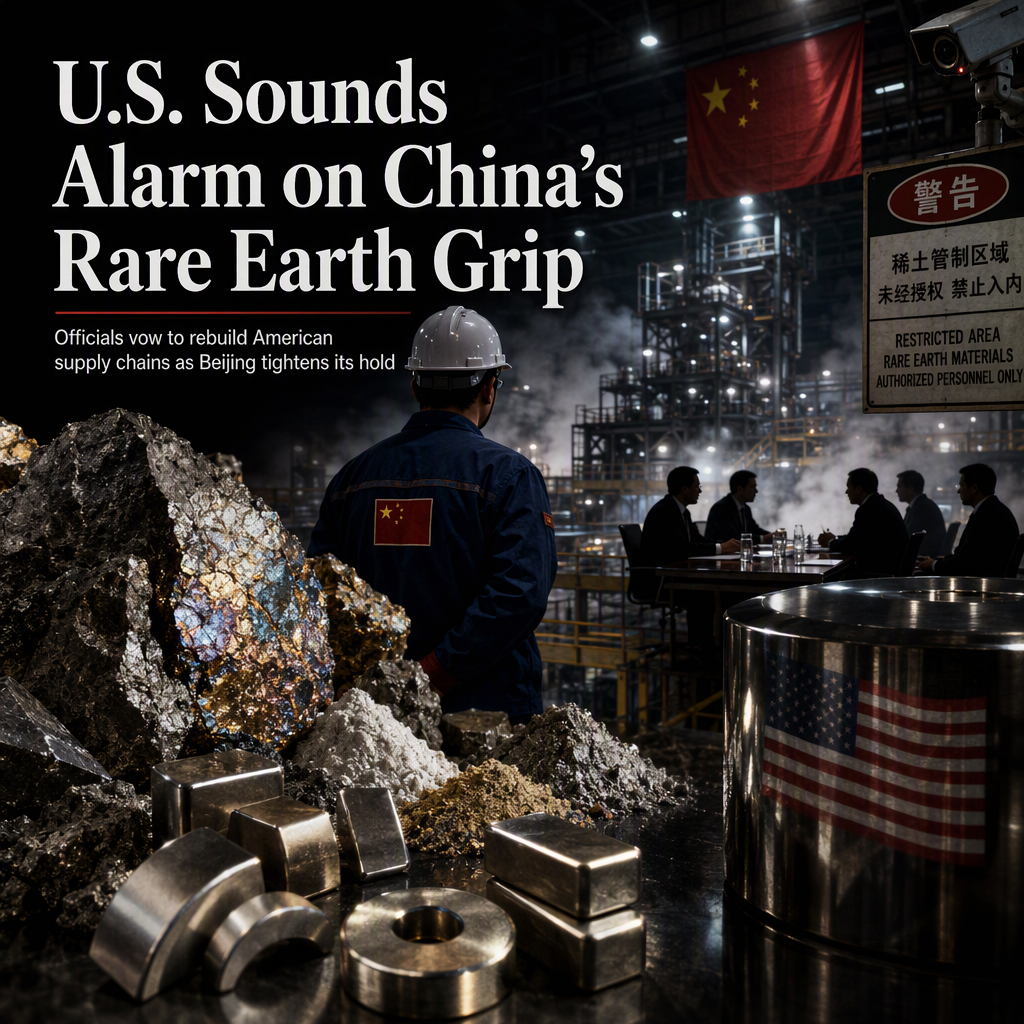
U.S. Ambassador to China David Perdue has issued a warning that China is 'weaponizing' its dominant position in critical minerals, specifically rare earths, by expanding its rules in a way that could expose efforts to diversify supply chains away from China to risks such as arrest, criminal prosecution, and asset seizures [1]. Perdue emphasized that this single-source dominance is being used by China as leverage against the world and stated that the United States has committed to opposing this behavior [1]. He further noted that America's dependence on China for critical materials, including rare earth magnets, commercial shipbuilding, and pharmaceuticals, has developed over the past two decades, and the Trump administration is now seeking to reverse this trend and rebuild U.S. self-sufficiency in these sectors [1].
U.S. Trade Representative Jamieson Greer also expressed concerns regarding China's rare-earth deliveries, stating that the U.S. seeks greater volumes and more timely shipments of these critical materials [1]. Greer mentioned that President Trump has directly raised these issues with President Xi, and the administration is treating the next two months as a 'compliance period' to evaluate whether China fulfills its commitments [1].
Additionally, the U.S.-China Board of Trade recommended that both countries identify $30 billion in nonsensitive goods that could receive more favorable tariff treatment, according to Greer's office [1]. The U.S. Trade Representative's office also indicated that efforts would continue to ensure China complies with its agricultural and energy commitments [1].
No specific market reactions or analyst opinions were provided in the article, but the warnings and policy shifts suggest significant implications for industries reliant on rare earths and other critical materials [1].
CONCLUSION
U.S. officials are taking a firm stance against China's use of its rare earth dominance as leverage, signaling a strategic shift to reduce dependence on Beijing for critical materials. The next two months will be crucial as the U.S. assesses China's compliance with its commitments, with potential impacts on supply chains and trade relations.