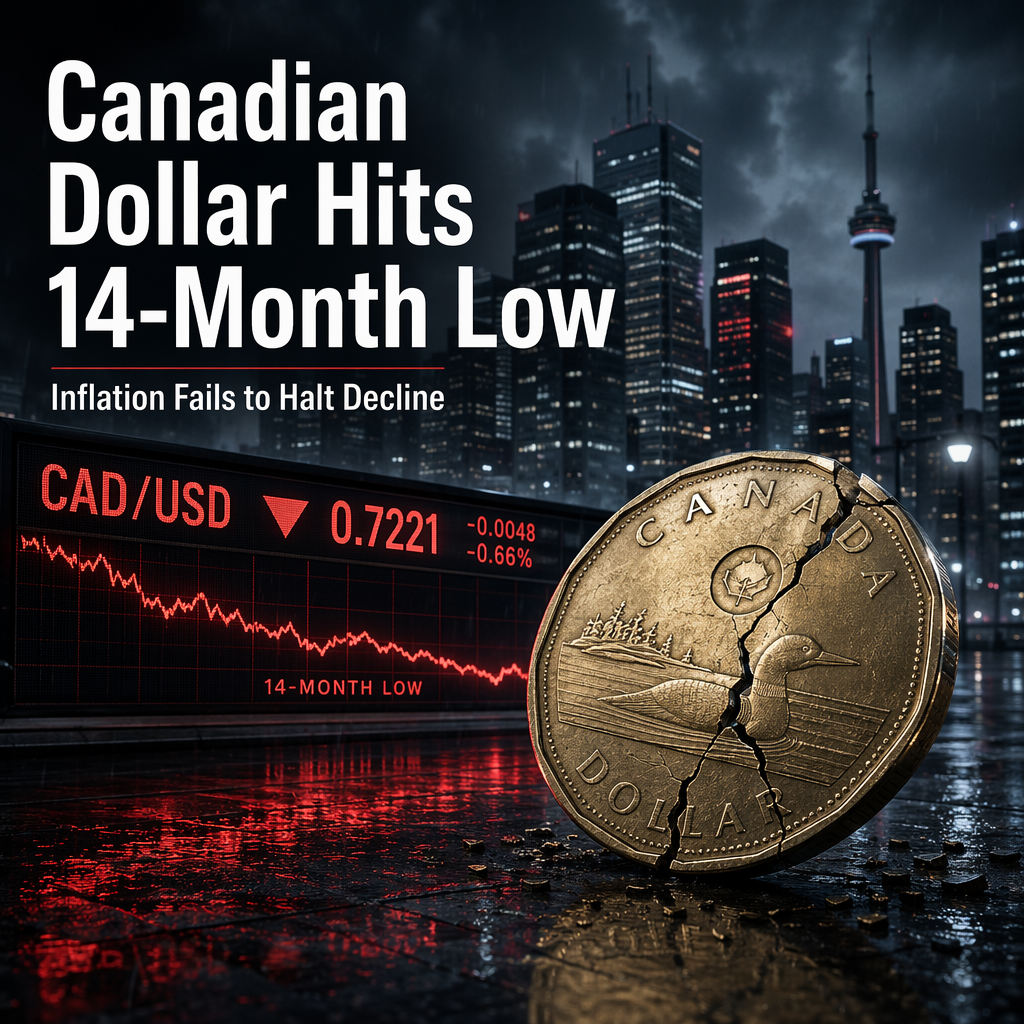
The Canadian Dollar (CAD) has fallen to its lowest level in 14 months, with the USD/CAD currency pair extending its rally and breaking out of a long-term downtrend, according to Societe Generale analysts. They highlight that the November peak at 1.4130-1.4150 now acts as support, with upside targets for USD/CAD stretching toward 1.4285-1.4335. Societe Generale notes that while the move appears stretched, there are currently no clear signals of a meaningful pullback, suggesting further downside risk for the Canadian Dollar [1].
On the macroeconomic front, the Royal Bank of Canada (RBC) reports that Canadian headline inflation accelerated to 3.2% year-over-year in May. However, this increase was primarily driven by volatile components such as energy, airfares, and food costs. RBC emphasizes that core inflation readings remain subdued, indicating that the Bank of Canada is unlikely to respond aggressively to the headline inflation figure. As a result, the Canadian Dollar lacks a clear interest-rate tailwind, even as headline inflation rises [1].
Both Societe Generale and RBC suggest that the outlook for the Canadian Dollar remains weak. Societe Generale's technical analysis points to an ongoing uptrend in USD/CAD, while RBC's inflation analysis underscores that underlying inflation pressures are contained once volatile categories are excluded. This combination of technical and fundamental factors leaves the Canadian Dollar vulnerable to further declines against the US Dollar [1].
CONCLUSION
The Canadian Dollar's decline to 14-month lows is driven by technical weakness and a lack of support from underlying inflation trends. With no clear signals of a reversal and subdued core inflation, the CAD is likely to remain under pressure in the near term.