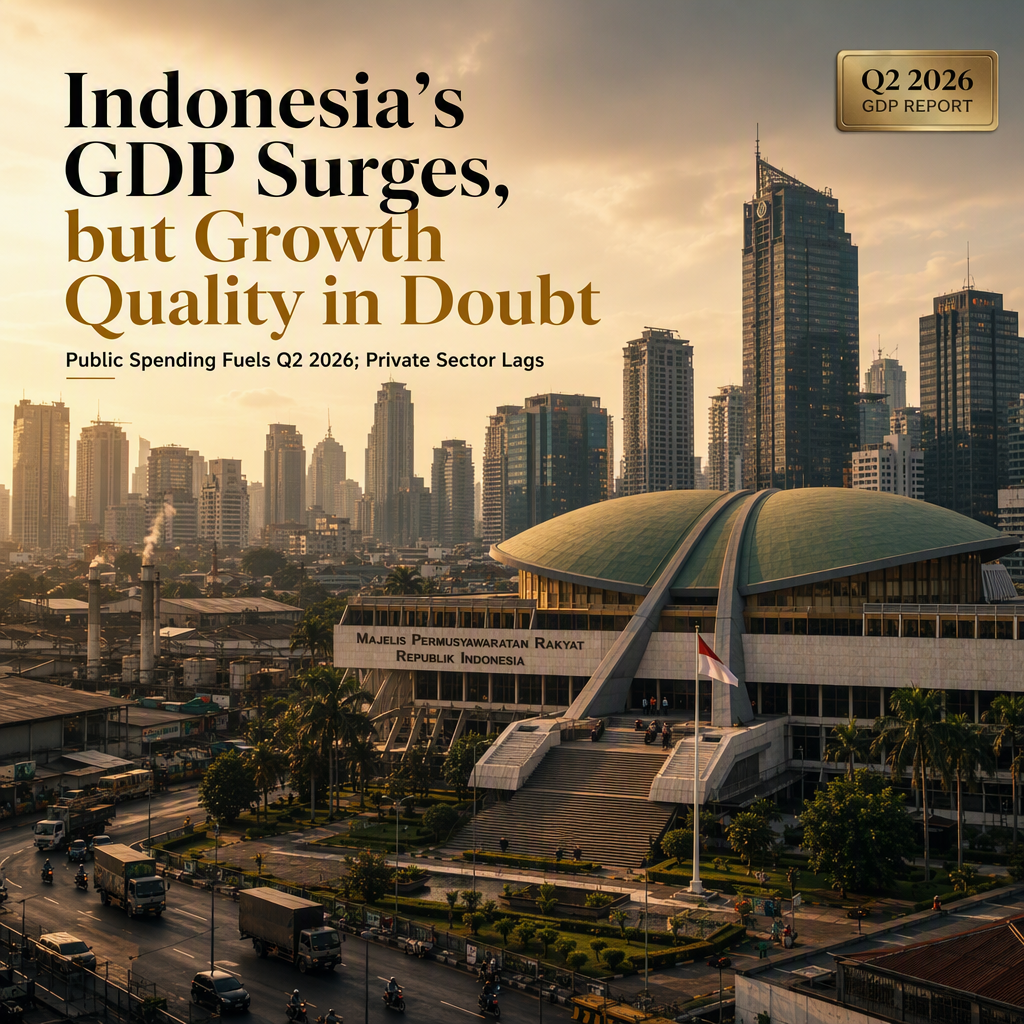
Indonesia's Gross Domestic Product (GDP) for the second quarter of 2026 grew by 5.3% year-on-year, surpassing Societe Generale's forecast of 5.1% [1]. According to Societe Generale economist Kunal Kundu, this stronger-than-expected headline figure was primarily driven by public spending, while non-government GDP, private consumption, and manufacturing remained weak [1]. Investment activity showed improvement; however, this also led to an increase in imports, and a significant statistical discrepancy complicates the assessment of the true quality of Indonesia's growth [1].
Kundu emphasized that the reliance on public spending masks underlying softness in the private sector, stating, 'non-government GDP growth continued to languish, reinforcing the view that underlying economic momentum remains softer than the headline print suggests' [1]. He further noted that growth led by public spending is qualitatively different from growth driven by private demand, which weakens the argument for a strong consumer-led recovery based on the current GDP data [1].
The report concludes that while Indonesia's economy continues to expand, the quality, breadth, and reliability of this growth remain uncertain, raising questions about the sustainability and inclusiveness of the current economic momentum [1].
CONCLUSION
Indonesia's Q2 2026 GDP exceeded expectations, but the growth was largely driven by public spending rather than private sector strength. Analysts caution that the headline figure may overstate the underlying economic momentum, and the sustainability of this growth remains in question.