
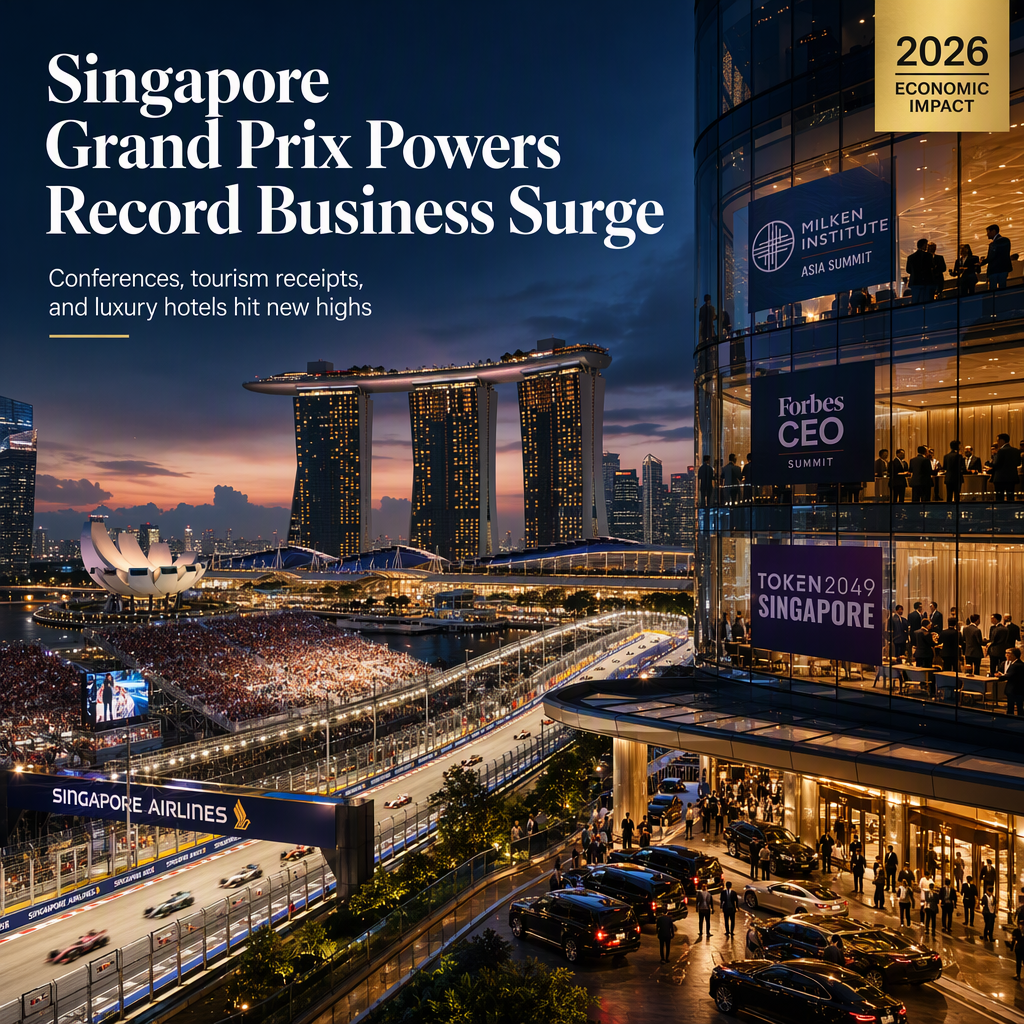
Singapore experienced a significant boom in business events coinciding with the 2026 Formula 1 Grand Prix, with more than 40 business events held around the race period, up from over 25 in 2025 and over 30 in 2024, according to the Singapore Tourism Board (STB) [1]. High-profile conferences such as the Milken Institute Asia Summit, TOKEN2049, the Forbes Global CEO Conference, Solana Summit APAC, and the Global-Asia Family Office Summit attracted billionaires, global CEOs, and crypto executives to the city [1].
The influx of international visitors was notable, with overseas attendees accounting for 85.6% of participants at TOKEN2049 in 2026, up from 82.7% in 2025. Chinese attendees made up 11.8% of participants, nearly double the 6% share from the previous year, surpassing Americans as the largest group [1]. The Singapore GP reported that the 2026 race drew 301,294 spectators, marking the second-highest attendance in the event's history [1].
The economic impact of Formula 1 has been substantial, generating more than S$2.2 billion ($1.72 billion) in incremental tourism receipts between 2008 and 2024, averaging S$150 million annually. The cost to organize the race is approximately S$140 million per year, according to Singapore's Ministry of Energy, Trade and Industry, though this figure is not directly comparable to the revenue generated [1].
Business events are becoming an increasingly important source of tourism revenue. Receipts from meetings, incentives, conventions, and exhibitions (MICE) rose 35% to S$2.3 billion in 2025, outpacing the 10% growth in Singapore's overall tourism receipts, which reached a record S$32.8 billion. The STB noted that MICE visitors typically spend significantly more than leisure travelers [1]. The surge in business travelers also led to near-full occupancy at luxury hotels such as Marina Bay Sands during race week, underscoring the broader economic benefits beyond the race itself [1].
Organizers are leveraging the excitement of Formula 1 to extend delegates' stays, with Poh Chi Chuan, executive director of exhibitions and conferences at STB, stating that the city's vibrant atmosphere during the event period creates a 'natural gravitational pull' for business planners [1].
CONCLUSION
Singapore's strategy of aligning major business events with the Formula 1 Grand Prix has resulted in record tourism receipts, increased international participation, and strong demand for luxury accommodations. The data highlights the growing economic significance of MICE events and the broader impact of high-profile sporting events on the city's economy.