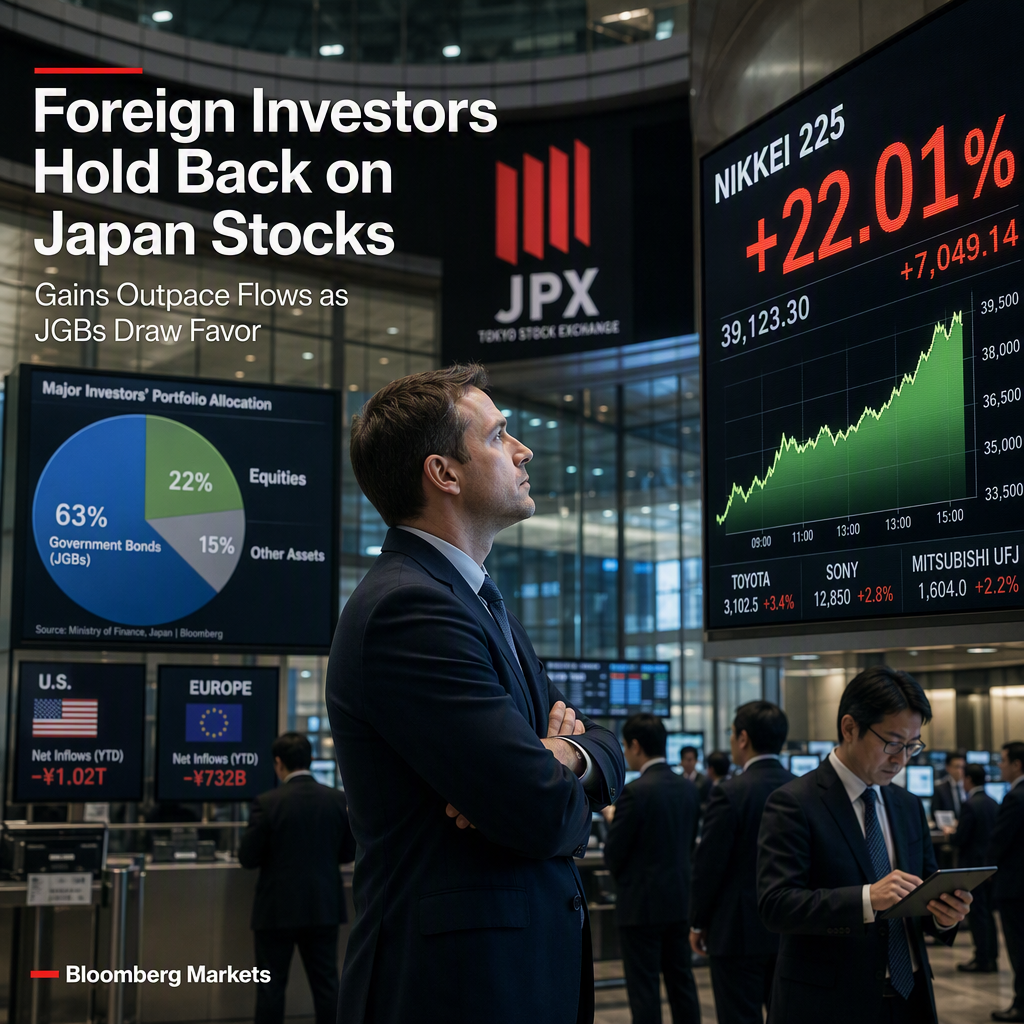
According to BNY's Geoff Yu, foreign demand for Japanese equities remains subdued, even though the MSCI Japan Index delivered a 22% return in JPY terms over 2025 [1]. International investors' holdings in Japanese equities lagged behind benchmarks, with the median gain in holdings by key international investors at 17%, which is below the index's performance [1]. This underperformance is attributed to allocation limits and Japan's relatively minor role in the global semiconductor and memory chip theme compared to markets like Taiwan and South Korea [1].
Yu highlights that while there is emerging interest in Japanese yen (JPY) and Japanese government bonds (JGBs), equities are still considered the weak link in foreign portfolio flows [1]. As of the end of 2025, equities made up 63% of cross-border portfolio investment in Japan, but any rebalancing of foreign portfolios is more likely to favor JGBs rather than equities [1]. The U.S. and Europe collectively account for nearly 90% of all international equity holdings in Japan, totaling approximately ¥320 trillion at the end of 2025 [1].
The report notes that Japanese survey data as of end-2025 do not indicate a surge in foreign inflows into equities [1]. Furthermore, the initial reaction to JPY strength could undermine Japanese equities due to negative earnings translation effects [1]. Structural shifts in hedge ratios, particularly if front-end rates align more closely, are expected to have a greater impact on flows than changes in the earnings outlook [1].
Yu concludes that while the recent correction in Japanese equities could create opportunities if a long-term growth and earnings narrative is established, currency markets should remain realistic about the numbers and not expect a dramatic shift in foreign equity flows in the near term [1].
CONCLUSION
Foreign investor interest in Japanese equities remains limited despite strong index returns, with flows lagging benchmarks and a preference for JGBs over equities. Market participants should not anticipate a significant surge in foreign equity inflows unless a compelling long-term growth story emerges.