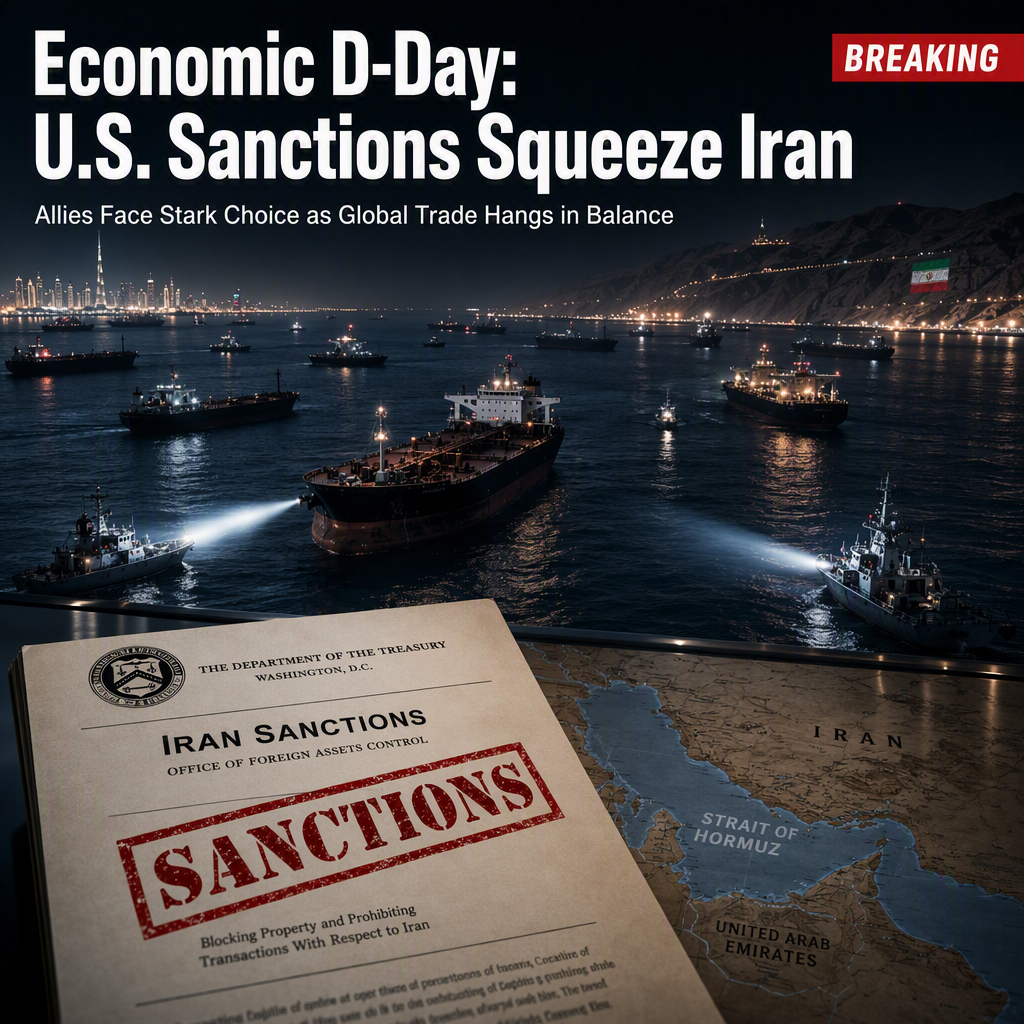
President Donald Trump is moving forward with what he has termed 'Economic D-Day' against Iran, introducing a new round of stringent U.S. sanctions designed to force allies and global businesses to choose between trading with the United States or Iran [1][2]. The Trump administration's approach marks a significant escalation, as it aims not only to target Iranian officials but also to punish foreign countries, banks, refiners, shipping companies, and intermediaries that continue to engage in commerce with Tehran [1]. Treasury Secretary Scott Bessent stated that these measures are intended to create 'the greatest coordinated economic isolation in the history of the world' against Iran, and he emphasized that the U.S. will be telling its allies, 'You are either with us or against us' [2]. Bessent also indicated that the new sanctions are expected to negate the need for further U.S. military action, with a detailed announcement scheduled for Monday [2].
The United Arab Emirates has already responded by suspending trade and financial transactions with Iran, a move described as a major development given Dubai's historical role as a gateway for Iranian trade and finance [1]. President Trump has threatened severe financial penalties on any nation that helps Tehran evade sanctions, reinforcing the administration's intent to enforce unprecedented economic warfare and isolation [2].
Iran has sharply criticized the U.S. sanctions, with Foreign Ministry spokesman Esmaeil Baqaei calling them an assertion of 'extraterritorial sovereignty' over other United Nations member states [2]. Iran's parliament speaker Mohammad Baqer Qalibaf urged Muslim countries to develop a plan to overcome what he described as 'cruel' sanctions [2].
Market implications are significant, as shipping through the Strait of Hormuz—a critical chokepoint for global oil trade—remains at a fraction of previous levels since the U.S. launched its war against Iran on February 28, with only 10 crossings on Monday and two on Sunday, according to Kpler data [2]. However, oil prices were little changed on Friday after Iran's president signaled a desire to end the conflict, though negotiations to reopen the strait have stalled [2].
U.S. Vice President JD Vance described economic pressure as the country's 'most effective tool' against Iran, noting that recent weeks have seen Iran feeling 'a lot more pressure than we have' [2].
CONCLUSION
The Trump administration's new sanctions represent a decisive escalation in economic pressure on Iran, compelling allies to sever commercial ties or risk losing access to U.S. markets. While the immediate market reaction in oil prices has been muted, the ongoing disruption in the Strait of Hormuz and the threat of further penalties signal high stakes for global trade and diplomatic relations.