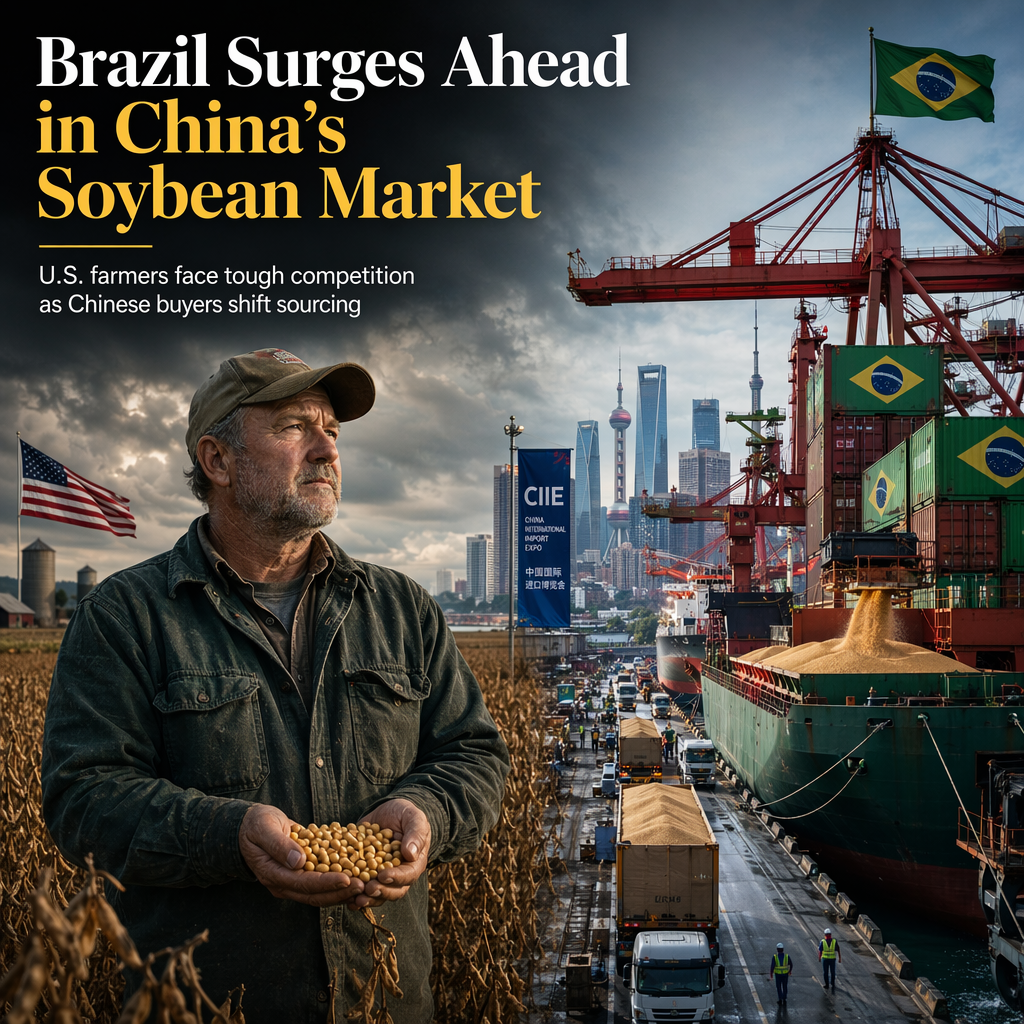
U.S. soybean sales to China, the world's largest soybean importer, have experienced a significant decline amid ongoing trade tensions between the two countries [1]. American advocacy groups are now emphasizing the quality differences between U.S. and Brazilian soybeans in an effort to win back Chinese buyers from their South American rivals [1]. Carlos Salinas, executive director for East Asia at the U.S. Soybean Export Council, highlighted the impact of weather conditions on crop quality, comparing rainfall levels in Brazil and Illinois, which he argued affects the condition and quality of the soybeans [1].
The U.S. Soybean Export Council, in collaboration with the China Council for the Promotion of International Trade, organized a half-day event in Beijing focused on advancing a sustainable and resilient U.S.-China soybean supply chain [1]. Jim Sutter, CEO of the U.S. Soybean Export Council, encouraged Chinese buyers to educate themselves on new ways to measure soybean quality and nutrition, particularly for animal feed [1].
Market data shows a dramatic shift in China's soybean sourcing: while the U.S. and Brazil each accounted for around 40% of China's soybean imports a decade ago, Brazil's share surged to over 60% in the first five months of 2026, while the U.S. share dropped to 23% and Argentina's to 10% [1]. U.S. soybean exports to China plunged 76% last year to $3.1 billion, down from a peak of $17.9 billion in 2022, though soybeans remained the largest American agricultural export to China at 7.37 million metric tons in the last calendar year [1].
Despite these challenges, there are signs of a modest pickup in U.S. soybean sales to China, supported by purchase commitments made by China. Last month, the White House announced that China would buy at least $17 billion of U.S. agricultural goods annually through 2028, in addition to soybean purchase commitments made in October 2025, following a meeting between U.S. President Donald Trump and Chinese President Xi Jinping in Beijing [1]. However, convincing Chinese buyers to significantly increase purchases of U.S. soybeans is expected to take time [1].
CONCLUSION
The U.S. faces significant challenges in regaining its share of the Chinese soybean market, as Brazil continues to dominate imports. While recent purchase commitments and advocacy efforts may support a modest recovery, the market impact remains high and the outlook for a swift rebound is uncertain.