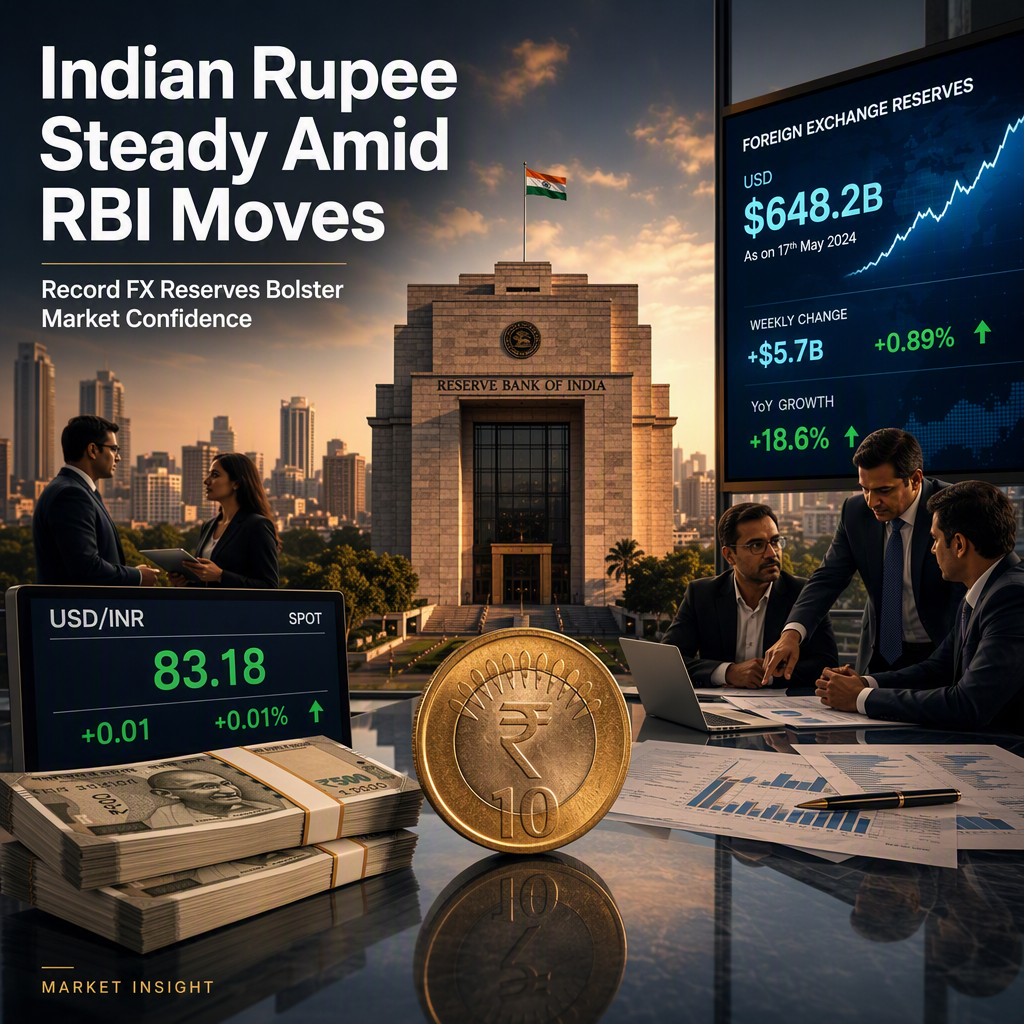
Commerzbank FX analysts Charlie Lay and Moses Lim report that the Indian Rupee (INR) has remained broadly stable against the US Dollar, with the USD/INR pair trading within a 94.00 to 97.00 range since May. This stability is attributed to the Reserve Bank of India's (RBI) decision to keep the policy repo rate unchanged at 5.25% and its ongoing wait-and-see approach to monetary policy [1].
The analysts note that the Indian economy continues to perform well, supported by strong domestic demand and encouraging export growth. While economic growth is expected to moderate, projections indicate a 6.7% expansion for the fiscal year 2026-2027, compared to 8% in the previous fiscal year [1]. Inflation remains stable, with the RBI projecting a 5% rate for the current fiscal year, which falls within the central bank's 2-6% target range. The RBI is expected to maintain the policy repo rate at 5.25% throughout the year [1].
The RBI's efforts to attract foreign capital and stabilize the INR have been described as successful. Notably, the Foreign Currency Non-Resident (Bank) or FCNR(B) deposit scheme will be closed one month ahead of schedule on 31 August. Additionally, India's foreign exchange reserves have risen above USD 700 billion, providing the RBI with increased capacity to manage currency volatility if market pressures re-emerge [1].
Despite these positive developments, the INR remains susceptible to increases in global crude oil and gold prices. The RBI is expected to continue relying on spot and forward FX interventions to smooth volatility should external pressures return [1]. Forecasts suggest a gradual drift lower in USD/INR toward 93.2 by December 2027, underpinned by strong FX reserves and previous USD deposit inflows [1].
CONCLUSION
The Indian Rupee is expected to remain stable in the near term, supported by the RBI's steady policy stance and robust foreign exchange reserves. While the currency remains vulnerable to external commodity price shocks, the RBI's proactive measures and strong balance of payments position provide a buffer against volatility.