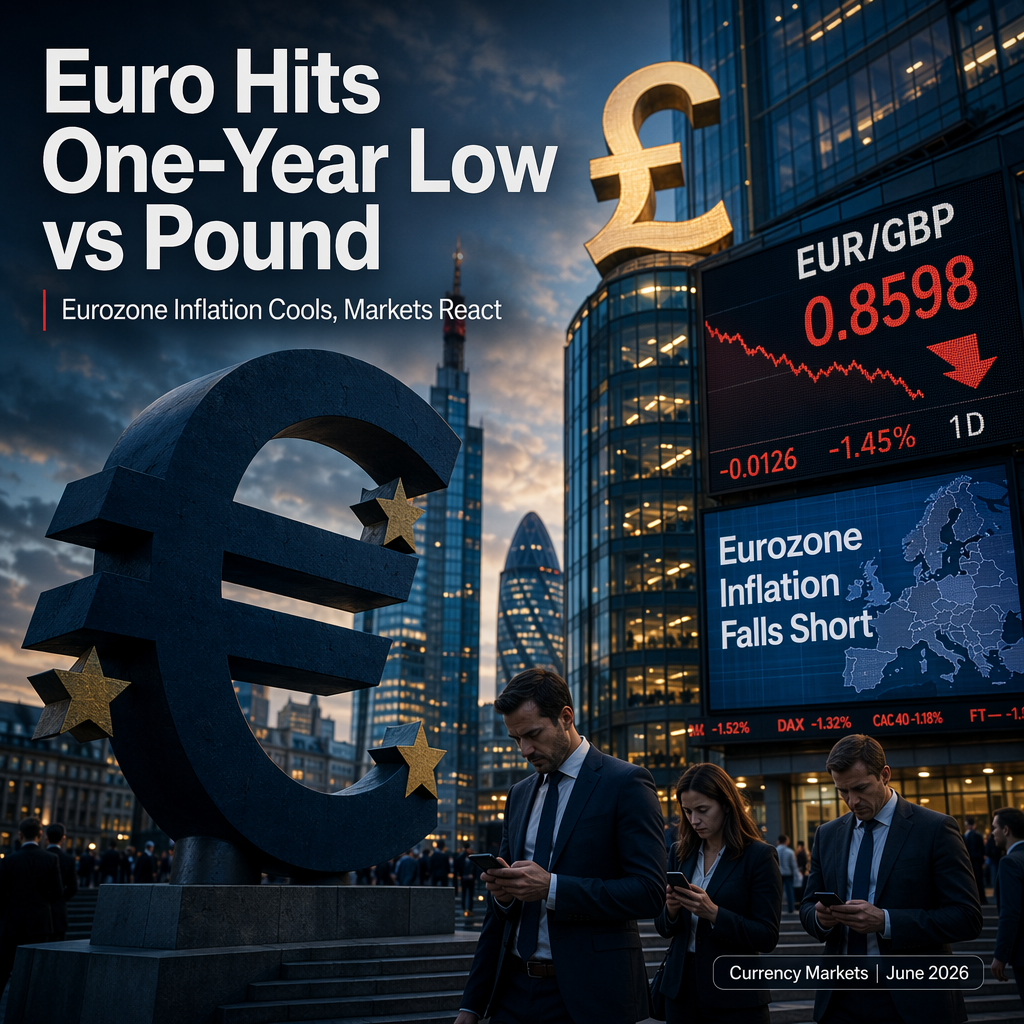
The Euro (EUR) fell to its lowest level against the British Pound (GBP) since July 2025, trading around 0.8598 on Wednesday, following the release of softer-than-expected Eurozone inflation data. The preliminary Harmonized Index of Consumer Prices (HICP) for June rose 2.8% year-on-year, down from 3.2% in May and below the 3.0% forecast. On a monthly basis, HICP declined by 0.1%, compared to a 0.1% increase in the previous month. Core HICP, which excludes volatile items such as food and energy, eased to 2.4% year-on-year in June from 2.6% in May, with a monthly increase of 0.2% versus 0.3% previously [1].
The weaker inflation data has led traders to reduce expectations for another European Central Bank (ECB) interest rate hike this year. Despite this, ECB policymakers remain cautious. Governing Council member Joachim Nagel stated he would 'keep options open for July, September decisions,' warning that inflation 'will stay on a high level this year' and 'will stay above target in 2027.' Fellow Council member Martin Kocher noted that the 'inflation threat is lower, not completely contained,' and that the next policy decision would be 'either hike or hold' [1].
On the UK side, market participants are monitoring political developments after Prime Minister Keir Starmer's resignation last month, with attention on whether frontrunner Andy Burnham would maintain fiscal discipline if he becomes the next prime minister. Additionally, the Bank of England's (BoE) policy outlook is in focus after Governor Andrew Bailey said UK inflation could still rise to 3.2% later this year, adding that 'financial conditions have tightened, giving the BoE time to evaluate whether it needs to raise the Bank Rate' [1].
In terms of currency performance, the Euro was the weakest against the British Pound among major currencies today, reflecting the market's reaction to the inflation data and shifting monetary policy expectations [1].
CONCLUSION
Softer-than-expected Eurozone inflation data has pushed the Euro to a one-year low against the Pound, prompting traders to question the likelihood of further ECB rate hikes this year. While ECB officials remain cautious, the market is clearly reacting to the cooling inflation trend. Political and monetary policy developments in the UK are also being closely watched for their potential impact on the GBP.