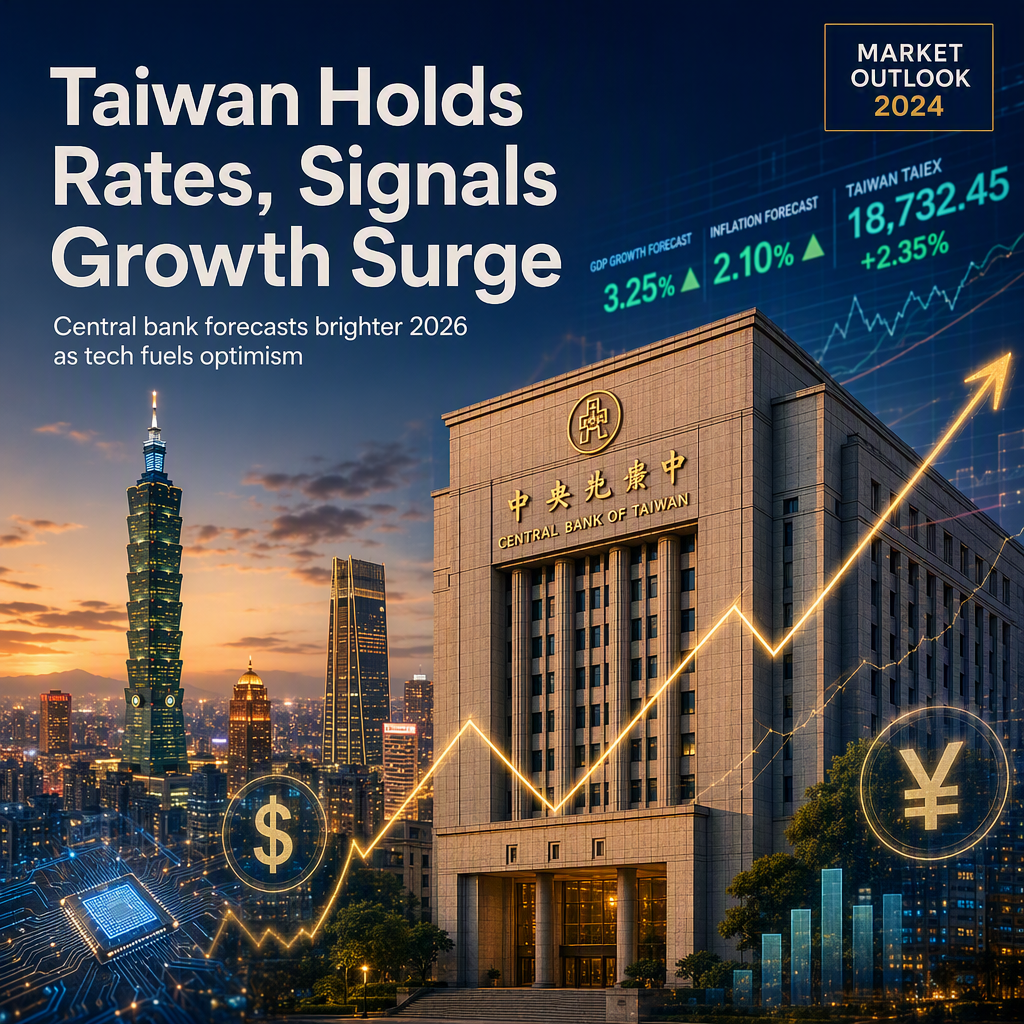
Taiwan's Central Bank (CBC) maintained its policy rate at 2.0% for the tenth consecutive quarter, adopting a mildly hawkish tone while refraining from signaling an imminent rate hike [1][2]. Both OCBC and Commerzbank analysts noted that the CBC sharply raised its 2026 GDP growth forecast, with OCBC citing a new projection of 11.48% and Commerzbank reporting an increase to 11.5% from the previous 9.5% [1][2]. The upward revision is attributed to strong AI-related semiconductor demand and robust investment growth, with the economy expanding 14.2% in the first half of the year [2].
On inflation, the CBC flagged persistent services inflation and slightly raised its 2026 headline inflation forecast to 2.0% from 1.9%, expecting inflation to ease to 1.8% in 2027 [1][2]. Despite these adjustments, the CBC signaled a patient, wait-and-see approach, with Commerzbank suggesting that policy could remain unchanged in December but may start hiking in Q1 2027 if price pressures persist [2].
Market reaction to the CBC's decision was muted, with the Taiwan Dollar (TWD) holding broadly steady despite post-FOMC USD strength. OCBC attributed this stability to a rebound in domestic equities and renewed foreign equity inflows after five consecutive sessions of selling [1]. Analysts emphasized that near-term USD/TWD direction will be more influenced by foreign equity flows, tech sentiment, and broader USD movements than by CBC policy itself [1]. Technical analysis from OCBC indicated bullish momentum for TWD, though some consolidation or pullback is possible if broader risk sentiment remains stable [1].
No direct market implications or analyst opinions were provided regarding the South Korean Won (KRW) in relation to the CBC's decision, as Source 3 focused exclusively on KRW and Korean equity flows [3].
CONCLUSION
The CBC's decision to hold rates while raising growth and inflation forecasts signals cautious optimism, with policy remaining on hold for now. Market participants are expected to focus on foreign equity flows and tech sentiment for near-term TWD direction. The central bank's mildly hawkish stance provides some policy support, but external factors will likely drive currency movements in the immediate future.