
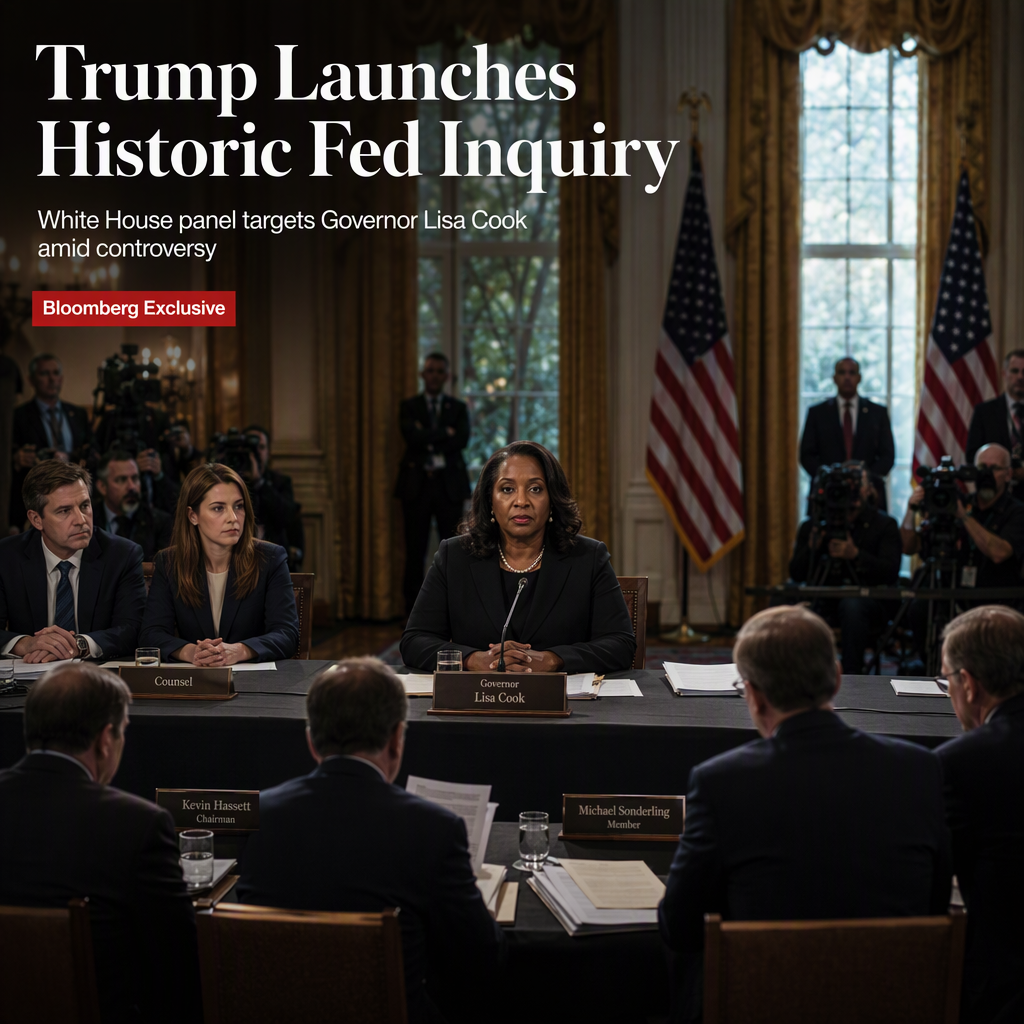
President Donald Trump has established a 'committee of inquiry' to investigate allegations that Federal Reserve Governor Lisa Cook made false statements related to mortgages, according to the White House [1]. This committee, comprised of three executive branch officials—all appointed by Trump—includes Kevin Hassett, Trump's top economic aide, Keith Sonderling, acting head of the Office of Government Ethics, and Equal Employment Opportunity Commission Chair Andrea Lucas [1]. The committee's formation follows the Supreme Court's decision to block Trump's initial attempt to fire Cook, who was nominated by former President Joe Biden [1].
The move is highly unusual, with no modern precedent for such a committee investigating a sitting Federal Reserve governor. The last similar panels were convened by President William Taft in 1912 and President Herbert Hoover in 1931, as cited by the Supreme Court in its June ruling [1]. The committee and Cook are scheduled for an in-person hearing at the White House on November 5, two days after the midterm election. The committee is authorized to consult with the Department of Justice and other agencies during its inquiry [1].
The announcement has sparked controversy, with Congressional Democrats criticizing the decision and Cook's lawyers questioning the legitimacy of the panel. Attorneys Abbe Lowell and Norm Eisen stated that while Cook welcomes the opportunity to clear her name, they have 'grave doubts' about the hearing's objectivity, citing President Trump's repeated statements about his intent to fire Cook regardless of the facts [1]. They asserted that if the process is objective, it will show that Governor Cook did not commit mortgage fraud and there is no cause for her removal from the Federal Reserve Board [1].
This development is expected to fuel further accusations that Trump is undermining the Federal Reserve's independence and using government power against political opponents. The outcome of the inquiry could have significant implications for the Fed's governance and perceived autonomy [1].
CONCLUSION
President Trump's unprecedented move to investigate and potentially remove Fed Governor Lisa Cook has raised concerns about the independence of the Federal Reserve and the legitimacy of the inquiry process. The scheduled hearing and its outcome could have far-reaching effects on the Fed's governance and the broader perception of political influence over central banking.