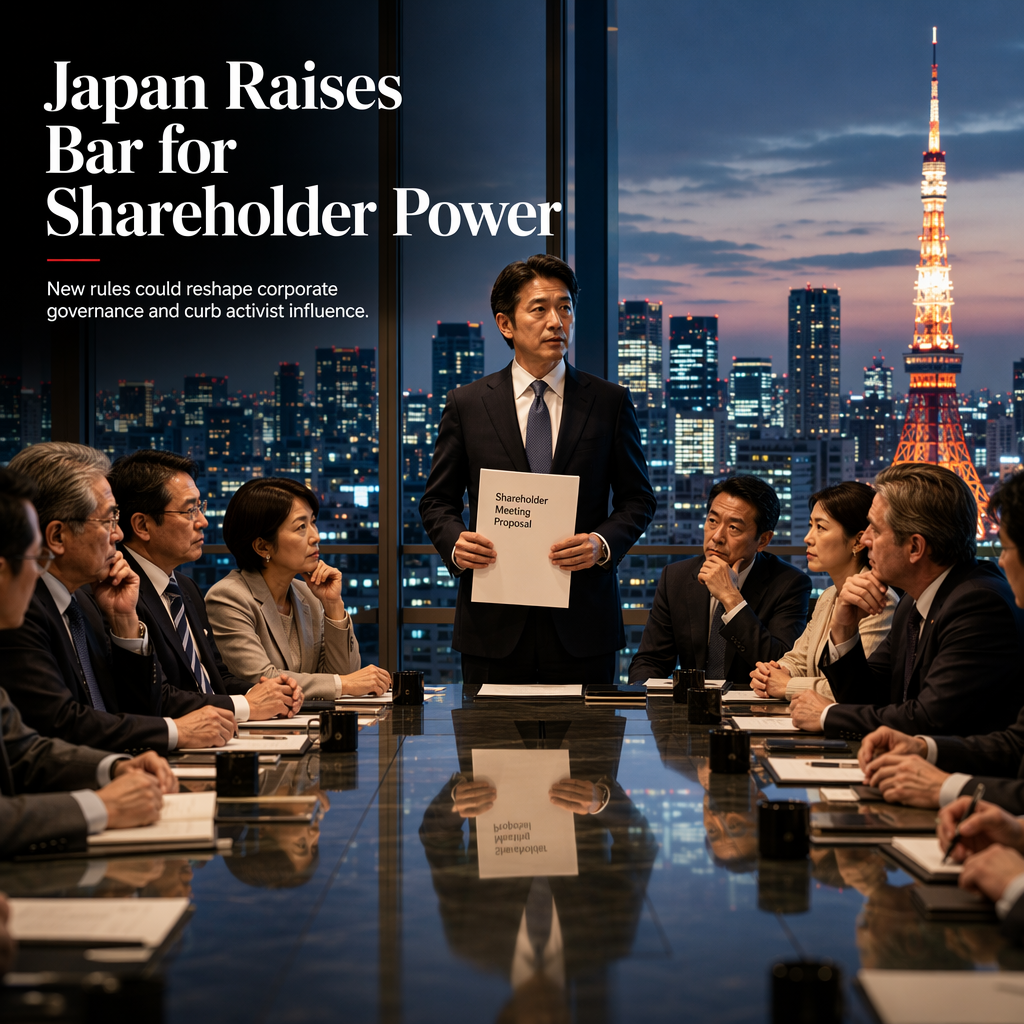
Japan's government and the ruling Liberal Democratic Party are considering a proposal to raise the minimum ownership stake required for shareholders to request extraordinary meetings at Japanese listed companies [1]. The proposed change would set the threshold at 5% of voting rights, which is higher than the current requirement. This adjustment is aimed at curbing the frequency of special meetings initiated by activist investors, who have become increasingly active in Japan's equity markets [1]. Activist investors often use these meetings to push for corporate reforms, higher returns, or changes in management [1].
The government intends for the new threshold to reduce what it sees as excessive or disruptive interventions by activist shareholders, while still maintaining a balance between shareholder rights and corporate governance [1]. If implemented, the proposal could significantly impact the landscape of shareholder activism and corporate governance in Japan, potentially making it more difficult for smaller activist groups to influence company decisions through extraordinary meetings [1].
No specific dates for implementation or further details on the legislative process were provided in the article [1]. There were also no explicit market reactions or analyst opinions mentioned regarding the proposal [1].
CONCLUSION
Japan's plan to raise the threshold for calling special shareholder meetings is likely to reduce the influence of activist investors and reshape corporate governance dynamics. The move aims to balance shareholder rights with the need to prevent disruptive interventions. Market participants should monitor further developments, as the proposal could have notable implications for shareholder activism in Japan.