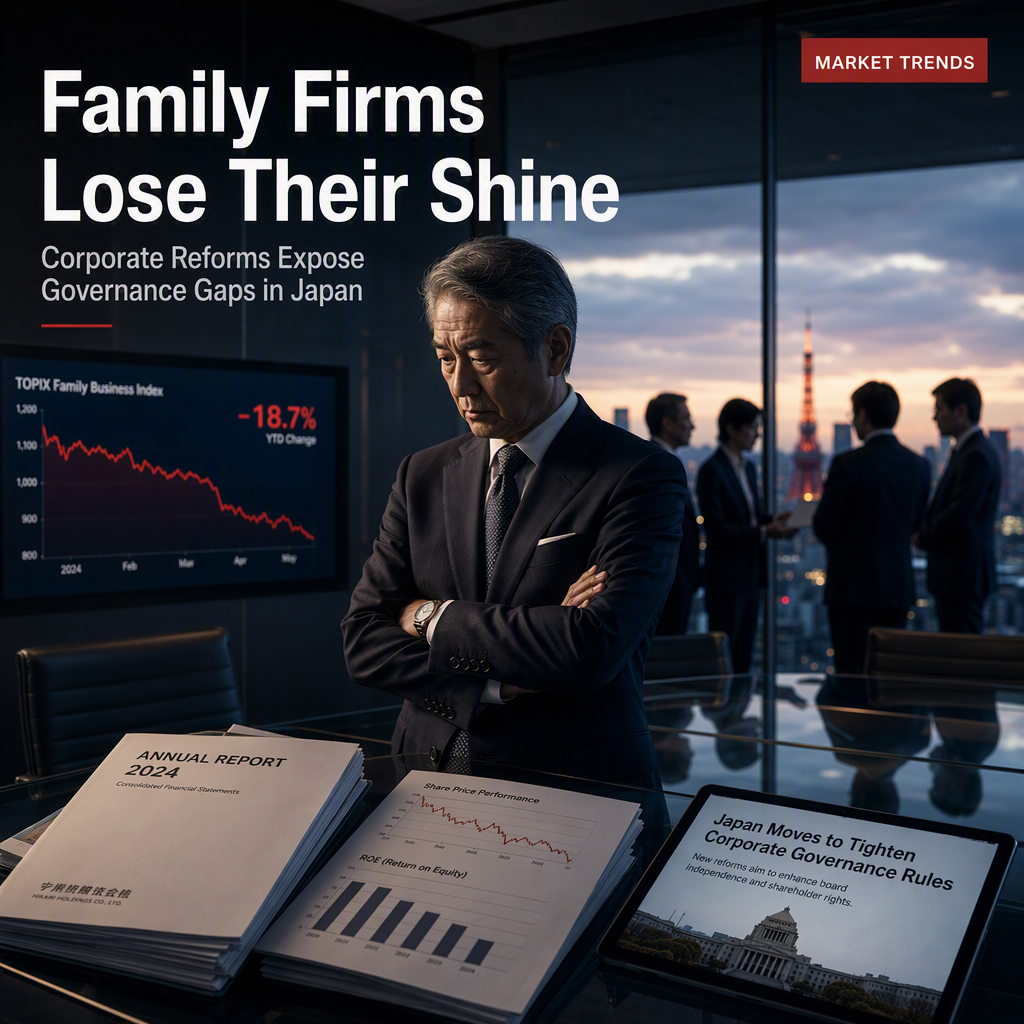
Shares of Japanese companies with significant founding family management control or major shareholdings have underperformed in recent years, as the traditional advantages of family ownership—such as long-term planning and rapid decision-making—are increasingly outweighed by concerns over governance practices [1]. The spread of corporate governance reforms across Japan has led to growing investor skepticism toward family-controlled firms, resulting in sluggish stock performance compared to peers with more transparent and diversified management structures [1].
A notable example is Nidec, where the founder stepped down as chairman emeritus earlier in the year following the emergence of governance issues, underscoring the risks associated with concentrated family control, including a lack of independent oversight and transparency [1]. Market participants have observed that while family-owned companies were once valued for their stability, the modern Japanese equity market now prioritizes accountability and shareholder rights, eroding the historic premium these firms once enjoyed [1].
Technical analysis indicates that the stock performance of family-owned firms continues to lag behind broader market indexes, as investors demand higher levels of corporate disclosure and independent board representation [1]. Analysts warn that without meaningful reform, family-controlled companies could experience further declines in market capitalization and increased pressure from activist shareholders seeking structural changes [1].
The ongoing shift in market sentiment is attributed to Japan’s corporate governance reforms, which emphasize transparency, independent oversight, and shareholder engagement. As a result, the outlook for stock growth among Japan’s family-owned businesses remains subdued relative to the broader corporate sector [1].
CONCLUSION
Japan’s family-owned firms are facing increased investor scrutiny and underperforming in the stock market as corporate governance reforms reshape market expectations. Without significant changes to governance structures, these companies may continue to lag behind their peers and face mounting pressure from shareholders.