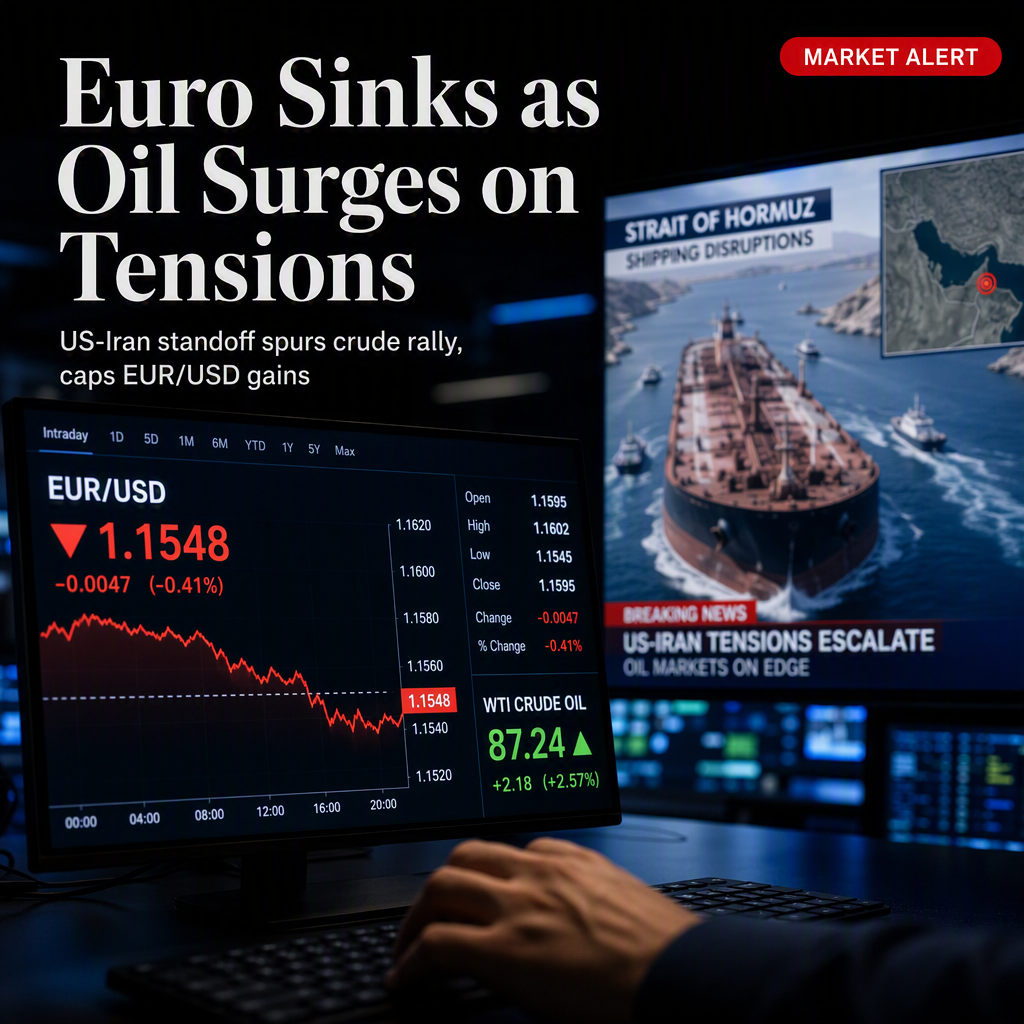
The Euro (EUR) declined against the US Dollar (USD) on Tuesday, falling to 1.1539 in the early European session after reaching a seven-week high of 1.1580, as hopes for a swift US-Iran peace deal faded and oil prices surged [1][3]. The ongoing stalemate in US-Iran negotiations, particularly over reciprocal compensation claims for war damages, has kept the key Strait of Hormuz largely closed to sea traffic, leading to higher crude prices and pressuring the eurozone's oil-importing economies [1][2]. Brent crude oil traded above $87 per barrel, about 7% higher than last week's close, while West Texas Intermediate (WTI) rose nearly 7% on Monday to around $82.50, up 1.3% on the day [1][2]. Commerzbank analysts highlighted that Brent crude rose 5.0% to $87.72 as the Strait of Hormuz standoff persisted, with satellite imagery indicating a visible supply impact on Iran's main oil exports [2].
On the US side, Cleveland Federal Reserve President Beth Hammack delivered hawkish remarks, stating that current monetary policy "is not hurting the economy" and suggesting that more than one interest rate hike may be needed to bring inflation back to target [1]. This stance provided additional support to the US Dollar, which recovered modestly after last week's losses, with the USD Index staying slightly below 100.00 early Tuesday [2].
Market participants are awaiting Wednesday's US Consumer Price Index (CPI) data, with expectations for headline inflation to ease to 3.4% year-on-year in July from 3.5% in June, and core CPI to slow to 2.5% from 2.4% [1]. The market remains evenly split on the Federal Reserve's September decision, with the upcoming CPI figures seen as a potential catalyst [1].
Strategists at United Overseas Bank (UOB) and analysts at FXStreet note that the recent Euro rally is losing momentum, with EUR/USD repeatedly failing to break above the 1.1560–1.1580 resistance area [1][3]. UOB now sees the 'strong support' level at 1.1515, up from 1.1495, and suggests that a close above 1.1580 is required for the Euro to target 1.1600 and beyond [1][3]. Momentum indicators are described as mostly flat, and the pair is expected to trade in a narrow range between 1.1530 and 1.1560 in the near term [3].
CONCLUSION
The Euro's recent gains against the US Dollar have stalled amid renewed geopolitical tensions in the Middle East and surging oil prices, which are weighing on the eurozone. With the EUR/USD pair capped below key resistance and market momentum fading, traders are looking to upcoming US inflation data for direction. The market impact is medium, with sentiment leaning negative for the Euro in the short term.