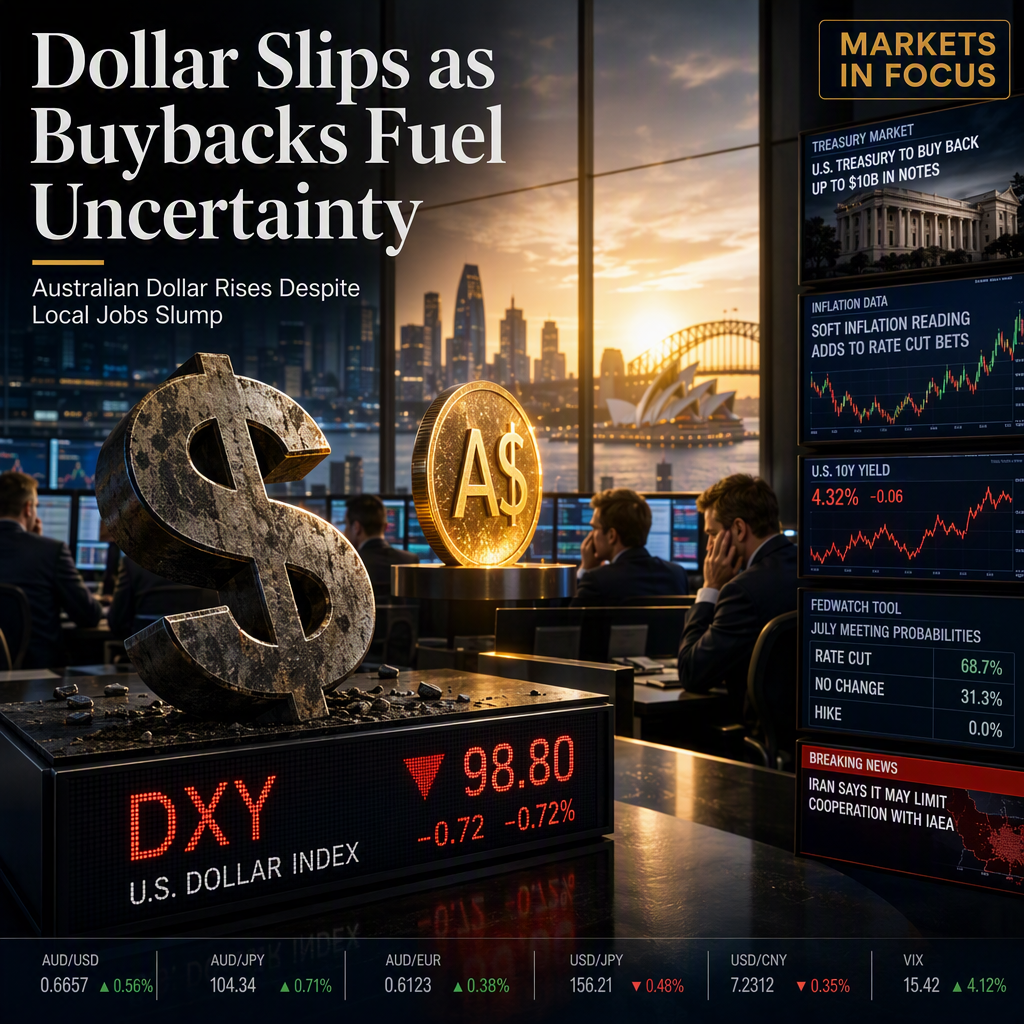
The US Dollar experienced notable weakness during Asian trading on Friday, with the US Dollar Index (DXY) trading around 98.80-98.75, marking a 0.10% decline for the day and positioning the index for heavy weekly losses, its lowest levels since May 14 [2]. The Australian Dollar (AUD) gained ground against the Greenback, with the AUD/USD pair approaching 0.7135, as concerns over US fiscal health and the credibility of US institutions weighed on the USD [1].
The US Treasury Department announced it would double the size of buybacks on longer-dated securities over the next quarter, aiming to address a sharp rise in yields. US Treasury Secretary Scott Bessent indicated that buybacks could increase beyond $4 billion, emphasizing that the decision was not related to interest rates but to signal that current yields do not reflect economic fundamentals [1]. However, the immediate market reaction to this announcement faded quickly, as inflation risks from higher energy prices and geopolitical tensions, particularly regarding US actions against Iran, kept a risk premium on the USD [2].
Soft US inflation figures released last week led traders to reduce bets on an immediate Federal Reserve rate hike, further pressuring the USD [2]. Nevertheless, the CME Group's FedWatch Tool shows that investors still price in a 68% chance of at least one rate hike by year-end, supporting elevated US bond yields and potentially limiting further USD losses [2]. Fed’s Musalem maintained a moderately hawkish tone, highlighting upside inflation risks and the possibility of pre-emptive tightening, while stressing the Fed’s credibility and independence from fiscal pressures [1].
On the Australian side, the upside for AUD/USD may be capped by disappointing labor data. The Australian Bureau of Statistics reported an unexpected employment decline of 15,800 jobs in July, against expectations of a 15,000 gain, pushing the unemployment rate up to 4.5% [1]. Analysts noted this softening labor market could reinforce the Reserve Bank of Australia's case to hold rates steady, especially amid broader economic weakness [1].
Technical analysis shows the DXY remains bearish below its 200-day Simple Moving Average at 99.16, with failed attempts to break key resistance levels suggesting further downside risk [2]. The USD was weakest this week against the Swiss Franc (-1.59%), New Zealand Dollar (-1.34%), and Euro (-1.11%), while it was strongest against the Japanese Yen (-0.22%) [2].
CONCLUSION
The US Dollar is under pressure due to Treasury buyback actions, soft inflation data, and persistent fiscal concerns, while the Australian Dollar has benefited despite weak domestic labor figures. Market sentiment remains cautious, with elevated bond yields and geopolitical risks providing some support to the USD. The outlook for both currencies will depend on upcoming economic data and central bank policy signals.