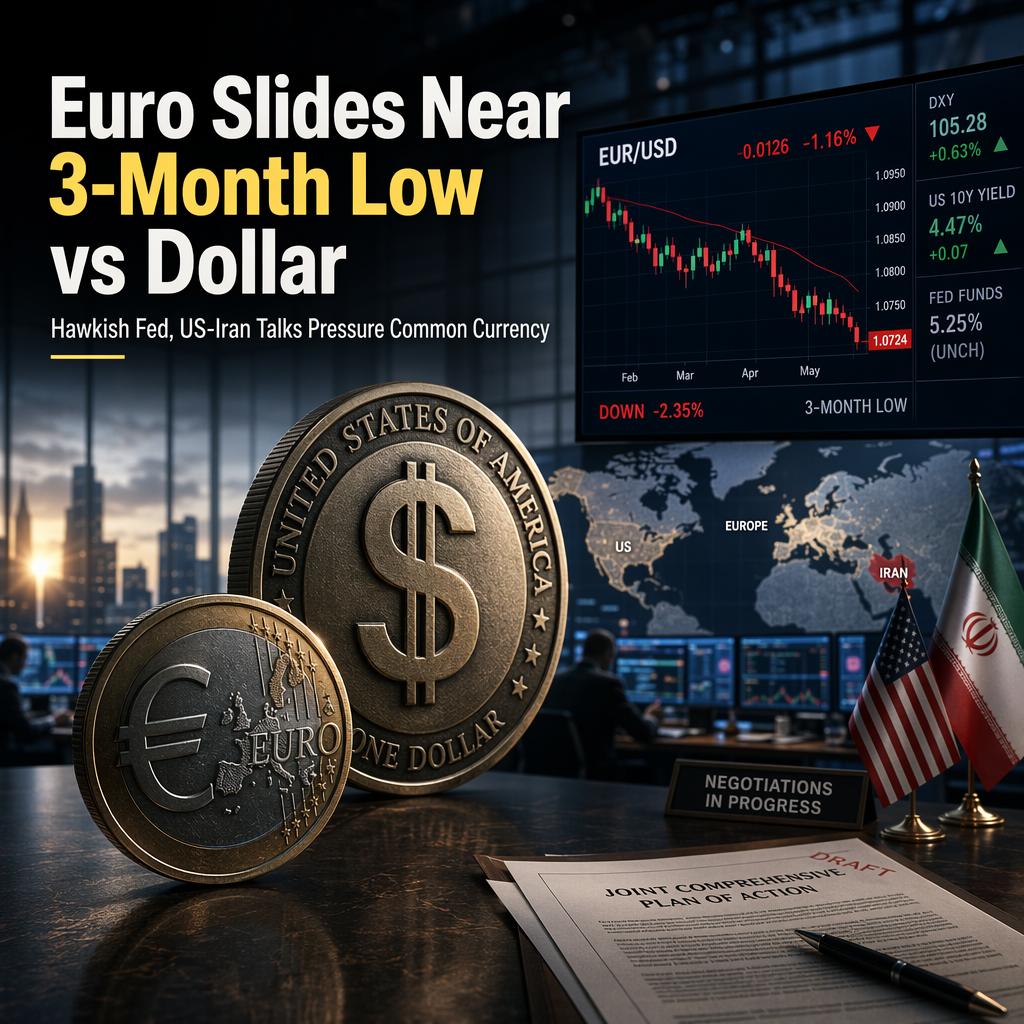
The Euro continued to trade under pressure against the US Dollar on Monday, extending losses from the previous week and hovering near its lowest level in three months, with EUR/USD trading around 1.1498 at the time of writing [1]. This weakness in the Euro comes despite progress in US-Iran negotiations, where the first round of face-to-face talks concluded in Switzerland with Pakistan and Qatar mediating. According to a joint statement from Qatar and Pakistan, Washington and Tehran agreed on a roadmap to reach a final deal within 60 days and will continue technical-level talks throughout the week [1].
Market optimism regarding the US-Iran talks did not translate into a recovery for the Euro, as expectations of a hawkish Federal Reserve continued to support the US Dollar. The US Dollar Index (DXY) is trading around 101.00, close to its highest level in thirteen months [1]. Last week, Federal Reserve policymakers reiterated their commitment to returning inflation to the 2% target after recent price pressures accelerated due to the energy shock [1].
On the European side, the European Central Bank (ECB) faces a challenging environment, balancing rising inflation with slowing economic growth. The ECB responded by raising interest rates by 25 basis points earlier this month [1]. ECB President Christine Lagarde stated that the ECB must remain agile in responding to the Iran shock and is 'well positioned' to navigate the situation. She highlighted that the outlook remains uncertain, with upside risks to inflation and downside risks to economic growth, but noted there is 'no evidence yet of de-anchoring or second-round effects that warrant a more forceful policy action' [1].
Looking ahead, markets are focused on a busy week featuring speeches from ECB policymakers, preliminary global Purchasing Managers Index (PMI) data, the US Personal Consumption Expenditures (PCE) Price Index report, and the final estimate of first-quarter US Gross Domestic Product (GDP) [1].
CONCLUSION
The Euro remains under pressure near three-month lows against the US Dollar, driven by hawkish Federal Reserve expectations and despite progress in US-Iran talks. Both the ECB and Fed are navigating complex economic conditions, with upcoming data releases and central bank communications likely to influence market direction in the near term.