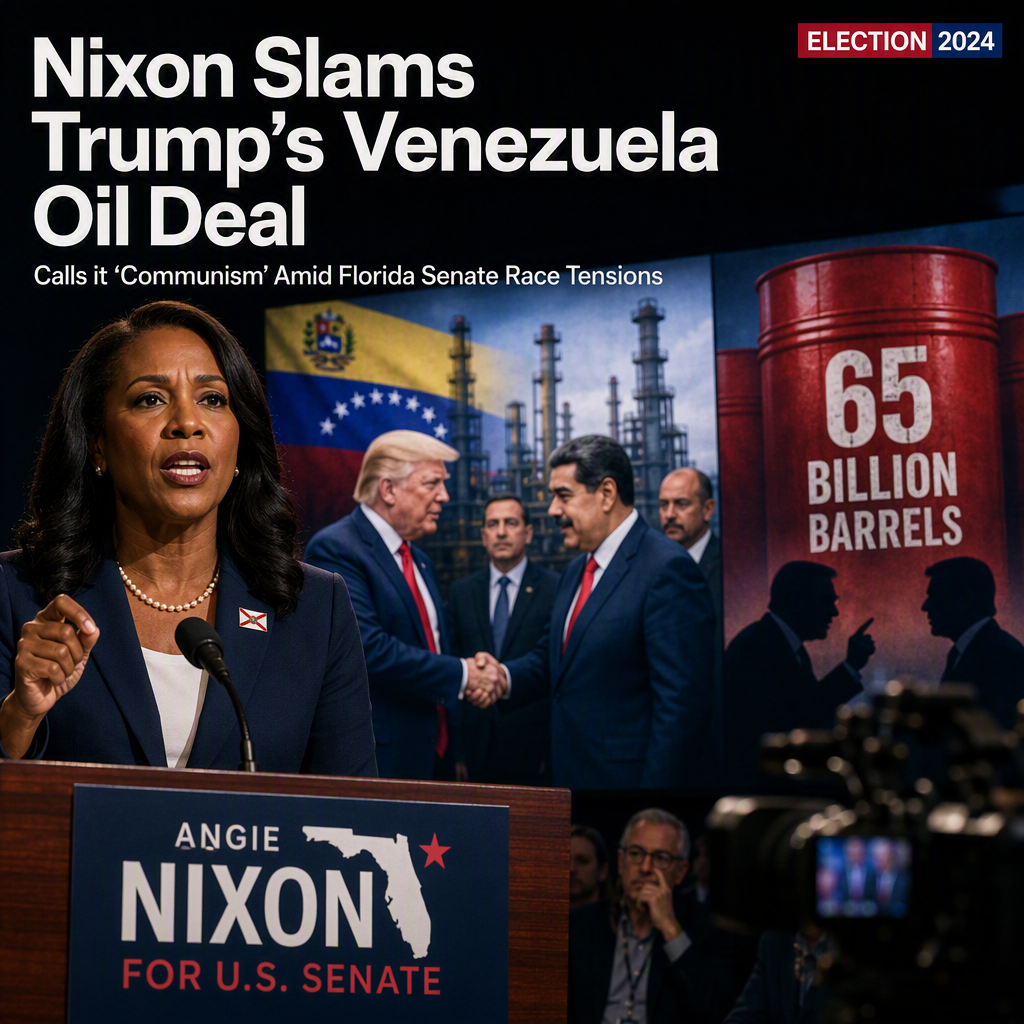
Democratic Florida U.S. Senate candidate Angie Nixon, a member of the Democratic Socialists of America (DSA), publicly accused President Donald Trump of promoting communism through a recent oil deal with Venezuela. During an appearance on MS NOW's 'The Beat,' Nixon argued that Trump and her Republican opponent, Sen. Ashley Moody, are aligned in supporting what she described as 'communism,' referencing the takeover and sale of Venezuela's oil reserves as the 'epitome of what communism is' [1]. Nixon specifically cited Trump's announcement on Friday regarding a U.S. oil deal with Venezuela, which involves more than 65 billion barrels of proven reserves. The deal reportedly followed a U.S. operation to capture Venezuelan leader Nicolás Maduro in January and subsequent collaboration with interim President Delcy Rodríguez [1].
Nixon's remarks come amid scrutiny over her DSA membership and her stance on socialism. She clarified that her affiliation with the DSA is based on advocacy for public housing, healthcare, and veterans' welfare, and denied supporting measures such as abolishing the Senate or drafting a new constitution [1]. Despite her denials, the Republican National Committee (RNC) has criticized Nixon, alleging she supports far-left initiatives including emptying prisons, opening borders, and raising taxes. RNC spokeswoman Emma Hall described Nixon's statements as beneficial to Republican campaigns in Florida and nationwide [1].
Market implications of the oil deal were not explicitly discussed in the article, nor were analyst opinions or forward-looking statements provided. The focus remained on the political debate surrounding the deal and its characterization by Nixon and Republican critics [1].
CONCLUSION
The core event centers on Angie Nixon's criticism of the Trump-Venezuela oil deal, framing it as an act of 'communism' and highlighting political tensions in Florida's Senate race. While the oil deal involves significant reserves, the article does not provide details on market reactions or analyst perspectives. The primary takeaway is the heightened political rhetoric and scrutiny of Nixon's positions as the election approaches.