
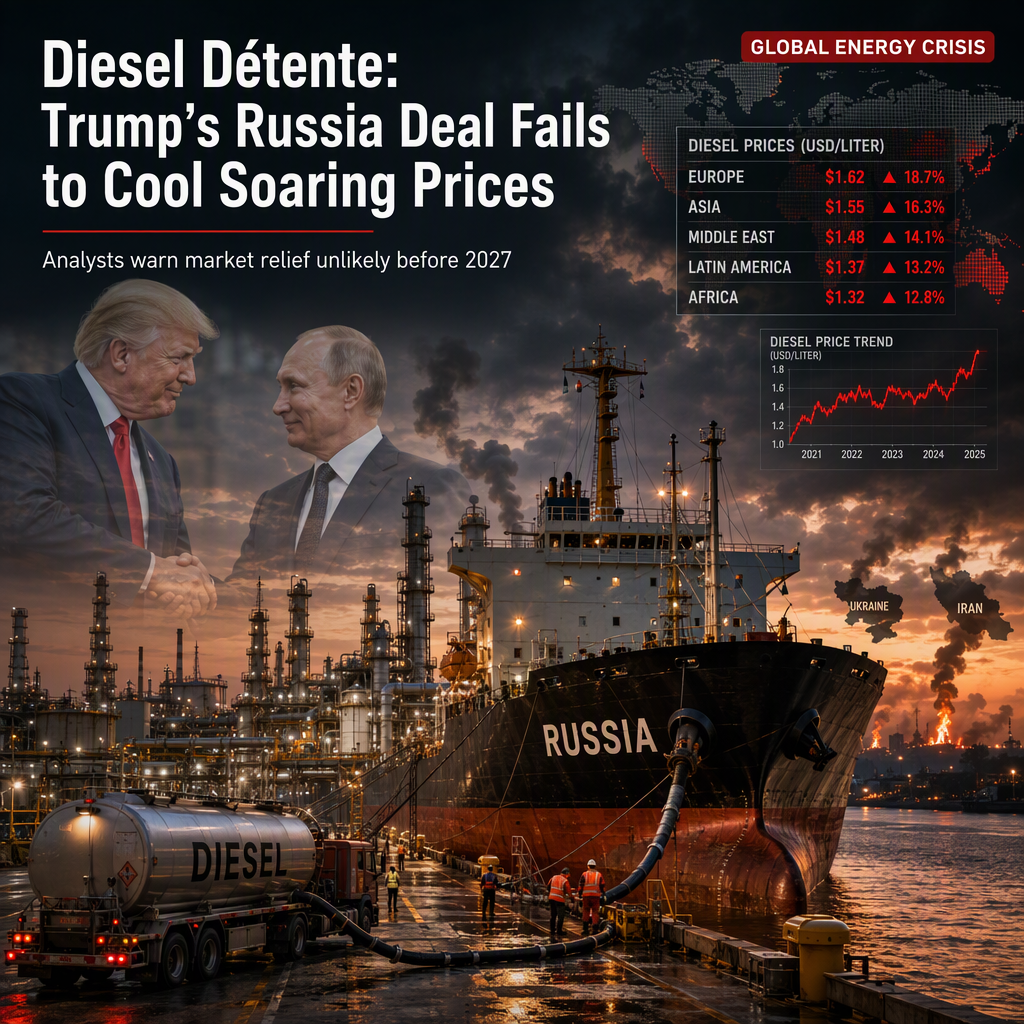
President Donald Trump has lifted restrictions on Russian diesel in an effort to address global shortages caused by ongoing wars in Ukraine and Iran, which have more than doubled wholesale diesel prices since the beginning of 2026 [1]. Last Friday, Trump announced a deal with Russian President Vladimir Putin for the Kremlin to release 4.8 million metric tons (nearly 36 million barrels) of diesel to the global market [1]. Despite this move, experts and analysts agree that the additional Russian diesel is unlikely to significantly impact near-term prices [1].
The International Energy Agency's October report, released Wednesday, forecasts that diesel market constraints will keep prices elevated into next year, with inventories expected to remain strained until the second half of 2027, even if refineries increase production [1]. Goldman Sachs echoed this outlook, predicting that diesel prices will remain high through 2027 as refineries struggle to meet demand [1].
The surge in diesel prices has become a major political issue ahead of the midterm elections, with Trump attributing the spike to the war in Ukraine. Russia banned diesel exports on July 8 after Ukrainian attacks on its refineries, leading to a nearly 40% increase in U.S. diesel prices between July 6 and September 22 [1]. However, prices had already risen following the onset of the Iran war and were still 20% above prewar levels when Russia's export ban took effect, exacerbating the supply crunch [1].
Over the weekend, Trump announced an 'energy ceasefire' between Russia and Ukraine on Truth Social, but Ukrainian President Volodymyr Zelenskyy later accused Russia of attacking Ukraine's energy facilities, highlighting ongoing instability in the region [1]. The dual impact of the Iran and Ukraine conflicts continues to cause significant volatility in global energy markets [1].
CONCLUSION
Despite President Trump's deal to release Russian diesel, analysts and major institutions expect diesel prices to remain elevated well into 2027 due to ongoing supply constraints and geopolitical instability. The market impact is high, with little immediate relief anticipated for consumers or industries reliant on diesel.